Why this course matters
- Finance
- Entrepreneurship
- Strategy
- Accounting
- Governance
Private Equity & Venture Capital draws on finance, entrepreneurship, strategy, accounting and governance, which is what makes it work as an integrative elective.

Course Guide
A practical, ready-to-adapt guide for anyone designing or refreshing a Private Equity & Venture Capital course. Inside: course positioning, constructively aligned intended learning outcomes, twelve core concepts with teaching notes, a 12-session structure, applied simulations, recommended readings and assessment briefs.
teach PE & VC as a named or closely related course
weeks as the most common course-design model
taught at undergraduate level
taught at postgraduate level (levels overlap)
offered as core; the rest elective
include an applied or experiential component
Private Equity & Venture Capital draws on finance, entrepreneurship, strategy, accounting and governance, which is what makes it work as an integrative elective.
How well this course prepares students for six role families, scored out of 10. Indicative, based on how directly the concepts map to each path - not a placement statistic.
Each is mapped to the session where students already hold the concepts to make a defensible decision, rather than added as an activity at the end.
This guide is built for anyone teaching Private Equity & Venture Capital at university or business-school level, whether you are designing a new module from scratch or refreshing an existing finance, entrepreneurial finance, investment banking, private markets or alternative investments elective.
It is especially useful for lecturers, professors, module leaders and programme directors working with final-year undergraduate, MSc, MBA or executive education cohorts. The guide is written for educators who want students to understand Private Equity and Venture Capital as applied investment disciplines: fund structures, investor incentives, deal screening, valuation, term sheets, LBOs, due diligence, governance, exits and downside risk.
A Private Equity & Venture Capital course teaches students how private capital investors raise funds, source deals, evaluate companies, structure investments, create value during ownership and exit investments. The organising principle that works most reliably is the investment lifecycle: private capital foundations, fund economics, deal sourcing, business and market analysis, valuation, VC financing, LBOs, due diligence, portfolio governance, exits, restructuring and responsible investment.
The course should also make clear that Private Equity and Venture Capital are connected but distinct. Private Equity often emphasises control, leverage, mature businesses, governance and operational value creation. Venture Capital usually emphasises uncertainty, innovation, staged financing, founder-investor alignment, term sheets and scaling risk. Students should leave able to judge whether an investment is attractive, how it should be structured, what risks could break the case, and how investors might realise value through M&A, IPO, recapitalisation, secondary sale or restructuring.
A one-screen planning view. If you are drafting a syllabus, most of what a course-approval form asks for is in this table; the detail sits in the sections below.
Planning area | Suggested approach |
|---|---|
Best fit | Final-year or senior undergraduates, specialist master's cohorts (MSc/MS Finance, Investment Management, Entrepreneurship and equivalents), MBA and EMBA, and executive education. |
Typical length | 10, 12 or 14 teaching sessions, with 12 as the standard model. Roughly 24–36 contact hours plus 120–150 hours of independent study - about 150–180 notional learning hours, or one standard semester elective in most credit systems. |
Course role | Usually a specialist finance or entrepreneurial finance elective. Its integrative nature also makes it a strong source of assurance-of-learning evidence for whichever accreditation or quality framework your school reports against. |
Useful prerequisites | Introductory finance, accounting, corporate finance, valuation, investment analysis or financial modelling. Students do not need to be expert modellers at the start, but they should understand financial statements and basic valuation logic. |
Main student output | An investment committee memo, LBO analysis, VC term-sheet critique, deal recommendation, exit plan, simulation reflection or board-style investment presentation. |
Best assessment fit | A group applied output carrying most of the summative weight, plus an individual component - assumptions note, reflection or short oral defence - that produces a mark you can attribute. Most courses use two assessment points, not eight; the assessment section is a menu to choose from. |
Best simulation fit | Leveraged Buyout after valuation and capital structure; Investment Banking after deal analysis; M&A and IPO during exit-route teaching; Debt Restructuring during downside, distress and stakeholder-claim analysis. |
Each learning outcome below opens with a single assessable verb and sits at the analysis and evaluation end of Bloom's taxonomy rather than the recall end, and each has at least one assessment task in this guide that generates evidence for it, the constructive alignment any course review will look for. "Understand" and "be familiar with" are avoided deliberately: they are difficult to grade and harder to defend. Outcomes 1 and 2 sit lower in the taxonomy because students need the vocabulary first; outcomes 7 to 10 carry the weight of the course and should attract most of the credit.
These learning outcomes map closely to recognised private equity, venture capital and entrepreneurial finance teaching sources, especially Josh Lerner and Ann Leamon’s Venture Capital, Private Equity, and the Financing of Entrepreneurship and Andrew Metrick and Ayako Yasuda’s Venture Capital and the Finance of Innovation.
The concepts and sequence in this guide reflect patterns commonly seen in leading global business school courses on Private Equity & Venture Capital, private markets, entrepreneurial finance, investment banking and related advanced finance electives. It also follows an Ivy League-style course format: establish the foundations, build the analytical concepts, move into applied deal decisions, and close with assessment, reflection and integration. The structure below keeps the course practical for lecturers to adapt while still giving students a disciplined progression through the private capital lifecycle.
There are twelve core concepts in this Private Equity & Venture Capital course. The plan builds deliberately: students first understand the private capital ecosystem, then learn how funds are structured, how deals are sourced and analysed, how investments are valued and structured, how ownership creates value, and how investors exit or respond when the investment case breaks down.
The following notes expand each core concept into a teaching question, suggested coverage, learning outcomes, teaching approach, short case-style example and common student difficulty.
This is the alignment map: one way of grouping the twelve concepts, following the investment lifecycle as set out in Lerner and Leamon, and what each stage leaves behind as tangible output. Insisting on an output at every stage gives you formative evidence session by session and makes the final summative task an assembly rather than a cliff. It also stops the course drifting into a sequence of disconnected finance topics.
Stage of private capital work | Principal concepts | Expected student output |
|---|---|---|
Understand the private capital setting | Private capital markets; PE vs VC; fund lifecycle; investor roles (1–2) | A map of the PE/VC ecosystem and the incentives of LPs, GPs and portfolio companies |
Build the investment thesis | Deal sourcing; screening; sector focus; investment fit (3) | A short investment thesis and screening rationale |
Analyse the company and market | Business model, unit economics, competitive position, market growth, management quality (4) | A company and market assessment identifying what would make the investment attractive or unattractive |
Value the opportunity | DCF, comparables, transaction multiples, venture valuation, ownership dilution, scenario analysis (5) | A valuation range with assumptions and limitations clearly stated |
Structure the investment | VC terms, staged financing, LBO structure, leverage, control rights and downside protection (6–8) | A proposed investment structure, term-sheet view or LBO structure |
Test the case | Commercial, financial, legal, operational and management due diligence; IC process (9) | An investment committee memo or decision recommendation |
Own and improve | Portfolio governance, management incentives, 100-day plans, KPI monitoring, operational value creation (10) | A portfolio value creation plan |
Exit, restructure or report | IPO, M&A, secondary sale, recapitalisation, distress, restructuring, LP reporting, responsible investment (11–12) | An exit, restructuring or LP-facing recommendation |
Models support investment judgement. They do not make the investment decision.
Credit the interpretation of a model, the challenge to its assumptions, the recognition of what it omits, and the link between financial output and business quality, incentives, governance, downside risk and exit feasibility. A technically clean model with an undefended assumption should not outscore a rougher one that states clearly what would have to be true.
The architecture holds across levels; what changes is the scaffolding and the tolerance for ambiguity. The common design error is differentiating by content - cutting VC terms or distress from the undergraduate version because they look advanced. Undergraduates can handle a liquidation preference. What they cannot yet handle is an incomplete brief and being asked to work out what the question is, so raise the cognitive demand rather than the topic list. The same course architecture can work for final-year undergraduate, MSc, MBA and executive education students, provided the lecturer adjusts how much technical detail students are expected to handle and how much judgement they are asked to defend.
At undergraduate level, the priority is conceptual clarity: students need to understand the private capital lifecycle, the difference between PE and VC, the basic logic of fund economics, valuation, LBOs, term sheets, ownership and exits. At postgraduate and MBA level, the course can move more quickly into investment committee judgement, deal structuring, modelling assumptions, negotiation, due diligence and downside cases.
Course design area | Undergraduate version | Postgraduate / MBA / executive version |
|---|---|---|
Course emphasis | Build a clear understanding of the PE/VC lifecycle, the role of funds, basic deal logic, valuation and exit routes. | Treat the course as an applied investment decision-making module, with more ambiguity, live judgement and board-style defence. |
Technical depth | Use simplified valuation, dilution and LBO mechanics. Students should understand the drivers before being expected to build full models. | Use fuller LBO analysis, valuation ranges, sensitivity work, term-sheet economics, downside cases and investment committee materials. |
Venture capital coverage | Focus on stages of funding, pre-money and post-money valuation, dilution, founder-investor alignment and basic term-sheet terms. | Add liquidation waterfalls, anti-dilution, control rights, down rounds, follow-on financing, investor protections and board dynamics. |
Private equity coverage | Focus on buyout logic, leverage, cash flow, value creation and exit. | Add debt capacity, covenant pressure, operating plans, sponsor returns, lender risk, governance and restructuring scenarios. |
Reading load | Use textbook chapters, accessible technical notes, short cases and structured preparation questions. | Add academic papers, practitioner reports, complex case studies, fund documents, investment memos and current market commentary. |
Student activity | Guided deal screening, basic valuation, structured term-sheet critique, short memos and group presentations. | Open-ended investment committee memos, negotiation exercises, model defence, simulation debriefs, LP updates and viva-style questioning. |
Assessment style | Mark students on correct concept use, clear reasoning, basic calculations and ability to justify a recommendation. | Mark students on judgement quality, assumption defence, trade-off analysis, risk recognition and ability to respond to challenge. |
Simulation use | Use simulations as guided applied exercises with structured preparation and a clear debrief. | Use simulations as decision pressure, assessment evidence, negotiation practice or capstone integration. |
The syllabus below follows the full private capital lifecycle: students begin with private capital foundations and fund structure, then move through sourcing, business analysis, valuation, VC terms, LBOs, capital structure, due diligence, ownership, exits, distress and responsible investment. The structure is designed for a standard 12-session course and can be adapted for weekly teaching, intensive blocks or blended delivery.
The design principle worth keeping if you change nothing else: do not defer application to the end. Every session should produce something markable: a screening view, valuation range, term-sheet judgement, LBO recommendation, investment committee memo, value creation plan, exit recommendation or restructuring response.
A 12-session course fits a 15-week North American semester with room for reading and assessment weeks, and maps one-to-one onto a 12- or 13-week teaching period elsewhere.
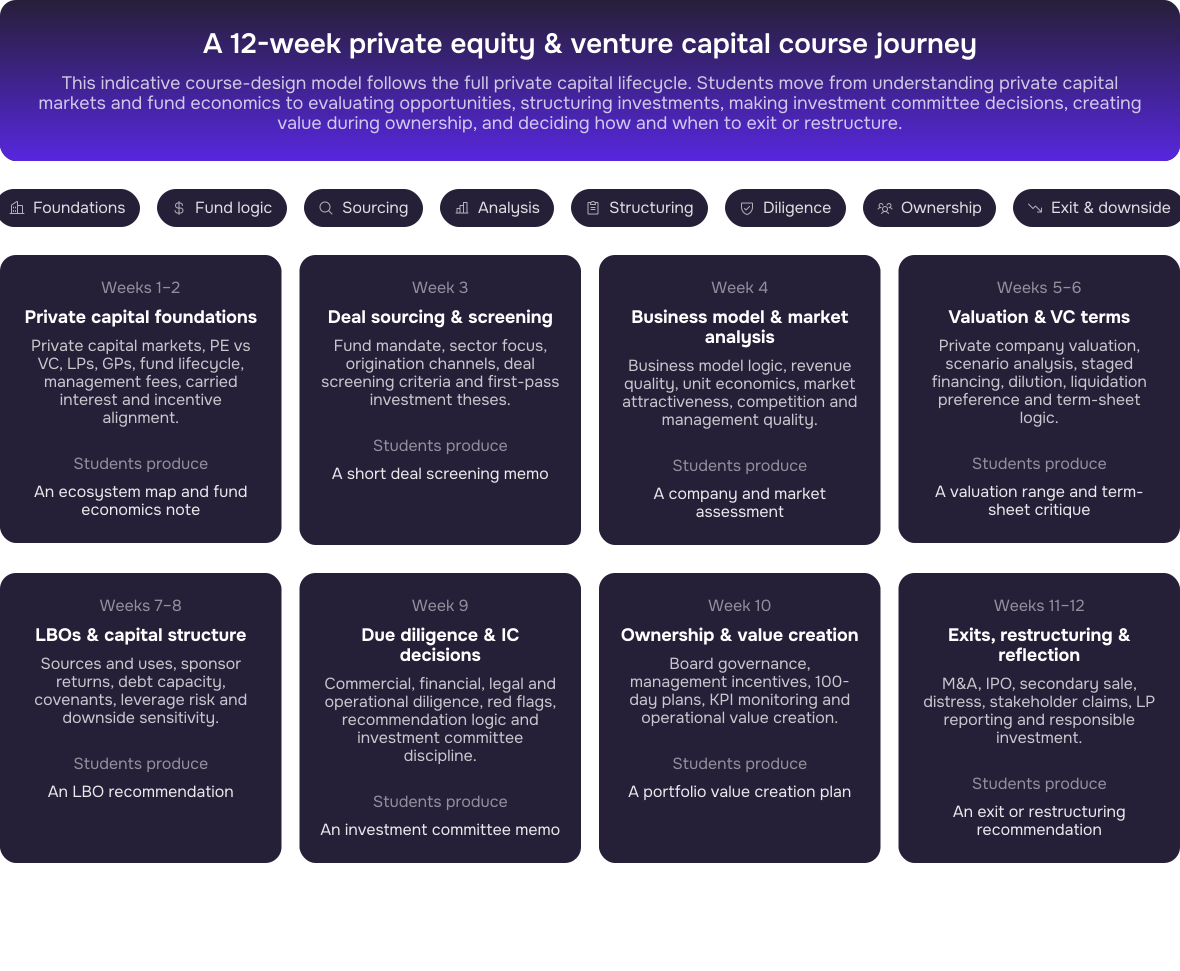
Indicative 12-week Private Equity & Venture Capital course arc. Use alongside the detailed syllabus table below.
Week | Topic | Teaching focus | Student activity | Best-fitting simulation, where relevant | Assessment or output |
|---|---|---|---|---|---|
1 | Introduction to private capital markets | Introduce PE and VC as part of the private capital ecosystem. Cover public vs private ownership, PE vs VC, growth equity, buyouts, private credit, fund roles and the basic investment lifecycle. | Students map the private capital ecosystem and compare a buyout target with a venture-backed start-up. | - | Short ecosystem map explaining LPs, GPs, companies, lenders, founders, advisors and exit buyers. |
2 | Fund structure, LPs, GPs and fund economics | Explain fund life, limited partnerships, capital commitments, capital calls, management fees, carried interest, hurdle rates, distributions and incentive alignment. | Students work through a simplified fund economics example and identify where LP/GP incentives align or diverge. | - | Fund economics calculation and short note on incentive alignment. |
3 | Deal sourcing, screening and investment theses | Show how funds originate opportunities, screen deals, build sector theses and decide which opportunities deserve deeper diligence. | Students receive a fund mandate and a set of potential opportunities, then select which deals should progress and why. | - | One-page deal screening memo with a clear investment thesis and key diligence questions. |
4 | Business model analysis and market attractiveness | Teach students how to evaluate revenue model, margins, unit economics, customer concentration, competitive dynamics, scalability, market growth and management quality. | Teams analyse a company profile and identify the three drivers that would most affect investment attractiveness. | - | Company and market assessment identifying value drivers, risks and evidence gaps. |
5 | Private market valuation | Cover DCF, comparables, precedent transactions, venture valuation logic, ownership dilution, scenario analysis and valuation under uncertainty. | Students create a valuation range using more than one method and defend the assumptions that matter most. | Optional: Investment Banking | Valuation range with assumptions note and sensitivity commentary. |
6 | Venture capital financing, term sheets and staged investment | Teach pre-money and post-money valuation, staged financing, dilution, liquidation preference, anti-dilution, board rights, protective provisions and founder-investor trade-offs. | Students compare two VC term sheets: one with a higher valuation and harsher terms, one with a lower valuation and cleaner control structure. | - | VC term-sheet critique from both founder and investor perspectives. |
7 | Leveraged buyouts and sponsor returns | Explain LBO structure, sources and uses, entry valuation, debt, cash flow, exit multiple, IRR, MOIC, deleveraging and value creation levers. | Students assess whether a company is a credible buyout candidate and identify which assumptions drive sponsor returns. | LBO recommendation with key return drivers, downside case and rejected assumptions. | |
8 | Debt capacity, capital structure and financing risk | Cover leverage, debt capacity, covenants, interest coverage, seniority, refinancing risk and the point at which leverage shifts from return enhancer to risk amplifier. | Students test a proposed capital structure under base and downside cases, then explain whether the business has enough room for error. | - | Capital structure note identifying sustainable leverage, covenant pressure and downside risk. |
9 | Due diligence and investment committee decision-making | Bring commercial, financial, legal, operational and management diligence together. Teach students how to convert findings into an investment committee recommendation. | Students receive a short investment memo plus diligence findings and decide whether to proceed, renegotiate, pause or walk away. | Investment committee memo with recommendation, material risks, mitigants and unresolved questions. | |
10 | Portfolio governance, monitoring and operational value creation | Shift from transaction thinking to ownership thinking. Cover board roles, management incentives, KPI monitoring, 100-day plans, operational value creation, add-ons and VC investor support. | Students build a 100-day value creation plan linked to the original investment thesis. | - | Portfolio value creation plan with KPIs, owners, timeline and risk controls. |
11 | Exit routes: M&A, IPOs, secondary sales and fund returns | Compare trade sale, secondary buyout, IPO, recapitalisation and other exit routes. Cover IPO readiness, strategic buyer logic, fund timing, LP distributions and exit risk. | Teams recommend an exit route for a portfolio company and defend why the alternatives are less attractive. | Exit recommendation comparing M&A, IPO and secondary sale logic. | |
12 | Distress, restructuring, LP reporting and responsible investment | Close the course with downside cases. Cover covenant breaches, liquidity pressure, restructuring, stakeholder claims, founder dilution, write-downs, LP reporting, ESG and responsible ownership. | Students respond to an underperforming investment and decide whether to inject capital, renegotiate, restructure, sell or write down the position. | Final integrated recommendation or LP update memo explaining what happened, what action is proposed and what the fund should learn. |
Private Equity & Venture Capital is a decision-led subject. Students can learn the vocabulary of funds, term sheets, valuation, leverage, due diligence and exits from lectures and readings, but the discipline only becomes real when they must decide what they would do with incomplete information, competing stakeholders and uncertain returns.
Simulations belong in this course because private capital decisions are rarely made by one person looking at one spreadsheet. A buyout depends on sellers, sponsors, lenders, advisors, management teams and market conditions. An exit depends on buyer appetite, public-market timing, investor demand and fund objectives. A restructuring depends on creditor claims, equity value, liquidity and negotiation power. Simulations help students experience these tensions in a controlled academic setting.
There is an accreditation dimension worth noting if you are building a case internally, and it travels well because the major frameworks agree on this point. AACSB, EQUIS and AMBA all encourage experiential learning and engagement with practice, and national quality agencies generally ask the same question in local language: what is your evidence that students can apply and evaluate, rather than recall? A structured applied component with recorded decisions and a documented debrief produces that evidence in auditable form, which is usually a stronger argument to a department or programme head than student enjoyment. If you need the accreditation language itself, what and say about simulations sets it out.
Teaching format | What it does well | Limitation | Best use in this course |
|---|---|---|---|
Traditional case study | Gives students a rich written situation, usually with background, exhibits and a defined teaching question. | Students may discuss the decision without feeling the pressure of making it or negotiating with others. | Best for introducing fund structures, VC term sheets, business model analysis, due diligence and governance. |
Simulation | Places students into roles where they must analyse information, negotiate, make trade-offs and defend decisions. | Needs careful preparation and debriefing; otherwise students may remember the game but miss the learning. | Best after students know the theory and need to practise deal judgement, transaction structure, stakeholder negotiation and investment recommendation. |
A simulation is not a substitute for teaching the concept, and it is not a reward at the end of term. It works when students already hold the theory and need to apply it against opposition, and it fails when it arrives before the concepts or without a debrief - in which case students remember the competition and forget the learning. Every placement suggested on this page is positioned after the relevant teaching, with prerequisites and debrief questions stated, so the activity can be assessed rather than merely enjoyed.
Out of the simulations suggested, the two most relevant simulations for this course are Leveraged Buyout and Investment Banking. The LBO simulation maps directly to private equity deal structuring, capital structure, sponsor returns and bidding decisions. The Investment Banking simulation gives students a broader transaction environment in which valuation, modelling, pitching, advisory work, deal structuring and execution can be connected to private capital investment judgement.
Course point | Simulation | Where it fits | How to use it |
|---|---|---|---|
Weeks 7: LBOs, debt capacity and capital structure | Use after students have covered LBO mechanics, sponsor returns, entry and exit assumptions, debt capacity and downside sensitivity. | Use for live deal analysis, role-based bidding, capital-structure negotiation, lender selection, debrief and written investment reflection. | |
Week 5 and 9: Due diligence and investment committee decision-making | Use after valuation and business model analysis, before the final IC memo or deal recommendation. | Use for transaction analysis, modelling, pitching, advisory work, proposal development, negotiation and debriefing what further diligence would be needed before capital is committed. | |
Week 11: Exit routes, strategic sale and IPO readiness | Use selectively if the module has time for an exit-route workshop. | M&A supports trade-sale logic, buyer-seller negotiation and term structuring. IPO supports public-market exit, valuation, roadshow, book-building and allocation. | |
Week 12: Distress, downside and stakeholder claims | Use as a final downside case or optional capstone debrief. | Best after students understand leverage, claims, covenants, liquidity pressure and stakeholder conflict. |
AI is changing how students approach Private Equity & Venture Capital because it can accelerate the first draft of many tasks: company screening, market summaries, competitor mapping, memo structure, valuation assumptions, diligence checklists and exit-route comparisons. That makes the lecturer’s task more difficult and more interesting.
The teaching focus should shift toward judgement. Students need to show how they selected assumptions, how they tested evidence, how they identified missing information, how they responded to downside risk and why their recommendation is defensible. Tools can support the work; they cannot make the decision or defend it under questioning. In practice this means shifting credit from the artefact to the defence. It also means stating a permitted-use policy rather than leaving students to guess: most colleagues land on permitted for structuring, drafting and checking, must be declared, with the analytical choices remaining the student's and defensible on request. A blanket prohibition is difficult to enforce under most academic integrity codes and tends to penalise the honest.
AI affects PE/VC teaching in several ways. Deal sourcing and screening can be simulated at greater scale. Valuation work becomes easier to draft but not easier to defend. Diligence becomes more structured, but private capital diligence is still not a checklist exercise. Memo writing becomes less reliable as an assessment signal, which increases the value of simulation, oral defence and live challenge.
Teaching area | AI implication | Lecturer response |
|---|---|---|
Deal sourcing | AI can generate long lists of sectors, companies and market themes. | Require students to justify why a target fits a specific fund mandate. |
Market analysis | AI can summarise markets quickly, but may flatten uncertainty or invent unsupported claims. | Ask students to critically appraise evidence quality and identify what still needs verification. |
Valuation | AI can support assumptions and model commentary, but valuation judgement remains human. | Mark students on critical analysis of assumptions, sensitivity work and model limits. |
Due diligence | AI can create diligence checklists and summarise documents. | Require students to identify which findings are material enough to change price, terms or recommendation. |
IC memos | AI can draft polished memos. | Use oral defence, live challenge and individual reflection to assess critical thinking rather than output quality. |
VC term sheets | AI can explain terms, but may not show how terms interact across exit scenarios. | Ask students to compare economic and control consequences under different outcomes. |
Core textbook: Josh Lerner and Ann Leamon, Venture Capital, Private Equity, and the Financing of Entrepreneurship, 2nd edition, Wiley. This is the best single-textbook fit for a combined PE/VC course because it follows the active-investing lifecycle from fund structure and deal evaluation to valuation, structuring, post-investment ownership and exits.
Alternative textbook: Andrew Metrick and Ayako Yasuda, Venture Capital and the Finance of Innovation, 3rd edition, Wiley, 2021. This is especially useful where the course gives greater weight to venture capital, high-growth-company valuation, preferred stock and term-sheet economics.
Twelve teaching cases, free to adapt. Each concept in this guide includes a short case-style example with figures, written to be used as it stands or adapted to your own cohort. They use fictional companies deliberately: no licence fee, no currency or jurisdiction issues, reusable across cohorts, and free of the hindsight bias students bring to a deal they can look up.
LBO case
Susan Chaplinsky and Felicia C. Marston, University of Virginia Darden School Foundation / Harvard Business Publishing, Product #: UV1056-PDF-ENG, 2009.
Use this case for LBO modelling, acquisition price, debt structure, sponsor returns and bid discipline. It works well immediately before or after the Leveraged Buyout Simulation.
VC case
Harvard Business Publishing, Product #: E460-PDF-ENG.
Use this case for VC financing, founder-investor negotiation, valuation versus control, liquidation preference, dilution and investor protections.
Running this in shorter blocks. For a two-hour session, drop the mini-lecture to 15 minutes and set the pre-class note as required preparation. For two separate one-hour sessions, run the opening frame, mini-lecture and deal-team analysis in the first, and IC preparation, committee challenge and debrief in the second. The natural break is after the deal-team analysis, once teams have a draft view to bring back. If your teaching is split into a lecture plus smaller discussion sections, run the mini-lecture in the lecture and the team stages in the sections.
Session stage | Time | Teaching purpose | Lecturer approach | Student output |
|---|---|---|---|---|
Pre-class preparation | Before class | Give students the technical foundation before class time is used for judgement. | Assign an LBO reading, a short valuation note and a simple company profile. | One-page pre-class note identifying three value drivers and three deal risks. |
Opening frame | 10 minutes | Set up the central question: “Is this a credible buyout, and at what price?” | Introduce the target, fund mandate, proposed transaction and investment committee context. | Students understand the decision they are being asked to make. |
Mini-lecture | 25 minutes | Connect LBO mechanics to investment judgement. | Review sources and uses, sponsor equity, debt capacity, cash flow, exit multiple, IRR, MOIC and downside sensitivity. | Students can explain how the deal generates returns. |
Deal team analysis | 35 minutes | Move students from mechanics to assumptions. | Put students into deal teams and ask them to test entry price, leverage, operating improvement and exit assumptions. | Draft LBO view with key assumptions and downside case. |
Investment committee preparation | 25 minutes | Force prioritisation. | Ask each team to prepare a recommendation: invest, renegotiate, reduce leverage, lower price or walk away. | Three-slide IC recommendation or one-page memo. |
Committee challenge | 30 minutes | Test whether students can defend the deal under pressure. | Challenge each team on valuation, debt capacity, management credibility, exit route and downside risk. | Oral defence of investment recommendation. |
Simulation link | Optional | Turn the concept into a competitive applied process. | Run the Leveraged Buyout Simulation after the teaching session, once students have the technical base. | Simulation performance plus post-simulation reflection. |
Debrief | 20 minutes | Connect outcomes to course concepts. | Ask which assumptions mattered most, which risks were underweighted and how the team would revise its recommendation. | Individual reflection on investment judgement. |
Closing question: If the model says the deal works, what still has to be true in the business, the capital structure and the exit market for the investment to be worth making?
Because the intended learning outcomes reward judgement rather than recall, assessment has to ask students to recommend and defend rather than describe. A common and defensible summative split is 60% group applied output and 40% individual defence or reflection: it preserves the collaborative work that makes the subject realistic while producing an individual mark that survives moderation. Three design points repeatedly cause trouble. Weight the defence, not just the artefact - it is the part a student cannot outsource. Publish grading criteria that explicitly credit assumption defence, recognition of what the analysis cannot resolve, and treatment of downside, or students will optimise for length. And if you use group work, build in a mechanism that produces individual evidence, or free-riding becomes invisible until the marks are challenged.
Eight formats, offered as a menu rather than a set. Most courses use two assessment points; the table is here so you can pick the two that fit your regulations and your marking capacity.
Assessment format | How it works |
|---|---|
Investment committee memo | Students assess a target company and make a clear invest / do not invest / renegotiate recommendation, supported by valuation, diligence, risks and exit logic. |
LBO model and assumptions note | Students build or interpret a buyout case and explain the assumptions driving IRR, MOIC, debt capacity and downside sensitivity. |
VC term-sheet critique | Students compare venture financing terms from founder and investor perspectives, including valuation, dilution, liquidation preference, control rights and future financing implications. |
Due diligence report | Students identify commercial, financial, legal, operational and management issues, then explain which findings are material enough to change price, terms or recommendation. |
Exit recommendation | Students compare M&A, IPO, secondary sale, recapitalisation or restructuring options and justify the best route for the company and fund. |
Group deal presentation or board-style defence | Teams present a transaction recommendation and respond to challenge from the lecturer, classmates or an investment committee panel. |
Simulation reflection | Students explain the decisions they made, the information they had at the time, the trade-offs they accepted and what they would change with hindsight. This works as an individual component precisely because the decisions are timestamped and attributable, which makes it resistant to free-riding. Keep it to 500 to 800 words on two or three specific decisions and connect two or three of those decisions back to the assigned literature, so students see which mechanisms the research already explains and which it does not. |
Viva-style questioning | A 10–15 minute individual oral in which students defend assumptions, explain what their model cannot resolve and demonstrate individual command of group work. The most effective control against outsourced analysis, and it gives you a defensible individual mark. For large cohorts, sampling a proportion - announced in advance, selection unknown — achieves most of the effect.
|
The strongest courses do not only teach students to calculate returns. They repeatedly ask students to use finance, strategy, incentives and judgement to make and defend investment decisions. None of these is a sign of a weak course; most are the natural result of time pressure.
Common mistake | Why it weakens the course | Better approach |
|---|---|---|
Turning the course into only LBO modelling | Students may learn spreadsheet mechanics but miss sourcing, fund economics, governance, VC terms, diligence and exits. | Treat LBO modelling as one major component within the wider private capital lifecycle. |
Treating Venture Capital as early-stage Private Equity | Students miss the difference between control and minority investment, mature cash flows and uncertainty, leverage and staged financing. | Teach PE and VC together, but make the differences in ownership, risk, terms and return logic explicit. |
Ignoring fund economics | Students analyse deals as if investors are using a neutral pool of capital. | Include LPs, GPs, fund life, fees, carried interest, capital calls, distributions and incentives early. |
Teaching valuation as a single correct number | Students can become falsely precise and understate uncertainty. | Require valuation ranges, scenarios, sensitivities and written assumption defence. |
Skipping term sheets and control rights | VC becomes reduced to valuation and ownership percentage. | Include liquidation preferences, anti-dilution, board rights, protective provisions and founder-investor trade-offs. |
Treating due diligence as a checklist | Students list issues without explaining how they affect price, terms or recommendation. | Require students to classify findings by materiality and convert them into an IC decision. |
Leaving portfolio value creation until the end | Students think returns are created mainly at entry and exit. | Include ownership, governance, 100-day plans, KPI monitoring and operational improvement as central topics. |
Ignoring downside and distress | Students only see successful transactions and miss what happens when leverage, liquidity or growth assumptions fail. | Include Debt Restructuring, covenant pressure, stakeholder claims, write-downs and LP reporting. |
Having no clear AI policy | Students may outsource the investment judgement the course is meant to develop. | State permitted and prohibited AI uses, then assess what AI cannot produce for the student: assumption defence, response to live challenge, and decisions recorded during applied work. |
For valuation, capital structure, investment decisions, payout policy, working capital and firm-level financial management.
For advisory work, transaction analysis, valuation, pitching, capital markets and deal execution.
For acquisition strategy, due diligence, valuation, negotiation, synergies and post-deal integration.
For start-up funding, founder-investor negotiation, venture valuation, term sheets, dilution and growth financing.
Use after LBO and capital-structure teaching to apply sponsor-return logic, leverage decisions and deal structuring.
Use during downside and distress teaching to understand creditor claims, equity pressure and restructuring negotiation.
Use these options to explore the teaching materials, speak with the team, or see how the simulations would fit into your course.
Start
A practical introduction for lecturers running a simulation for the first time.
Operate
See the lecturer workflow for setup, delivery, dashboards, debriefs and student support.
During the call, we can: