Apply core governance principles
Use fiduciary duty, disclosure, executive accountability and board oversight to evaluate the conflict.

Corporate Governance Simulation
Students apply conflict-of-interest management, fiduciary duty, executive accountability, transparency and board oversight to a case involving a senior executive who holds a financial interest in a competing company.
Each role approaches the case with different responsibilities and incentives. Students must use the evidence to defend their position while working towards a resolution that can be approved by all four stakeholder teams.
Use fiduciary duty, disclosure, executive accountability and board oversight to evaluate the conflict.
Examine how the CEO, CTO, CCO (Chief Compliance Officer) and Shareholder define an acceptable outcome.
Agree the immediate response and establish safeguards for future conflicts.
Duration
Run the simulation in one intensive session or divide its principal stages across separate classes.
Format
Students prepare in stakeholder teams before meeting in four-role negotiation groups.
Level
Suitable for corporate governance, business ethics, leadership, risk and related courses.
Professor tools
Manage students, adjust stage timings, control progression, send alerts and monitor decisions from the Admin Panel.
Prerequisites
The case, roles, objectives and activity stages are introduced within the simulation.
Delivery
Use the web-based platform in the classroom, remotely, across multiple sessions or within a professor-defined homework window.
Assessment
Use recorded decisions, group outputs and role-specific performance to support feedback or assessment.
Syllabus fit
Suitable for Corporate Governance, Business Ethics, Leadership, Risk Management and related modules.
A CTO holds a financial stake in a competing company - CEO, CTO, CCO and shareholder teams must negotiate a resolution together.


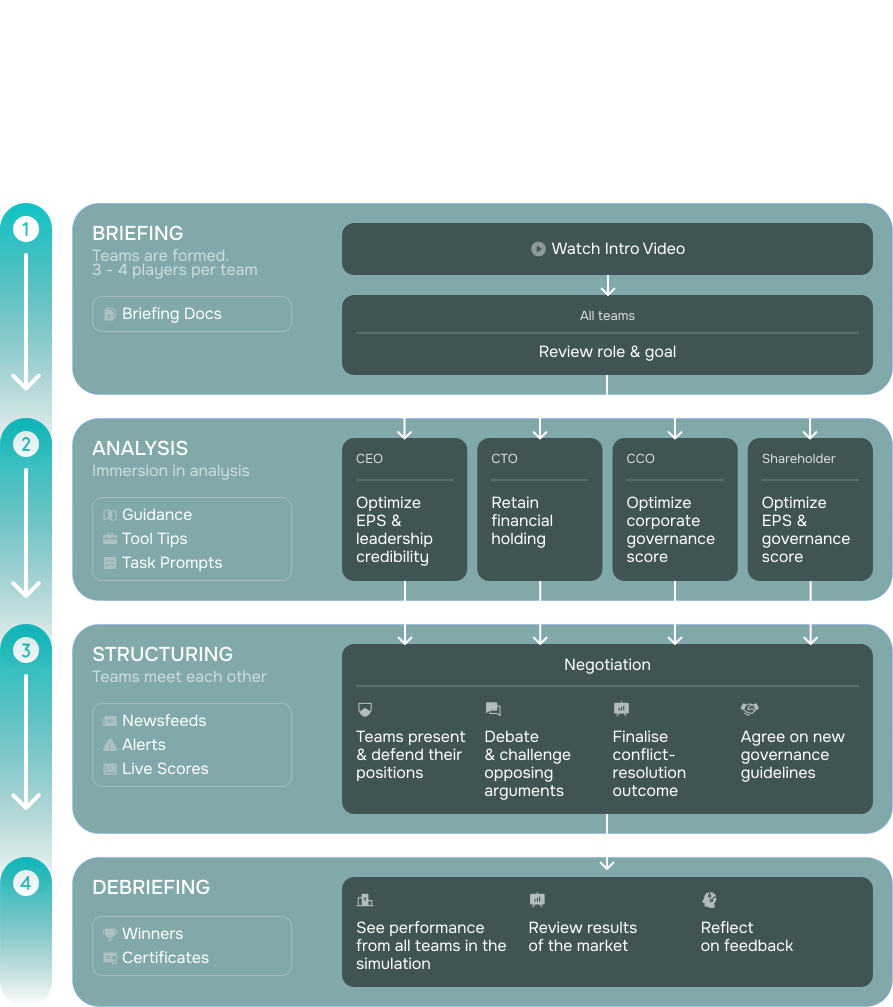
Use the simulation to consolidate core governance concepts, examine how stakeholder incentives affect decision-making and generate a common case for comparison and debriefing.
Students use conflict-of-interest management, fiduciary duty, disclosure, executive accountability and board oversight to evaluate a specific executive governance problem.
The CEO, CTO, CCO and Shareholder roles interpret the same evidence differently, allowing students to examine how responsibility, incentives and accountability affect governance judgement.
Negotiated terms, group agreement and role-specific results allow professors to compare how different groups resolved the same case and whether the final outcome was defensible.
The Admin Panel brings together the controls and guidance needed to run the session. The Student Interface keeps the case, role objectives, decision areas and final results visible as teams move through the activity.
Review every stage, adjust the available time and move the entire cohort through the simulation from one timeline.
Open Setup & Facilitation guidance and Teaching Notes directly from the Admin Panel. A Gameflow Diagram is also available in the same guide area.
Play starts automatic progression. Pause holds the timer in the current stage. Stop locks student screens.
Teams review their respective roles, understand the objectives and responsibilities they represent, and clarify the key conflict-of-interest, negotiation and governance decisions they will need to make during the simulation.
Students see the outcomes their role is expected to protect before deciding how the conflict should be resolved.
Teams can review the final outcomes across all groups, compare the strategies taken, view the final leaderboard rankings and evaluate performance within each stakeholder role.
Students interpret evidence that supports different stakeholder arguments. The documents combine quantitative indicators with qualitative governance judgement.
The brief presents extracts from various reports about the CTO's performance, company innovations, R&D progress and organisational continuity among others.
The Governance Agency Note is one of the case elements connecting governance credibility with investor confidence, financing costs, valuation and access to capital.

5 mins
The video introduces the simulation context, the four stakeholder roles, the objectives they are working towards and the stages they will complete before the timed activity begins.
Assessment is optional. Professors may run the simulation as an ungraded applied activity, use it to support classroom discussion or incorporate its outputs into a wider assessment. Platform data can support academic judgement, but simulation scores should not automatically replace it.
The simulation can run automatically once started, and coaching is optional. Professors can intervene selectively, pause for teaching moments or stop the activity when student screens need to be locked.
Step 1
Add participants through Player Management and organise them into CEO, CTO, CCO and Shareholder teams.
Step 2
Review the default stage timings and use Adjust to fit the session around the available teaching time.
Step 3
Select Play to begin automatic progression. Pause temporarily halts the timer. Stop locks student screens without resetting submitted work. Select Play to resume.
Step 4
Review team decisions, coach selectively where needed and use the final Outputs and Performance screens to structure the debrief.
Everything needed to prepare, run and debrief the Corporate Governance Simulation is organised within the resources below.
The Corporate Governance simulation is designed to be integrated into existing courses, either as in-classroom or as homework.
Option 1:
3 hours in one session. The Corporate Governance simulation can be paused to allow short breaks. The facilitator may provide coaching during the simulation (optional).
Option 2:
Break up the simulation into smaller sessions:
• 4 x 45 min
• 3 x 1 hour
• 2 x 1.5 hours
The simulation for Corporate Governance can be paused at the end of each session and resumed at the next one. The facilitator may provide coaching during the simulation (optional).
Option 3:
Students can complete the simulation as homework, with a set timeframe such as one day or one week determined by the facilitator.
Option 4:
Hybrid approach, beginning the simulation in a class setting and allowing students to finish it independently.
These industry professionals were involved in the inception, creation, development, testing and optimisation of the simulation.

Investment banking, capital markets, PE, and corporate ratings experience at Morgan Stanley, S&P, and HPS Investment Partners. Holds a PhD in Quantitative Finance.

Structured finance, credit derivatives, and NPL expertise. Portfolio Director at a private equity impact fund and active VC investor. Holds CFA and FRM qualifications.

Worked in the finance department of Precomp Tools. Studied Engineering and holds an MSc in Corporate Finance from Bayes.

Assistant Professor of Finance at Tilburg University, teaching corporate finance courses. Also lectures at TIAS Business School.
During the call, we can: