Funding and valuation
Agree the funding amount, pre-money and post-money valuation, investor ownership and founder dilution - and work out how the option pool quietly shifts all four.

Startup Funding Simulation
Students negotiate the full term sheet - valuation, ownership, dilution, option pool, board seats, consent rights and investor protections - and discover that the headline valuation is the least of it.
An early-stage EdTech company is raising its seed round. Founders want enough capital to grow without giving away the company or the right to run it. Investors want a meaningful stake, oversight and protection against what might go wrong. Every provision in the term sheet moves that balance, and students negotiate all of them.
Agree the funding amount, pre-money and post-money valuation, investor ownership and founder dilution - and work out how the option pool quietly shifts all four.
Settle board representation, voting and consent rights, and how much of the founders' decision-making survives the round.
Negotiate anti-dilution, pre-emption, transfer and exit provisions - the terms founders sign without reading and later wish they hadn't.
Duration
Configure the simulation for one intensive workshop or divide it across several teaching sessions.
Format
Each startup team is paired with one VC team, so every group negotiates its own deal.
Level
Adapt the expected depth of analysis and reflection to the level of the course.
Professor tools
Manage participants, adjust the timeline, control progression and review team inputs.
Prerequisites
No prior startup finance required. Every term is defined in the materials.
Delivery
Run it in one session, across several classes or within a professor-defined homework period.
Optional assessment
Use the final agreements and comparative outputs to support optional assessment and debriefing.
Course fit
Entrepreneurship, new venture creation, entrepreneurial finance and venture capital modules.
Students examine how capital, ownership, control and risk interact within a seed-round agreement. By comparing Startup and VC priorities across valuation, dilution, governance and protection terms, they learn to assess the complete deal rather than treating one headline figure as the measure of success.
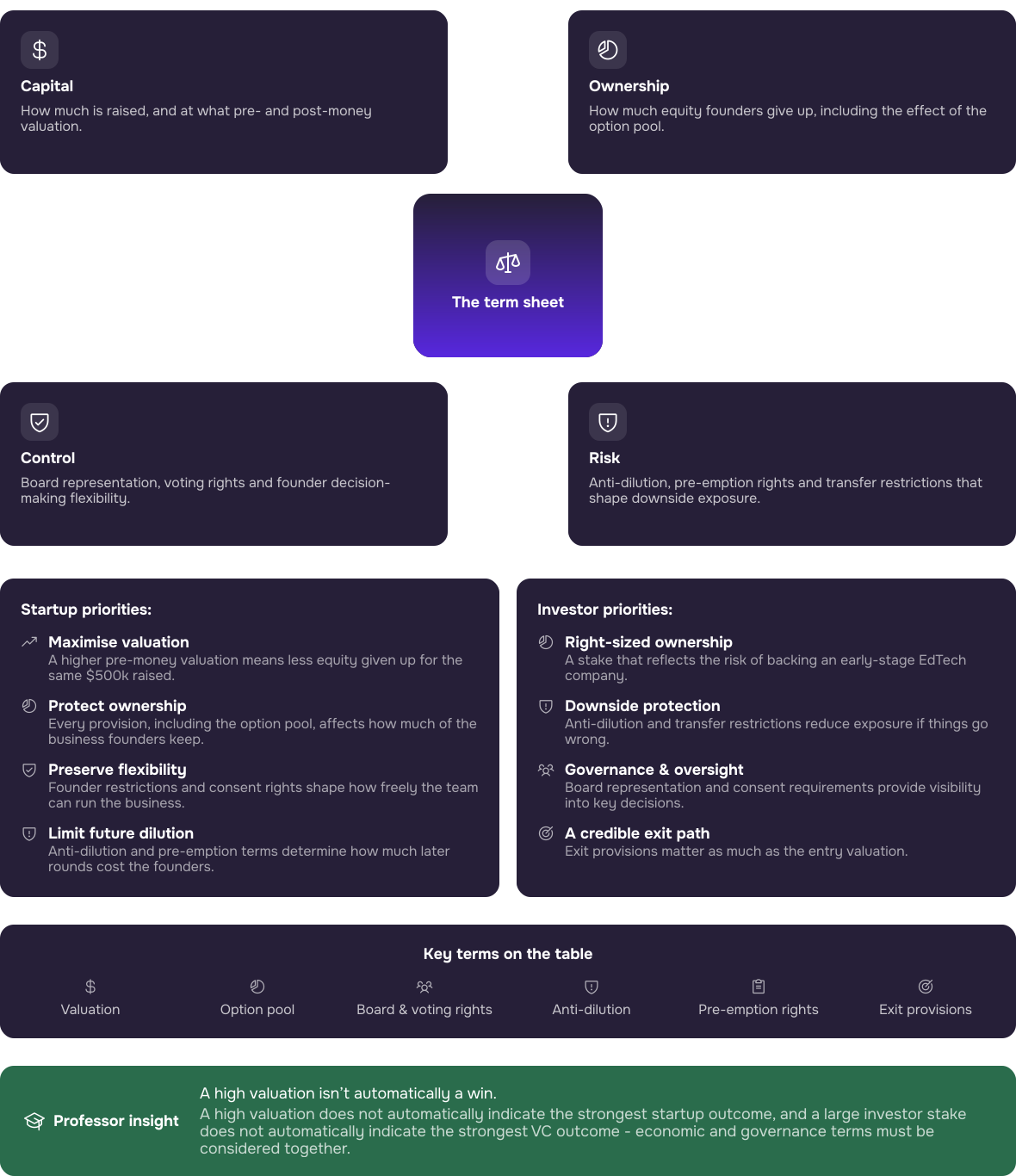


Valuation, dilution, the option pool, board control and investor protections stop being separate lecture topics and become provisions students have to trade against each other in real time.
Two hours of live negotiation, with every team's final terms visible to the whole cohort afterwards, reliably pulls in students who stay quiet through a normal seminar.
Compare Startup teams with Startup teams and VC teams with VC teams to discuss priorities, concessions and why groups reached different outcomes.
The Professor Admin Panel supports preparation and delivery, while the Student Interface guides teams from role-specific analysis to a completed funding agreement.
See the complete stage sequence, adjust the time allocated to each activity and control progression. Play begins automatic progression, while Pause and Stop help the professor respond to class pace or divide the activity across sessions.
Access setup and facilitation guidance, the Teaching Notes and the Gameflow Diagram without leaving the Admin Panel.
Live Monitoring provides access to student inputs and decision tables. Professors can identify incomplete work or groups that need clarification without directing them towards a preferred agreement.
Students use the Term Sheet to turn the company information and their role objectives into a specific funding proposal. They enter decisions covering valuation, capital raised, the option pool and other economic, governance and investor-protection terms.
Startup and VC teams work through the required provisions of the funding agreement. Both teams prepare an initial Term Sheet. During the negotiation, one team enters or updates the agreed terms while the other records acceptance of each provision before the deal is finalised.
At the end of the simulation, students review their negotiation status, final terms and selected outcome metrics. They can compare results across negotiation groups, giving the class a clear basis for discussing valuation, ownership, control, concessions and the overall balance of each deal.
Students receive the company's pitch material, its commercial proposition and its opening funding ask. Founders hold fuller information than the investors do - the same information asymmetry that shapes a real round - and the Data Room lets teams share files, models and documents as the negotiation demands them.
The case combines qualitative evidence about the company’s problem and proposed solution with quantitative evidence about the funding requirement, valuation and ownership.
Finsim is presented as a response to the gap between financial theory and applied business practice. Students assess the commercial problem and value proposition before considering the funding terms.
The company proposes raising $500,000 for 10 per cent of the business, based on a $4.5 million pre-money valuation and a $5 million post-money valuation. Students evaluate this opening proposition rather than treating it as the required outcome.

7 mins
Before the timed activity begins, students watch a short briefing that introduces the case, explains the Startup and VC perspectives, and outlines how the funding negotiation will unfold.
Assessment is optional. Professors may run the Startup Funding Simulation as an ungraded applied activity focused on analysis, negotiation and reflection.
The platform does not generate scores. It shows the outcome of each negotiation alongside selected deal and cohort metrics. These data can support academic judgement, but they should not automatically replace the professor’s evaluation of reasoning, participation and any additional work assigned.
Once participants, roles and timings are configured, Play begins automatic progression through the stages. Coaching is optional. Professors can pause, stop, resume or adjust the session where necessary.
Step 1
Assign three to five students to each team and pair one Startup team with one VC team in every independent negotiation group.
Step 2
Review the five-stage timeline and adjust individual stage lengths to match the available teaching period or a multi-session plan.
Step 3
Press Play to begin automatic progression. Pause keeps students in the current stage. Stop logs students out, and Play resumes the session when teaching continues.
Step 4
Review inputs and group progress. Coaching should clarify process or consequences without recommending a preferred valuation or agreement.
Everything needed to prepare, run and debrief the Startup Funding Simulation is organised within the resources below.
The simulation is designed to be integrated into existing courses, either as in-classroom or as homework.
Option 1:
3 hours in one session. The simulation can be paused to allow short breaks. The facilitator may provide coaching during the simulation (optional).
Option 2:
Break up the simulation into smaller sessions:
• 4 x 45 min
• 3 x 1 hour
• 2x 1.5 hours
The simulation can be paused at the end of each session and resumed at the next one. The facilitator may provide coaching during the simulation (optional).
Option 3:
Participants can complete the simulation as homework, with a set timeframe such as one day or one week determined by the facilitator.
Option 4:
Hybrid approach, beginning the simulation in a class setting and allowing participants to finish it independently.
These industry professionals were involved in the inception, creation, development, testing and optimisation of the simulation.

Experienced technology executive. Founded and built several companies and managed the commercialisation of technologies across Europe, Asia, and the US.

Structured finance, credit derivatives, and NPL expertise. Portfolio Director at a private equity impact fund and active VC investor. Holds CFA and FRM qualifications.

Assistant Professor of Finance at Tilburg University, teaching corporate finance courses. Also lectures at TIAS Business School.

Worked in the finance department of Precomp Tools. Studied Engineering and holds an MSc in Corporate Finance from Bayes.
During the call, we can: