Model the transaction
Test how earnings, adjustments, synergies and the multiple affect value.

M&A Simulation
Students apply valuation theory in a live acquisition deal, analysing a company and defending key assumptions. Professors can monitor progress, manage timings and use the final outcomes for debriefing or optional assessment.
Kestrel Security, a cybersecurity company, is seeking to sell its business to Meridian Cloud, an international cloud-solutions provider. Seller and Buyer teams develop their preferred terms and work towards an acquisition deal.
Test how earnings, adjustments, synergies and the multiple affect value.
Balance the valuation with the proposed mix of cash and shares.
Examine how different groups valued and structured the same transaction.
Duration
Run the simulation within one class or divide it across shorter sessions.
Format
Students represent the Seller or Buyer within an independent acquisition group.
Level
Suitable for students applying M&A, corporate-finance and negotiation concepts.
Professor tools
Manage participants, review progress, adjust the timeline and broadcast alerts.
Prerequisites
A basic understanding of M&A is helpful but not essential.
Delivery
Use the web-based simulation in a timetabled session or across a longer window.
Assessment
No formal score is generated. Final terms and comparative results can support judgement.
Course fit
Fits Mergers & Acquisitions, Corporate Finance, Business & Finance & Negotiation
Students negotiate five interconnected terms that determine the transaction value and how risk, certainty and potential upside are shared between the buyer and seller. They understand that walking away may be a rational outcome when the proposed terms cannot be supported by the evidence.
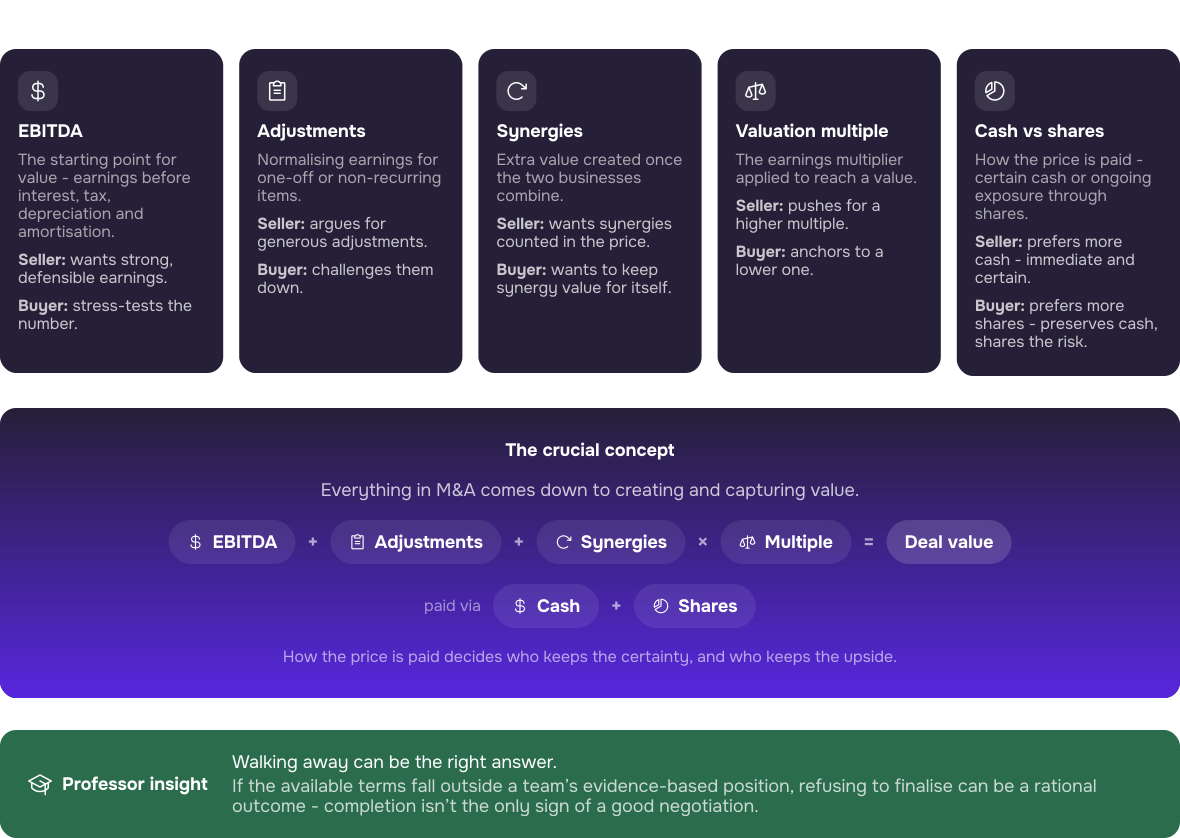


Because every group works from the same transaction, differences in valuation expose the assumptions and interpretations that are most useful to discuss.
Opposing mandates create meaningful debate around price, synergies and consideration without requiring the professor to manufacture a disagreement.
Final terms, valuations and performance outputs allow professors to compare how different groups approached the same transaction.
The simulation provides separate professor and student views. Professors manage the session from the Admin Panel, while teams access role-specific guidance, case documents, models, input screens and market information.
View all stages, their timings and the current position in the simulation. Start automatic progression, pause when teams need additional time, stop for a longer break and adjust the timeline when required.
Add students, organise teams and assign seller or buyer roles through Player Management. Professors can also use Login as Player to check what a particular student sees before or during the session.
Use Live Monitoring to follow team inputs and decision tables as the simulation develops. Broadcast alerts to all students, identify where clarification may help and gather evidence for the final debrief without directing teams towards a preferred decision.
Students review their Seller or Buyer role, understand the objectives they are working towards and clarify the key valuation and negotiation decisions they will need to make during the simulation.
Students test how the five transaction inputs affect the displayed valuation before entering the negotiation. Tooltips provide term explanations and hints.
Students review final valuation and cash consideration against other negotiation groups and cohort median lines.
Students work from a common transaction memorandum, then use role-specific objectives and evidence to build different positions on the same acquisition.
The memorandum introduces Kestrel, Meridian, the cybersecurity transaction and the five linked terms. Teams combine company information, financial evidence, valuation multiples, synergies and transaction risks without being given a recommended valuation.
Seller teams seek stronger earnings and synergy support, a higher multiple and more cash. Buyer teams challenge adjustments, seek a lower multiple and prefer a greater share component. Each side must decide which arguments to defend and where to compromise.

8 mins
Students use the interface to review case information, model the transaction, negotiate key terms and compare their final outcome with other teams.
Assessment is optional, and professors may run the simulation as an ungraded applied activity. No formal score is generated. Team-level platform data can support academic judgement, but the results should not automatically replace evaluation of the analysis, reasoning and participation behind them.
The simulation can progress automatically once started, while the professor retains control over timings, access and selective coaching.
Step 1
Use Player Management to create Seller and Buyer teams of three to five students and pair one team from each side into an independent negotiation group.
Step 2
Review the stage sequence and adjust the timeline to match a one- or two-hour class, a split session or a longer completion window.
Step 3
Use Play to start or resume. Pause holds students within the current stage. Stop halts the simulation and logs students out.
Step 4
Review student inputs and decision tables. Coaching is optional and should focus on evidence, assumptions and process rather than directing teams towards a preferred valuation.
Everything needed to prepare, run and debrief the M&A simulation is organised within the resources below.
Option 1:
Run the simulation in a single lecture. You can pause the simulation to provide coaching if you want.
Option 2:
Split the simulation over two lectures. Stop the simulation at the end of the first lecture and resume it at the beginning of the next.
Option 3:
Homework: Students complete the simulation independently within a timeframe, such as one day, week, or month.
Option 4:
Hybrid: Start in-class and let students finish independently within a set timeframe.
These industry professionals were involved in the inception, creation, development, testing and optimisation of the simulation.

Investment banking experience across UBS, Morgan Stanley, and Deutsche Bank. Studied Mathematics at Saratov University.

Former Practice Specialist in McKinsey’s Corporate Finance team in Germany and Finance professor at Aberdeen University.

Senior investment banker at Morgan Stanley with experience in M&A and TMT coverage across New York and San Francisco. Studied business at Kellogg.

Assistant Professor of Finance at Tilburg University, teaching corporate finance courses. Also lectures at TIAS Business School.

Worked in the finance department of Precomp Tools. Studied Engineering and holds an MSc in Corporate Finance from Bayes.
During the call, we can: