Find the opportunity
Teams establish problem-solution fit, define the customer segment and value proposition, and size the market using TAM, SAM and SOM.

Startup Creation Simulation
Students identify an opportunity, design a value proposition, size the market and build a Business Model Canvas, then pitch live to student venture capital teams.
Startup teams identify an opportunity, define the customer problem and value proposition, size the market and build a Business Model Canvas, then turn it into an investor pitch. Around 70% of teams are startups and 30% are VC firms, so capital is scarce. Not every team gets funded.
Teams establish problem-solution fit, define the customer segment and value proposition, and size the market using TAM, SAM and SOM.
Customer segments, channels, revenue streams, cost structure and unit economics come together on a Business Model Canvas, with a clear use of funds.
Teams pitch live to investor firms, get questioned, and negotiate investment amount and equity ownership - which set the post-money valuation.
Duration
Run the complete experience in one extended session or divide it across shorter teaching periods.
Format
70% of teams are startups and 30% are investors, so ventures compete for a limited pool of capital.
Level
Designed for undergraduate, postgraduate and MBA entrepreneurship, innovation and venture-finance teaching.
Professor tools
Use the timeline, Admin Guide, Player Management and Live Monitoring areas to organise delivery.
Prerequisites
Students do not need prior startup or venture-capital experience before taking part.
Delivery
Run the web-based simulation in class, remotely, as homework or through a blended format.
Optional assessment
Use team submissions, negotiated terms and final outcomes alongside professor-defined assessment tasks.
Course fit
Suitable for courses covering opportunity identification, business-model design, investor pitching, venture capital, startup funding and negotiation.
Two real-world processes behind every deal - how founders build a fundable startup, and how VCs decide whether to back it.
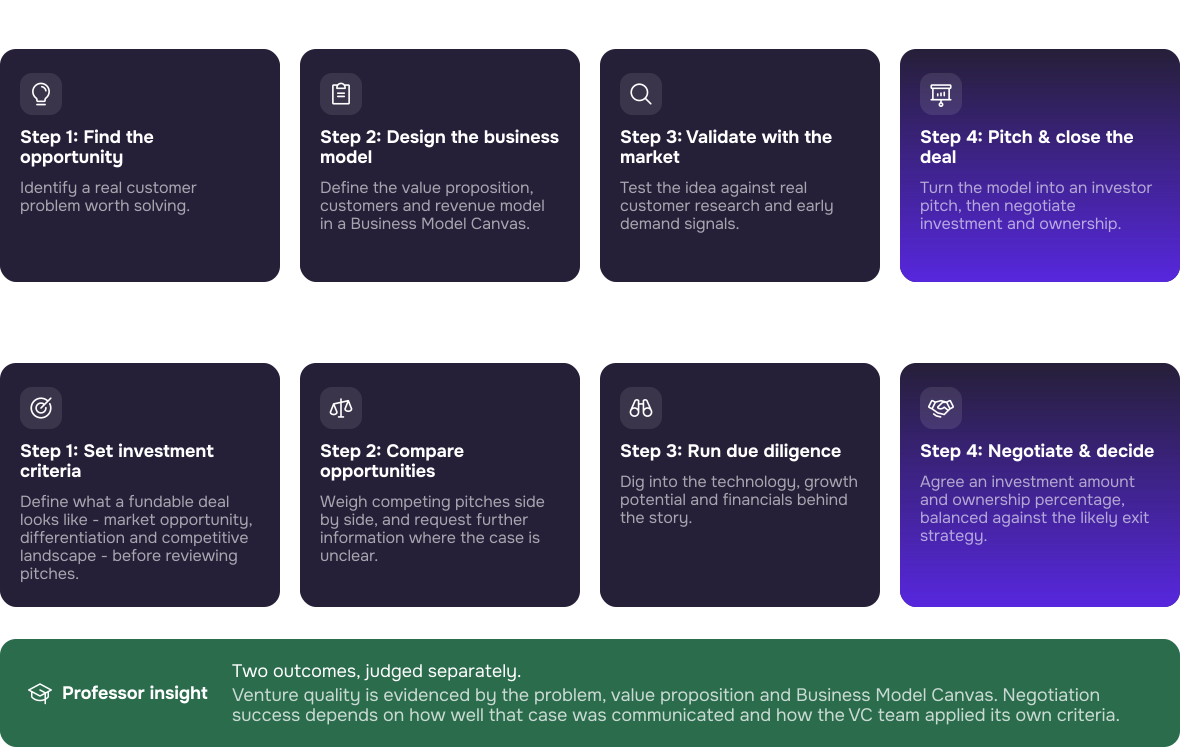


Opportunity identification, problem-solution fit, value proposition design, market sizing and the Business Model Canvas stop being separate lecture topics and become the inputs to a pitch that has to survive investor questioning.
The pitch stage is live, competitive and time-pressured - founders moving between firms, investors questioning the numbers, capital running out. It reliably pulls in students who stay quiet through a normal case discussion, and defending assumptions under pressure is where the critical thinking happens.
Every deal, valuation and ownership split is visible at the end. You debrief real decisions the class made - why one venture raised more than another, why some raised nothing, and whether investors actually backed what their stated criteria said they would.
The professor dashboard supports setup and delivery, while the student interface guides role-specific analysis, submissions and negotiations.
Review the complete stage sequence, adjust timings and use the simulation controls to manage the pace of delivery.
Access setup and facilitation guidance, the Teaching Notes and the Gameflow Diagram without leaving the Admin Panel.
Live Monitoring provides access to student inputs and decision tables. Professors can identify incomplete work or groups that need clarification.
Teams begin by reviewing their assigned role, objectives and available resources. This gives students a clear mandate before they begin making decisions and working through the simulation.
Startup teams develop their venture using a Business Model Canvas, connecting the value proposition, customer segments, channels, key activities, resources, partners, costs and revenue streams into one coherent business model.
At the end of the simulation, teams review how funding amount, ownership and valuation differed across the cohort.
Students receive a combination of platform guidance, reference evidence and role-specific working materials. Startup teams use the Business Idea template, Business Model Canvas and Pitch Elements. VC teams use reference articles, Investment Considerations and the Investment Process Document structure.
Startup teams use comparable deal information to define the customer problem, proposed solution and value proposition, then develop these into a coherent business model. This helps students turn an initial idea into an investable startup opportunity.
Investor teams assess market opportunity, differentiation, technology, growth potential, unit economics, exit routes and the competitive landscape, and commit to their criteria before the first pitch arrives.

5 mins
Watch this short introduction to understand the simulation’s purpose, the Startup and Venture Capital perspectives, and the key activities students will complete before the timed stages begin.
Assessment is optional. Professors may run the simulation as an ungraded applied activity or use its submissions, negotiated terms and comparative results as supporting assessment evidence. Platform data can inform academic judgement, but simulation outcomes should not automatically replace it.
Use four practical steps to prepare the cohort, configure the timetable, manage the live session and prepare the debrief.
Step 1
Use Player Management to assign students to Startup and Venture Capital teams.
Step 2
Review the five-stage timeline and adjust the schedule for a single workshop, several teaching sessions or an asynchronous window.
Step 3
Start the timeline, pause for a break or the end of a teaching session and resume when the class continues. The simulator manages clocks, rules and validation.
Step 4
Use Player Management and Live Monitoring during delivery, then compare funding, ownership and valuation outcomes. Coaching remains optional.
Everything needed to prepare, run and debrief the Startup Creation Simulation is organised within the resources below.
The simulation is designed to be integrated into existing courses, either as in-classroom or as homework.
These industry professionals were involved in the inception, creation, development, testing and optimisation of the simulation.

Experienced technology executive. Founded and built several companies and managed the commercialisation of technologies across Europe, Asia, and the US.

Structured finance, credit derivatives, and NPL expertise. Portfolio Director at a private equity impact fund and active VC investor. Holds CFA and FRM qualifications.

Assistant Professor of Finance at Tilburg University, teaching corporate finance courses. Also lectures at TIAS Business School.

Worked in the finance department of Precomp Tools. Studied Engineering and holds an MSc in Corporate Finance from Bayes.
During the call, we can: