Concepts students apply
FCFF and FCFE, WACC, terminal value, enterprise value against equity value, capital structure, covenants and security, hedging, and valuation in distress.

Investment Banking Simulation
Students apply financial statement analysis, DCF valuation and financial modelling, then structure the debt financing, hedging and advisory work that transactions require. An understanding of DCF is the only prerequisite.
Use one simulation to connect the topics students often study separately, from financial statement analysis and DCF valuation to financing, advisory and deal execution.
FCFF and FCFE, WACC, terminal value, enterprise value against equity value, capital structure, covenants and security, hedging, and valuation in distress.
Students meet lending, derivatives and advisory work for the first time inside the simulation. They come away understanding what these functions do and how they interact.
Financial models, written recommendations, valuation ranges and the decisions students made with them.
Duration
Deliver intensively across four days or divide the work into 4, 8 or 12 sessions.
Format
Teams work through linked rounds with changing transaction responsibilities.
Level
Use the simulation across undergraduate, postgraduate and MBA finance teaching.
Course fit
Fits modules in investment banking, corporate finance and valuation, capital markets, private equity and financial modelling.
Prerequisites
Students should understand basic finance and discounted cash flow valuation.
Delivery
The web-based simulation supports in-person, virtual and blended delivery.
Optional assessment
Use team inputs, models, approval memoranda and platform results as evidence.
Professor tools
Player management, admin guidance, automated timing and live monitoring are built in.
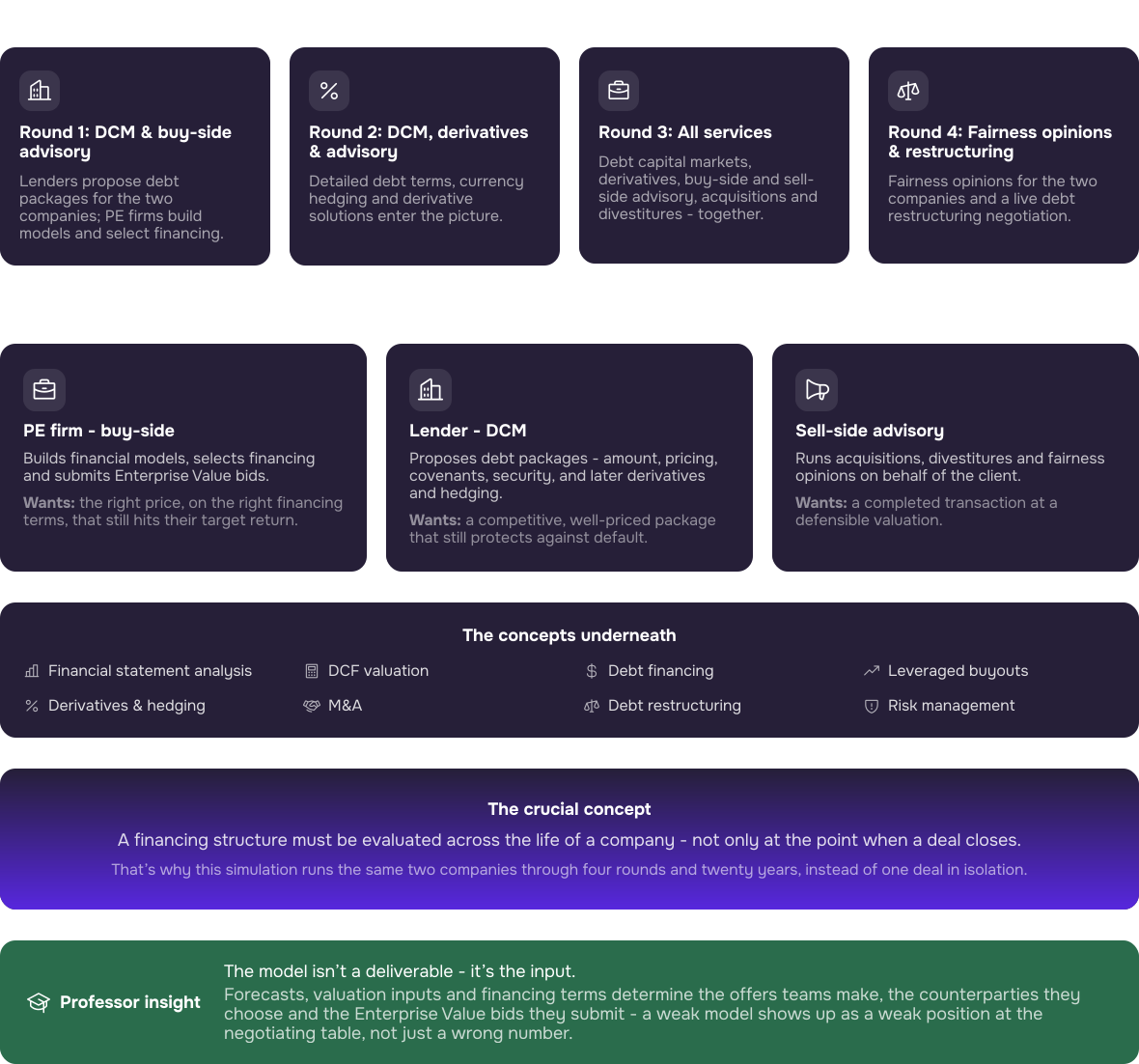
Across four rounds, students work through debt financing, derivatives, buy-side and sell-side advisory, fairness opinions and restructuring. By taking on different transaction roles, they see how financial analysis, valuation, financing terms and risk decisions interact across the lifecycle of a company.


Use one simulation to connect valuation, financing and advisory teaching.
Students apply financial statement analysis, DCF valuation, debt financing, derivatives, buy-side advisory and sell-side advisory in one connected exercise.
Forecasts, valuation inputs and financing terms determine the offers teams make, the counterparties they choose and the Enterprise Value bids they submit.
Teams with the same responsibilities produce directly comparable work, which makes the classroom discussion about why two credible models reached different answers.
The Admin Panel supports setup, timing and monitoring. The Student Interface guides teams from their mission and task list to decision inputs and final results.
Configure the stage timings across the four rounds and use Play, Pause, Stop and Adjust to manage the session.
Open the Setup and Facilitation guide, Teaching Notes and Gameflow Diagram from the Admin Guide.
Across the four rounds, use Live Monitoring to review current inputs and identify where neutral clarification may be useful.
Students review their role-specific mission and objectives, together with the actions required in each round. This helps them understand what they need to complete, what decisions are due and how each task contributes to the transaction.
Students submit the required transaction inputs and supporting work, including DCM terms, enterprise value decisions, financial models and memos. The interface guides teams through the information and deliverables required at each stage.
At the end of each round, students review the relevant outputs and see how their decisions affected the transaction. These output stages help teams compare outcomes, assess their performance and prepare for the next round.
Students work with company background, historical financials, management forecasts, existing financing and transaction context. They use the evidence to forecast performance, complete DCF valuations, structure financing and support bids.
Frametastic is a German manufacturer and distributor of window and door frames. Students use its company background, previous acquisition and existing Term Loan B to support forecasts, financing terms and valuation. Company background, previous acquisition and existing financing.
Star Hotel is an Italian discount hotel chain. Students use its operating profile, previous acquisition and existing Term Loan B to support forecasts, financing terms and valuation. Company background, acquisition history and existing leveraged financing.

11 mins
Students watch a short video introducing the simulation, their role, objectives and the key decisions they will make during the various transactions.
Assessment is optional. You may run the simulation as an ungraded capstone or use team models, approval memoranda, transaction inputs and platform results within a wider assessment.
The leaderboard should support, not replace, academic judgement.
The Admin Panel supports setup, automatic progression and selective intervention. You can run the simulation intensively or pause and resume it across multiple sessions.
Step 1
Add participants through Player Management, organise teams and confirm access before the timed activity begins.
Step 2
Review the four-round structure and adjust stage durations to fit the planned teaching schedule.
Step 3
Press Play to begin automatic progression. Use Pause for extra working time or clarification, and Stop when delivery must be suspended more fully.
Step 4
Use Live Monitoring to review inputs and decision tables. Ask teams to explain assumptions or inconsistencies without directing them towards a preferred answer.
Everything needed to prepare, run and debrief the Investment Banking Simulation is organised within the resources below.
Round 1
Round 2
Round 3
Round 4
The investment banking simulation is designed to be integrated into existing courses, either as in-classroom or as homework.
OPTION 1: Consecutive days, lasting 4 days with approximately 6 hours per day.
OPTION 2: Weekly schedule, running the investment banking simulation over 2 to 6 weeks.
2a: Breaking up the investment banking simulation into smaller sessions if the course has 2 to 5 hours per week. The simulation is stopped at the end of each session and resumed at the next one.
2b: Breaking up the simulation into smaller sessions with homework assignments if the course has 1 to 3 hours per week. The simulation is paused at the end of each session, participants can complete their tasks but can't move to the next stage.
2c: Hybrid approach, beginning the simulation in a class setting and allowing participants to finish it independently with a set timeframe determined by the facilitator.
These industry professionals were involved in the inception, creation, development, testing and optimisation of the simulation.

Investment banking, capital markets, PE, and corporate ratings experience at Morgan Stanley, S&P, and HPS Investment Partners. Holds a PhD in Quantitative Finance.

Senior investment banker at Morgan Stanley with experience in M&A and TMT coverage across New York and San Francisco. Studied business at Kellogg.

Former Practice Specialist in McKinsey’s Corporate Finance team in Germany and Finance professor at Aberdeen University.

Corporate finance experience across M&A, structured finance, credit risk, and leveraged finance at Morgan Stanley, SMBC, and Citi. Holds a BSc in Economics.

Worked in the finance department of Precomp Tools. Studied Engineering and holds an MSc in Corporate Finance from Bayes.
During the call, we can: