The six factors
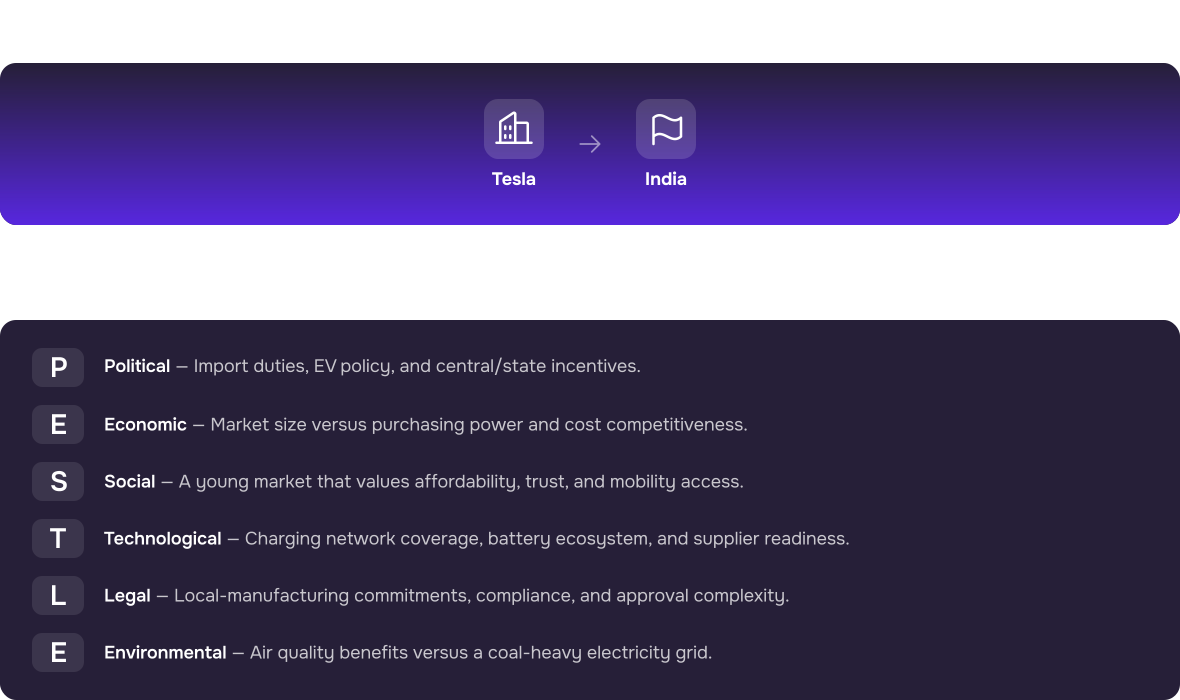
Political, economic, social, technological, legal and environmental conditions, each supported by evidence from the case.

PESTLE Analysis Simulation
A ready-to-run simulation where teams assess the six external factors behind a live market entry decision, weight the ones that change the answer, and defend their analysis against a team briefed to challenge it.
Students apply PESTLE to a real, unresolved market entry decision. Every factor needs evidence, a score and a weight, and students have to be explicit about which of the six should actually change the recommendation.
Political, economic, social, technological, legal and environmental conditions, each supported by evidence from the case.
Students distribute a fixed budget of 100 points across the six factors. Raising one factor means lowering another, so priorities have to be argued for rather than assumed.
Teams justify every score and weight to a team with the opposite mandate, then commit to a recommendation on whether the company should go ahead.
Duration
Two 60-minute stages. Run them in one teaching session or split them across two classes.
Format
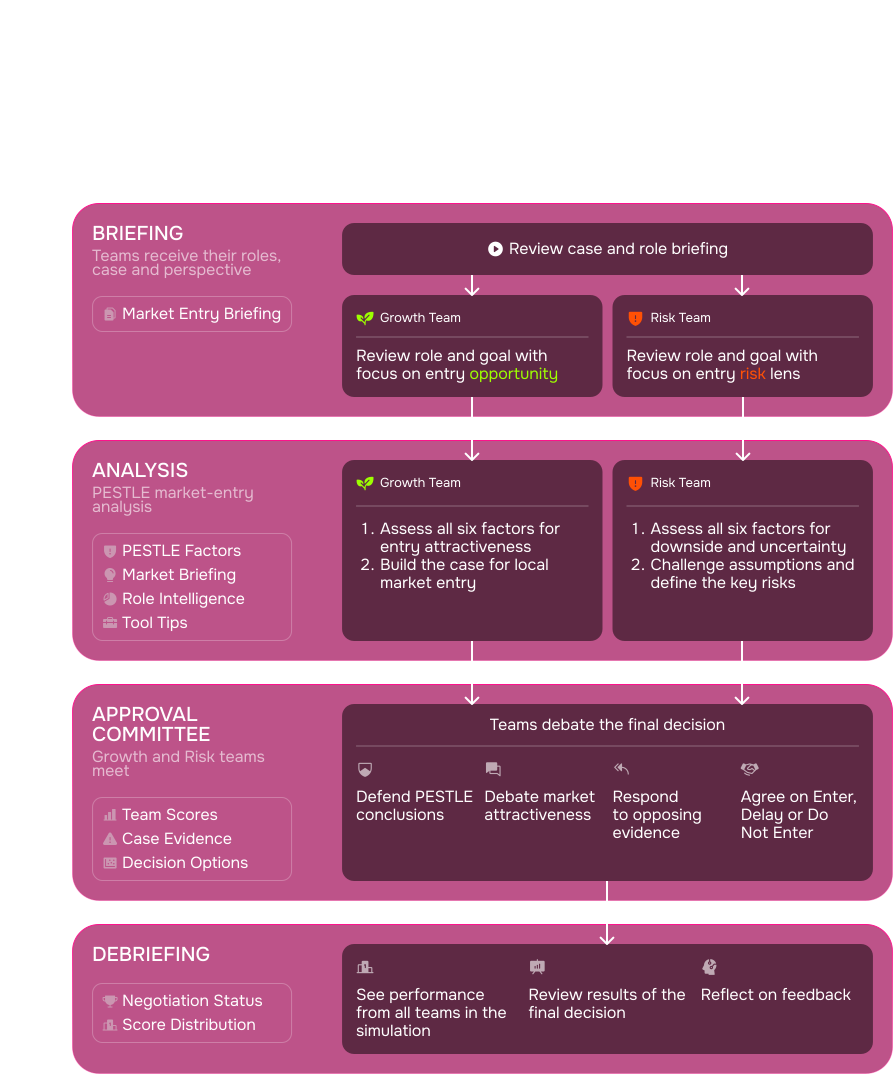
Two teams with opposing mandates assess the same case, then negotiate a single agreed assessment.
Level
Vary the expected depth of evidence, critique and theory.
Course fit
Fits Strategic Management, Business, Global Strategy, Marketing Strategy and MBA core strategy teaching.
Prerequisites
A short introduction to PESTLE is enough for beginners.
Delivery
Teams collaborate throughout in any delivery format.
Assessment
Use factor scores, written rationales, the negotiated outcome and individual reflection as supporting evidence.
Timeline
Set timings once, then pause, stop or resume whenever needed.
The case is a decision Tesla has not resolved: whether to commit to building a Gigafactory in India, or carry on serving the market through imports. Students assess it factor by factor.

It turns a framework students often complete as a list into a visible process of evidence, disagreement and decision-making.
Students have to identify the most relevant external factors, weigh them against one another and decide what actually matters, rather than simply filling in six headings with generic points.
Two teams with opposing mandates read the same evidence and reach different conclusions, then have to reconcile them factor by factor. Students defend interpretations rather than restate facts.
Written rationales, agreed scores, cohort weighting patterns and final recommendations give you concrete material for the debrief, instead of asking who would like to share their PESTLE.
The professor dashboard supports setup and delivery. The student interface makes scores, weights and reasoning visible throughout.
See stage timings and play controls in one focused view.
Open setup guidance, teaching notes and the gameflow without leaving the admin panel.
See how factors are being scored, how far each group has negotiated and where a team may need a prompt.
Students review their roles and the objectives they are working towards. They understand that they are in competition with each other.
Students set a score and a weight for each factor, with a running total showing how many points are still unallocated.
Both teams' initial scores appear side by side, making it immediately clear which factors are close and which need the most discussion.
Both teams receive the same market briefing, with the same figures on market size and growth, pricing, competition, charging infrastructure, import duties and government policy. Each team also receives material prepared for its own mandate, which is where the two readings of the same case begin to diverge.
The Growth Strategy team receives the arguments and precedents that support commitment: market trajectory, the cost advantage of manufacturing locally, and comparable entries the company has made elsewhere.
The Risk Management team receives the arguments for caution: the scale and irreversibility of the commitment, affordability, the entrenched competitive field, and global carmakers who tried the same market and withdrew.

6 mins
Watch the briefing students see at the start of the simulation. In under five minutes it introduces the company, the decision in front of it, the six PESTLE factors and how each team will be evaluated.
Assessment is optional. Professors can run the simulation as an ungraded applied activity, or use factor scores, written rationales, the negotiated outcome and individual reflection alongside team outputs. The simulation score supports academic judgement rather than replacing it.
Choose teams and stage timings, press play, and the simulation moves students through each stage automatically. Professors act as coaches, intervening only when it adds value.
Step 1
Add students, organise them into teams and assign each team its role. Teams are then paired into negotiation groups.
Step 2
Choose each stage duration once. The timeline then moves students through the session automatically.
Step 3
Pause for discussion, stop between stages or resume from the same point in a later session.
Step 4
Review scores, weights, written rationales and negotiation progress without interrupting students.
Everything needed to prepare, run and debrief the PESTLE Analysis Simulation is organised below.
• Macro-environmental analysis
• The six PESTLE factors
• Environmental scanning
• Factor weighting and materiality
• Weighted factor scoring
• Market entry assessment
• Interdependence between external factors
• Evidence, assumption and interpretation
• Apply PESTLE to a live market entry decision
• Distinguish material factors from background context
• Justify scores and weights with case evidence
• Negotiate and defend an assessment under challenge
• Reach a recommendation and explain the trade-offs behind it
• Reflect critically on mandate and role bias
The simulation can sit inside an existing course as a single workshop, a staged activity or a homework-supported exercise.
These industry professionals were involved in the inception, creation, development, testing and optimisation of the simulation.

Investment banking, capital markets, PE, and corporate ratings experience at Morgan Stanley, S&P, and HPS Investment Partners. Holds a PhD in Quantitative Finance.

Over 15 years of experience across advisory, PE, VC, family offices, and entrepreneurship. Covered M&A transactions from multiple angles and holds a PhD in Corporate Finance.

Worked in the finance department of Precomp Tools. Studied Engineering and holds an MSc in Corporate Finance from Bayes.

Senior investment banker at Morgan Stanley with experience in M&A and TMT coverage across New York and San Francisco. Studied business at Kellogg.
During the call, we can: