Segmentation
Use customer needs, buying behaviour and evidence to decide how the market should be divided.

Go To Market Simulation
Students apply segmentation, targeting and positioning to a consumer launch, choosing a target segment, launch regions, an access channel and a differentiated position, then see how the rest of the cohort chose.
The Go-to-Market Strategy Simulation is a two-hour, single-player competitive simulation in which each student acts as the founder of a protein-bar company entering the US market. Students apply Segmentation, Targeting and Positioning to divide the market, select target segments, launch regions, choose an access channel, and build a differentiated positioning strategy covering the value proposition, price, pack format and promotional message.
Use customer needs, buying behaviour and evidence to decide how the market should be divided.
Select one target segment, two launch regions and an access channel.
Align the value proposition, point of difference, price, pack format and promotional message.
Duration
Plan one complete teaching session covering the introduction, gameplay and final reflection.
Format
Each student develops an individual strategy while class and competitor information creates a shared competitive context.
Level
Works as the applied session after STP is introduced at undergraduate level, and as a fast strategy exercise for postgraduate and MBA cohorts.
Professor tools
Manage participants, control the timeline, adjust timings, send alerts and review results.
Prerequisites
No required prerequisites. Basic familiarity with the STP framework is advantageous.
Delivery
The web-based simulation supports live delivery and a split hybrid format.
Assessment
Run it as an ungraded applied activity or use platform data to support a wider assessment approach.
Course fit
Suitable for Marketing Management, Strategic Marketing, Go-to-Market Strategy, Brand Management and Entrepreneurship courses.
Students connect segmentation, targeting and positioning to decide who to serve, where to compete and how to differentiate. Strong go-to-market decisions depend on the consistency of the full STP strategy, not on any single choice.
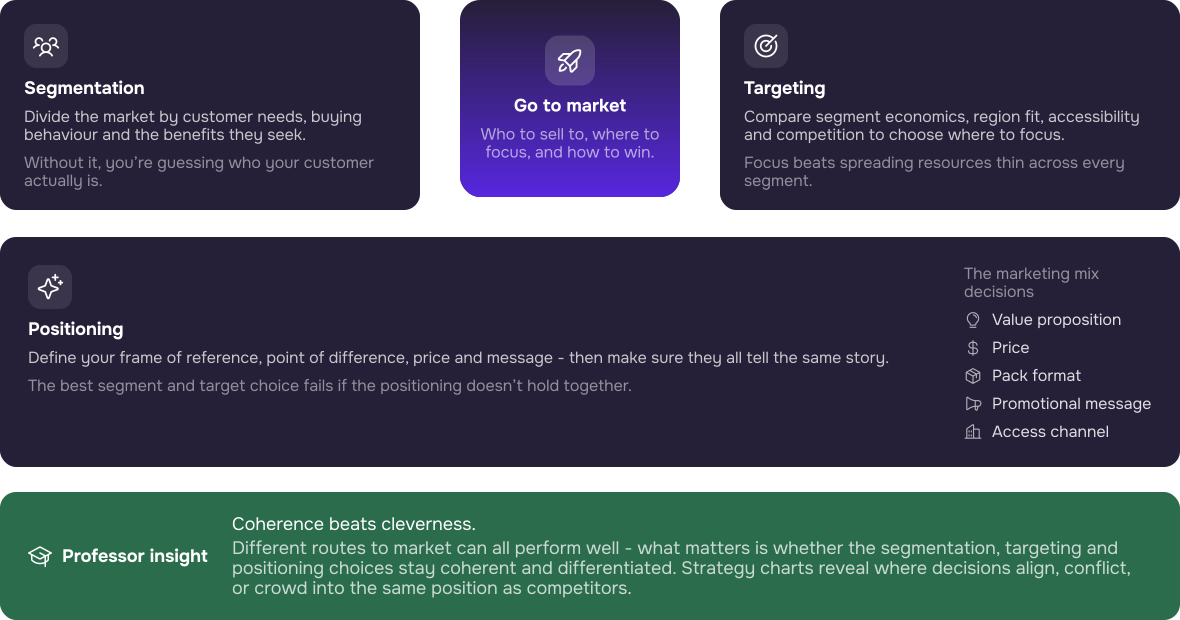

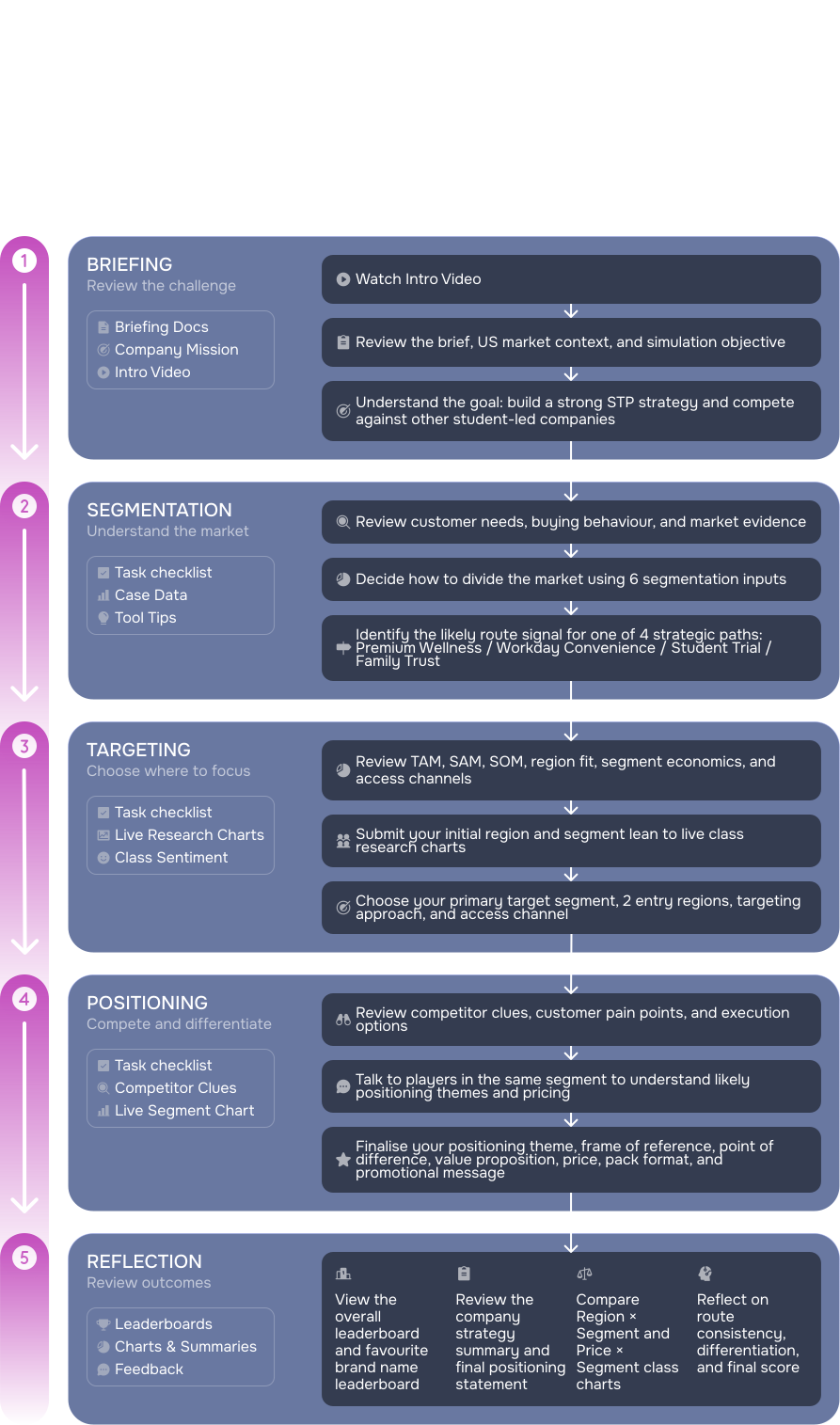
Students move from segmentation bases and customer evidence to target-market selection and positioning, showing how each stage influences the next.
Students balance segment size, growth, price tolerance, region fit, access and competition before deciding where to focus.
Strategy summaries and class charts show where decisions align, where they conflict and where several competitors occupy the same position.
The professor dashboard supports preparation and session control, while the student interface guides each learner through the decisions forming the final strategy.
Set the pace, adjust stage timings and use Play, Pause or Stop to respond to class progress. Continuous Play supports automatic progression, while Pause and Stop allow the professor to coordinate explanations, interruptions or the final reveal.
The Admin Guide gives professors direct access to Setup & Facilitation guidance, Teaching Notes and the approved Gameflow Diagram. Player Management can be used to manage access or open a student view, and alerts can communicate neutral instructions to the class.
Play starts automatic progression. Pause holds the timer in the current stage. Stop locks student screens.
Students review their role as founders, understand the US launch challenge and identify the key Segmentation, Targeting and Positioning decisions they must make.
Students select strategic options and enter a written reason explaining why the evidence supports their choice.
The Reflection summary combines the final leaderboard along with strategy information with cohort-level region and segment comparisons.
All students receive the same core company and market context. The material combines quantitative market evidence with qualitative information about customer needs, behaviour, product fit and access.
Students begin with a defined product rather than designing one without constraints. The baseline presents product specifications, production cost, shelf life, customer response and the limits affecting the launch.
Students compare four potential segments through market size, expected growth, price tolerance, margin and repeat behaviour. No single measure provides the answer, so the complete pattern must be interpreted.

6 mins
Watch a short introduction to understand the company, market challenge and your role before the timed simulation begins. You will also see how the Segmentation, Targeting and Positioning stages connect.
Assessment is optional. Professors may run the simulation as an ungraded applied activity or use its platform-generated data as supporting evidence within a wider assessment approach. The score is based on student inputs, but its underlying formula is not publicly disclosed. Scores and rankings should support academic judgement rather than automatically replace it.
The simulation can progress automatically, but the professor retains control of participants, stage timings and session progression. Coaching is optional.
Step 1
Add participants through Player Management and confirm student access. Each participant develops an individual strategy from the founder perspective, so no team or role assignment is required.
Step 2
Review the two-hour teaching window and the confirmed Intro, Gameplay and Reflection timings. Use Adjust where the configured stage timing needs to fit the class schedule.
Step 3
Use Play to begin or resume. Pause temporarily holds the timer. Stop holds the timer and locks student screens. Submitted data is retained when Play resumes the session.
Step 4
Check progress, provide neutral clarification where useful and decide how the class will enter Reflection. Continuous Play can advance automatically; Pause or Stop can coordinate a later reveal.
Everything needed to prepare, run and debrief the Go To Market simulation is organised within the resources below.
The Go To Market simulation is designed to be integrated into existing courses, either as in-classroom or as homework.
Option 1:
2 hours in one session. The Go To Market simulation can be paused to allow short breaks. The facilitator may provide coaching during the simulation (optional).
Option 2:
Break up the simulation into smaller sessions:
• 4 x 30 min
• 2 x 1 hour
• 3 x 40 min
The simulation for Go To Market can be paused at the end of each session and resumed at the next one. The facilitator may provide coaching during the simulation (optional).
Option 3:
Participants can complete the simulation as homework, with a set timeframe such as one day or one week determined by the facilitator.
Option 4:
Hybrid approach, beginning the simulation in a class setting and allowing participants to finish it independently.
These industry professionals were involved in the inception, creation, development, testing and optimisation of the simulation.

Investment banking, capital markets, PE, and corporate ratings experience at Morgan Stanley, S&P, and HPS Investment Partners. Holds a PhD in Quantitative Finance.

Structured finance, credit derivatives, and NPL expertise. Portfolio Director at a private equity impact fund and active VC investor. Holds CFA and FRM qualifications.

Worked in the finance department of Precomp Tools. Studied Engineering and holds an MSc in Corporate Finance from Bayes.

Corporate finance experience across M&A, structured finance, credit risk, and leveraged finance at Morgan Stanley, SMBC, and Citi. Holds a BSc in Economics.
During the call, we can: