


The science behind hiring decisions that hold up to scrutiny

Our simulations are designed as real-work assessments to reveal who is most likely to perform in the actual job.

What this page covers

  • What actually predicts job performance
  • Validity vs. scalability: why the strongest method is rarely the practical one
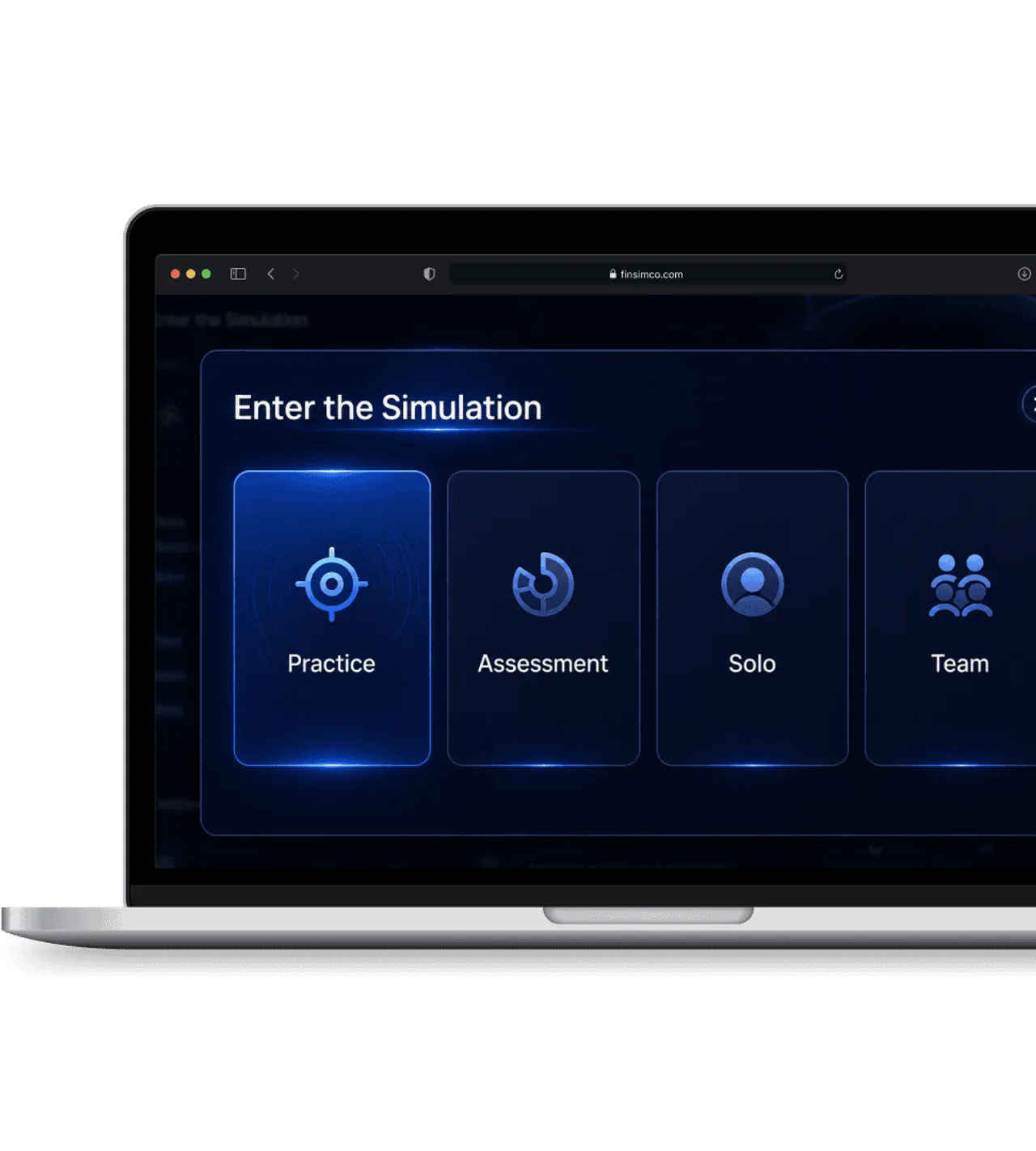
  • The 3-location assessment: individual work at a desk, collaboration in a team room, and negotiation in a boardroom
  • 4 measurement layers: behavior, decisions, communication, conduct
  • The 4 traits that predict early-career performance, drawn from 100,000+ participants a year
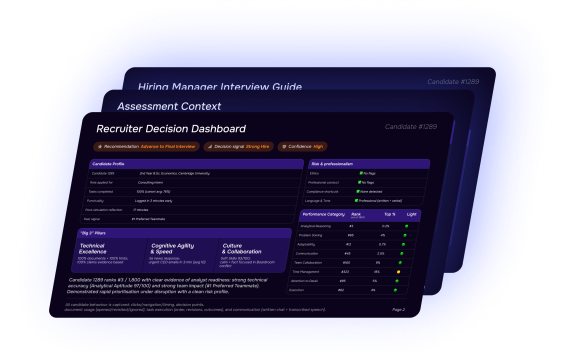
  • What a recruiter receives: ranking, skills breakdown, risk flags, interview guide
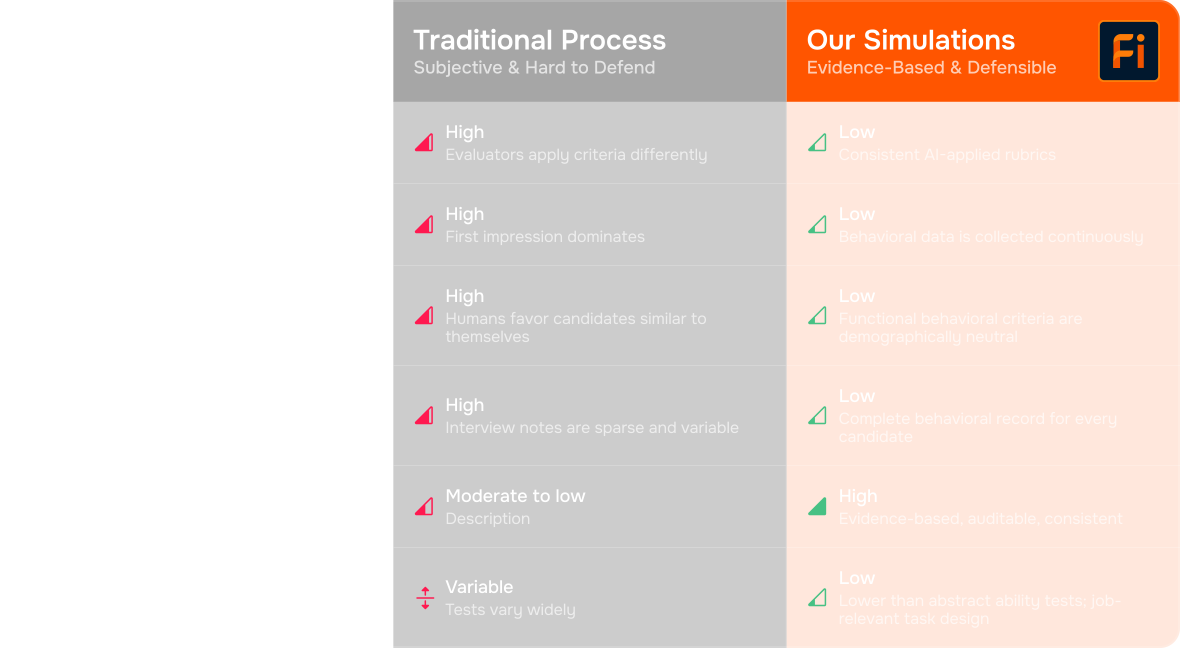
  • Bias and defensibility, compared line by line with a traditional process

Most hiring decisions are made on the weakest evidence

Decades of organizational psychology research confirm what most recruiters already sense: the tools most commonly used in hiring are the least predictive of actual job performance.

Still-dominant selection methods in early-career hiring provide limited insight into on-the-job performance, yet they consume the majority of recruiter time and introduce significant bias at scale.

Aptitude tests improve predictive accuracy, but they remain one-dimensional. They capture aspects of cognitive ability, but not how a candidate actually thinks under pressure, collaborates under stress, or handles the complexity of a real working environment.

Work-sample simulations, GMA tests, and structured interviews are the best predictors. Our simulations combine all three - the strongest individual predictors. When combined, their predictive power increases further.

How well different hiring methods predict job performance

Assessment methods: Validity vs. Scalability

The best assessments deliver predictive power and practical scalability.

assessment-science-assessment-methods-desktop for Assessment methods: Validity vs. Scalability

3 locations, each measuring what the others cannot

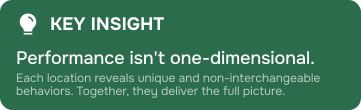
Candidates rotate through three distinct locations in a single session. Each location is designed to surface a different set of behaviours. Performance in one location does not carry over to another. A strong individual analyst can be a poor collaborator, and both show up in the data.

assessment-science-assessment-locations-desktop for 3 locations, each measuring what the others cannot

What Each Location Measures

Three locations. Complementary signals. A complete picture of performance.

Mobile Measurement Legend Image for 3 locations, each measuring what the others cannot
Mobile Measurement Table Image for 3 locations, each measuring what the others cannot
Mobile Measurement Insight Image for 3 locations, each measuring what the others cannot
assessment-science-assessment-locations-desktop for 3 locations, each measuring what the others cannot

What we assess and how

Traditional assessments collect a candidate's final answer. Finsimco collects everything that happens on the way to it - and that behavioral trace is where the real signal lives.

We capture the candidate's behavioural record across the full simulation. Which information they used. What they ignored. How they made decisions. How they communicated. How they responded when the scenario changed. How their conduct held up when pressure increased.

Our platform is built to capture that behavioral record at a level of granularity that no human observer could match. The point is not to replace human judgement. The point is to give hiring teams better evidence before they use it.

Here is a complete taxonomy of what we capture, across all three simulation locations:

assessment-science-what-we-assess-and-how-desktop for What we assess and how

What we capture – and why it matters

Data Layer What's Captured Why It Matters
Navigation & Document UseFiles opened, time spent, revisit frequencyReveals analytical thoroughness and prioritization
Decision SequencingOrder, timing, and revision patternsSeparates decisive thinkers from indecisive ones
Response to System EventsSpeed and accuracy of response to news, urgency, and executive requestsReal indicator of cognitive agility in a live environment
Written CommunicationClarity, structure, tone, and evidence usePredicts client-facing and stakeholder communication quality
Verbal Communication (AI)Transcribed and scored in real timeReveals true communication style, not a polished rehearsed answer
Team ContributionParticipation rate, influence, and listening behaviorIdentifies authentic collaborators vs. passengers
Conflict HandlingBoardroom behavior during negotiation and disagreementThe most stress-tested behavioral signal we collect
Professionalism FlagsEthics, tone, and conduct checksEnables defensible, auditable hiring decisions
Learning RateImprovement in decision quality and communication from Phase 1 to Phase 3The single strongest predictor of long-run career trajectory

What traits are most important for success

Being integrated into 500+ university programs and having more than 100,000 students go through our simulations each year, we are able to spot the patterns that separate top performers from the rest.

After observing and following a large population of candidates through the simulation and into employment, 4 competencies seem to be the most consistent predictors of strong performance in the first 12–24 months of an early-career role.

assessment-science-the-four-predictors-desktop for What traits are most important for success

Want to test it first? Run a live simulation with your team

For teams hiring larger early-career cohorts, we run a free 2-hour simulation with your team. After the session, you receive an assessment report showing each of your team member's performance.

Does It Predict Performance?

This is the question every HR leader should ask of any assessment vendor, and the one most vendors fail to answer credibly. "Our candidates perform better" is not an answer. A correlation coefficient is.

Predictive validity is measured on a scale of 0 to 1, where 1 would mean perfect prediction. No selection tool achieves 1. The relevant comparison is what's achievable and where different tools sit relative to each other.

Our simulation scores, when combined with cognitive agility measurement embedded within the simulation, achieve an estimated predictive validity of r = 0.55–0.62 for early-career performance outcomes, placing them at the top of what evidence-based selection science currently offers.

This figure comes from three sources:

  1. Meta-analytic data on work-sample assessments (Schmidt & Hunter, multiple updates)
  2. Our own outcome-tracking data: candidates hired through our platform and followed up at 6-month and 12-month performance review
  3. The incremental validity gain from combining work-sample performance with embedded cognitive measurement, a combination the research consistently shows outperforms either measure independently
Estimated predictive validity of common selection methods

What recruiters get after each simulation session

An Assessment Report including:

  1. Candidate ranking vs. the cohort
  2. Breakdown of analytical and soft skills
  3. Risk flags for ethics and professionalism
  4. Interview guide with strengths and follow-up questions

Recruiters and hiring managers can align faster, focus interviews on the right people, and reduce early-stage interview volume.

Example recruiter assessment report

What you can see with our simulations

A structured comparison of which signals each assessment method actually provides:

Recruitment Assessment Methods Comparison Chart for What you can see with our simulations
Simulation Platform Assessment Science Visibility Insight for What you can see with our simulations

A selection process you can defend

The shift toward defensible, documented, evidence-based hiring is increasingly required. Employment tribunal cases involving selection decisions increasingly scrutinize the evidence basis for hiring choices. "Gut feel," "culture fit," and "strong interview performance" are not defensible rationales. Our assessment approach provides an evidence-based record for every selection decision to reduce the exposure associated with subjective selection processes.

Simulation Platform Assessment Science Defensible for A selection process you can defend

The Research Foundation

Work-sample assessments are not a new idea. The science behind them has been accumulating since the 1960s. We've taken the strongest findings and built a platform around them.

The Work-Sample Principle

The foundational insight behind our simulations comes from a deceptively simple observation in organizational psychology: the best predictor of future job behavior is past job behavior. If you want to know how someone will perform in a role, the closest approximation is to observe them performing it under controlled conditions.

Work-sample testing consistently outperforms abstract aptitude tests, personality questionnaires, and interview-based methods on predictive validity. When combined with cognitive ability measurement, work samples represent the ceiling of what selection science currently offers. That combination is the starting point for everything Finsimco measures.

Why Cognitive Ability Still Matters

General Mental Ability (GMA) is the single strongest individual predictor of job performance, particularly in roles with significant learning requirements. Early-career hiring, where candidates have little job history to assess, is exactly the context where it matters most.

The limitation is this: GMA tests measure potential, not execution. They tell you a candidate can learn quickly. They tell you nothing about how they will perform under pressure, in a team, or when the stakes are real.

Finsimco measures both. Candidates solve problems under time pressure, with incomplete information, while managing competing demands. That is cognitive ability in context, a measurably richer signal than an aptitude score alone.

The Situational Judgment Principle

Situational Judgment Tests (SJTs) have shown consistent predictive validity in the 0.30 to 0.45 range, particularly for roles requiring judgment under pressure. The limitation of traditional SJTs is their format. Candidates read a scenario and select an answer. There is no way to observe how they think.

Finsimco's simulations are dynamic SJTs. Candidates do not select from options. They take real actions. Click-by-click behavioural logging, communication analysis, and decision sequencing capture the reasoning, not just the outcome.

The Assessment Centre - at scale

Traditional Assessment Centres (ACs) - with validity in the ~0.37 range - represent the industry's best attempt at multi-modal evaluation: group discussions, role plays, and structured interviews, assessed by trained evaluators. They are expensive, logistically intensive, and increasingly difficult to run at scale.

Finsimco delivers the substantive elements of an Assessment Centre - individual task work, team collaboration, real-time decision-making, and communication evaluation - with three advantages: scale (hundreds of candidates in a session), objectivity (AI analysis replaces variable human raters), and cost (a fraction of a traditional AC).

Book a Demo

If you have questions about the methodology, book a short call and we will walk you through the evidence and what the data looks like in practice. If you want to see it firsthand, request a free live simulation for your team - you will experience the assessment as candidates do and receive a full report afterwards.