Concepts students apply
Comparable company analysis and valuation multiples, book-building, investor demand, offer price setting, allocation and underpricing.

Initial Public Offering Simulation
Students apply the core IPO concepts, from company valuation and roadshows to book building, final pricing and share allocation. They work as Underwriters and Investors, using valuation and investor demand to make and defend each decision.
Three companies are preparing to go public. Each Underwriter team represents one company, while Investor teams assess and invest across all three opportunities. Underwriters structure, market, price and allocate an offering while Investors value, question, bid and compete for allocation.
Comparable company analysis and valuation multiples, book-building, investor demand, offer price setting, allocation and underpricing.
Students meet underwriting, book-building and allocation for the first time inside the simulation.
Valuation ranges and their justification, pricing and allocation decisions, and the outcome each produced.
Duration
Run one intensive session or divide the activity across several teaching sessions.
Format
Teams act as Underwriters or Investors across three distinct IPOs.
Level
Adapt the depth of modelling and debriefing to the course level.
Course fit
Use it to apply IPO valuation, book building, pricing and allocation.
Prerequisites
Students should ideally understand the fundamentals of relative valuation.
Delivery
The simulation also supports multi-session and homework-supported delivery.
Professor tools
Manage players, adjust the timeline, monitor decisions and send alerts.
Optional assessment
Use submitted decisions and results as evidence where appropriate.
The offer price shapes demand, capital and post-listing performance.
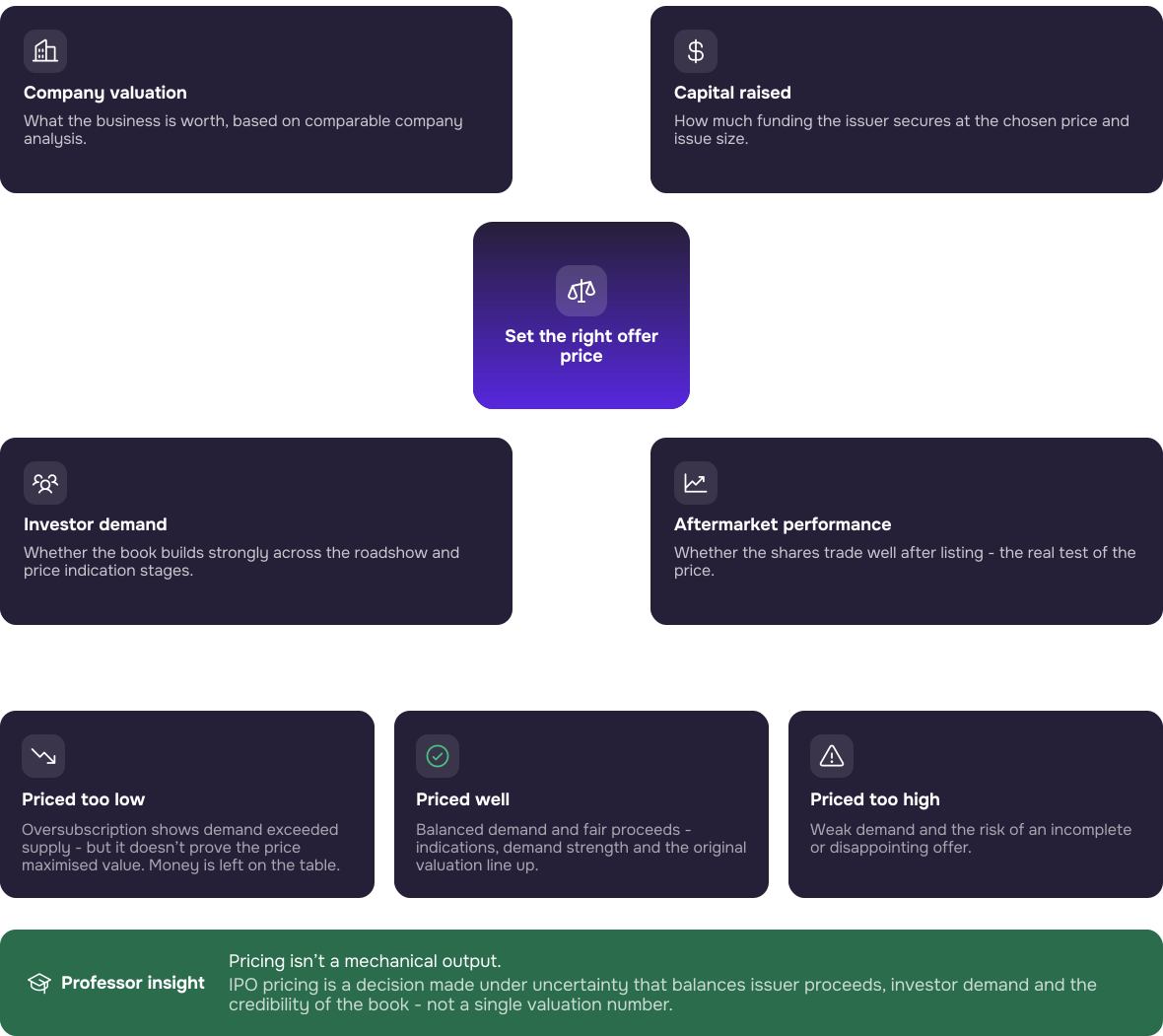


Students use their valuation outputs to determine a price range and offer size, then revisit their assumptions after observing investor demand.
Indicative orders and subscription coverage show how investor demand informs the Final Offer Price and the likelihood of completing the issue.
Professors can compare offer prices, subscription levels, capital raised, Investor bids and allocations across teams.
Professors control the pace and monitor team decisions from the Admin Panel. Students move from role guidance and case analysis to stage-specific decisions and final results.
View all seven stages, their timings and the current position in the simulation. Start automatic progression, pause when teams need additional time, stop for a longer break and adjust the timeline when required.
Add students, organise teams and assign Underwriter or Investor roles through Player Management. Professors can also use Login as Player to check what a particular student sees before or during the session.
Use Live Monitoring to follow team inputs and decision tables as the simulation develops. Broadcast alerts to all students, identify where clarification may help and gather evidence for the final debrief without directing teams towards a preferred decision.
Students review their Underwriter and Investor role, understand the objectives they are working towards and clarify the key valuation, pricing, bidding and allocation decisions they will need to make during the simulation.
Students use role-specific company information, downloadable Excel models and Data Room information to evaluate the IPOs. Underwriters analyse one company and prepare its offering, while Investors assess and compare all three opportunities.
Teams enter their prices, share quantities, firm bids and allocations through stage-specific input screens. They can follow relevant market information as it develops and review final pricing, subscription, capital invested and allocation results during Reflection.
Underwriters receive detailed company information and a valuation model for their assigned IPO. Investors initially receive more limited information and comparable-company data across all three companies, creating an information gap that is reduced through the roadshows and Data Room.
Professors can use the materials to discuss disclosure, management optimism, valuation assumptions and the quality of Investor questioning.
Students examine how geographic expansion, market access and expected growth support the company’s valuation.
Students consider how the proposed deployment of capital supports the company’s post-IPO strategy and investment case.

5 mins
Students watch a short video introducing the IPO process, their role, objectives and the decisions they will make during the simulation.
Assessment is optional. Professors may run the simulation as an ungraded applied activity, a formative exercise or one component of a wider assessment.
Platform data can support academic judgement, but team results should be considered alongside the quality of the students’ analysis, modelling, communication and decisions. Platform outputs should not automatically replace academic judgement.
Set up the teams, configure the timeline and start the sequence. The simulation can progress automatically, while the professor remains able to adjust the schedule, coach selectively and pause or stop the session when required.
Step 1
Organise students into teams of three to five. Assign three teams as the Underwriters for HealthCo, Techo and Utico Energy. The remaining teams act as Investors.
Step 2
Review the seven-stage timeline and adjust the schedule to match the teaching format and cohort.
Step 3
Select Play to start automatic progression. Use Pause when teams need additional time. Use Stop for a longer interruption.
Step 4
Review team inputs and decision tables. Intervene where students misunderstand the mechanics or need clarification, without directing them towards a preferred price or bid.
Everything needed to prepare, run and debrief the IPO Simulation is organised within the resources below.
The simulation is designed to be integrated into existing courses, either as in-classroom or as homework.
Option 1:
4 hours in one session. The simulation can be paused to allow short breaks. The facilitator may provide coaching during the simulation (optional).
Option 2:
Break up the simulation into smaller sessions:
• 4 x 1 hour
• 2 x 2 hours
The simulation can be paused at the end of each session and resumed at the next one. The facilitator may provide coaching during the simulation (optional).
Option 3:
Participants can complete the simulation as homework, with a set timeframe such as one day or one week determined by the facilitator.
Option 4:
Hybrid approach, beginning the simulation in a class setting and allowing participants to finish it independently.
These industry professionals were involved in the inception, creation, development, testing and optimisation of the simulation.

Investment banking, capital markets, PE, and corporate ratings experience at Morgan Stanley, S&P, and HPS Investment Partners. Holds a PhD in Quantitative Finance.

Senior investment banker at Morgan Stanley with experience in M&A and TMT coverage across New York and San Francisco. Studied business at Kellogg.

Assistant Professor of Finance at Tilburg University, teaching corporate finance courses. Also lectures at TIAS Business School.

Worked in the finance department of Precomp Tools. Studied Engineering and holds an MSc in Corporate Finance from Bayes.

Corporate finance experience across M&A, structured finance, credit risk, and leveraged finance at Morgan Stanley, SMBC, and Citi. Holds a BSc in Economics.
During the call, we can: