Apply CAPM and portfolio optimisation
Estimate expected returns, analyse covariance and determine portfolio weights.

Portfolio Management Simulation
Students apply CAPM and mean-variance optimisation to estimate expected returns, analyse portfolio risk and construct an equity portfolio across 25 global companies.
Each team manages a global equity portfolio from a distinct client perspective. Hedge Fund teams compete to generate higher Alpha, while Pension Fund teams compete to achieve a higher Sharpe Ratio.
Estimate expected returns, analyse covariance and determine portfolio weights.
Translate model outputs into equity selections, trades and revised allocations.
Compare return and volatility using Alpha or Sharpe Ratio within the relevant mandate.
Duration
The total time depends on the selected session format.
Format
Students collaborate to construct and manage an equity portfolio.
Level
Suitable for portfolio, asset and investment management teaching.
Syllabus fit
Covers expected return, beta, covariance, diversification, mean-variance optimisation, Alpha, Sharpe Ratio and rebalancing.
Prerequisites
Students need a basic understanding of CAPM, Sharpe Ratio and mean-variance optimisation.
Professor tools
Use participant management, timeline controls, class alerts and live decision monitoring.
Delivery
Run it in one session, across several classes or as a homework-supported activity.
Optional assessment
Use portfolio choices, trades and performance results to support academic judgement.
Diversification, risk measurement, optimisation and rebalancing work together to create a well-managed portfolio that balances risk and return.
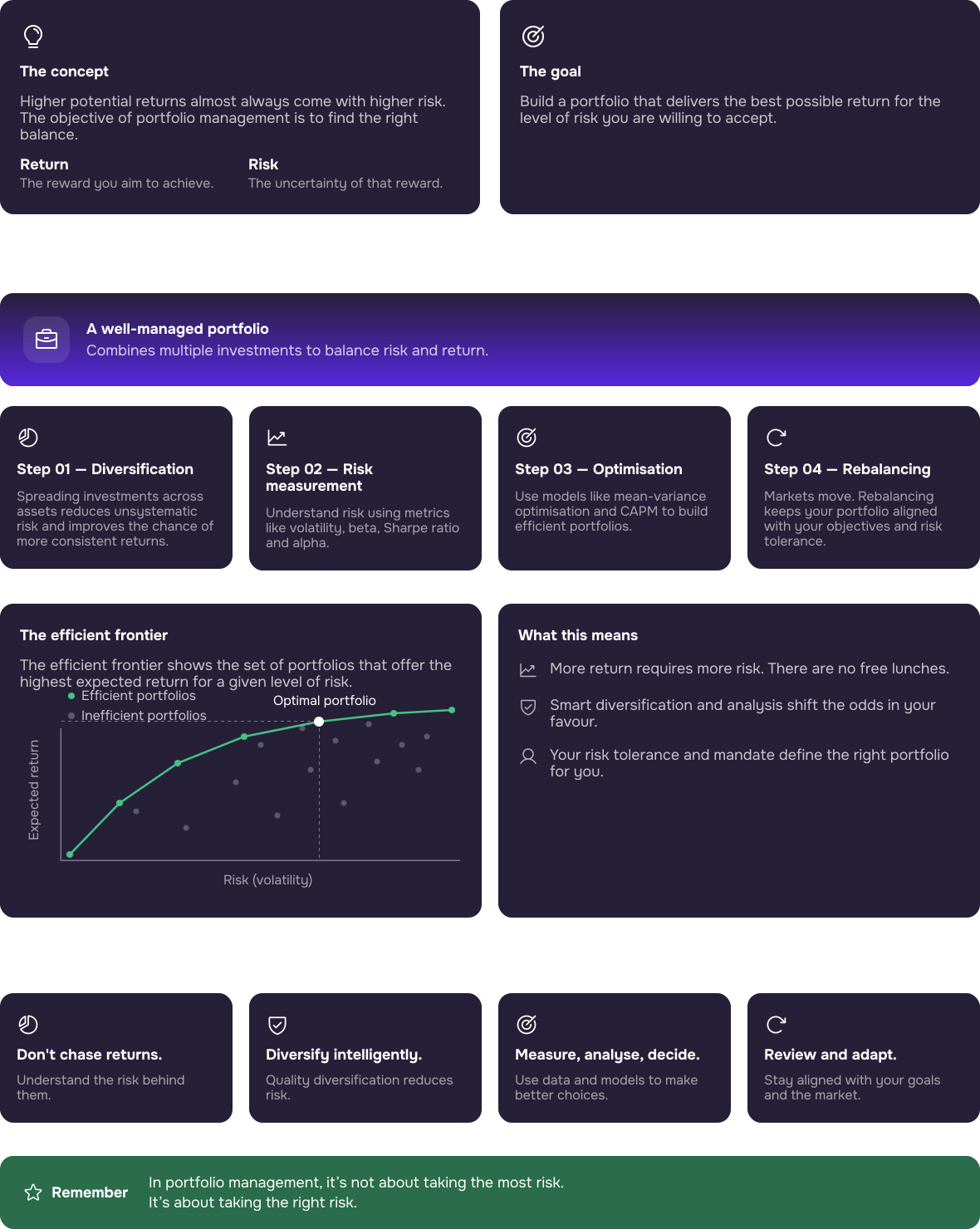


It connects technical portfolio concepts with visible choices, changing information and role-specific results.
Students calculate expected returns and portfolio risk, then decide how those outputs should influence security selection and portfolio weights.
Students see how concentration, covariance, volatility and new information affect the performance of an actual portfolio over time.
Holdings, trade history, return, volatility, Alpha and Sharpe Ratio give professors evidence for comparing strategies and questioning decisions.
The Professor Admin Panel supports setup, timing, participant management and monitoring. The Student Interface guides teams from analysis to portfolio construction, trading and final performance review.
View each stage and its duration, start automatic progression and adjust the pace where additional working time is needed.
Open Setup & Facilitation, Teaching Notes and the Gameflow Diagram directly from the Admin Guide.
Play starts automatic progression. Pause holds the timer in the current stage. Stop locks student screens.
Students examine the historical price series of each company before constructing their initial portfolio.
Students translate their analysis into action by buying and selling securities, adjusting portfolio weights and deciding whether to retain positions as market conditions change.
The leaderboard presents return and volatility together with separate rankings for Hedge Fund and Pension Fund teams.
Students receive quantitative market information and role-specific investment guidance. Historical data and the portfolio model support the calculation of expected return, covariance, volatility and portfolio weights. The mandate defines the client objective that should guide the team’s strategy.
Teams receive either a Hedge Fund or Pension Fund mandate that defines their objective, available choices and performance measure.
Students use CAPM guidance to estimate beta and expected return before considering how each security contributes to the portfolio.

7 mins
Students watch an introductory video explaining the simulation objectives, their assigned mandate, how performance is measured and what they need to do before the timed activity begins.
Assessment is optional. Professors may run the Portfolio Management Simulation as an ungraded applied activity focused on practice, comparison and debriefing.
Where assessment is appropriate, platform-generated portfolio data, trades and performance measures can support academic judgement. Simulation scores should be interpreted alongside the team’s analysis and decisions rather than automatically replacing the professor’s judgement.
The simulation progresses automatically after it is started. Coaching is optional, and professors can intervene when additional time, clarification or class communication is useful.
Step 1
Place students in teams of 3 to 5. Odd-numbered teams represent Hedge Funds and even-numbered teams represent Pension Funds.
Step 2
Review the default timeline and adjust stage durations where the class schedule requires a different pace.
Step 3
Select Play to begin automatic progression. Pause provides more working time. Stop suspends the activity and logs students out.
Step 4
Review team inputs, portfolio decisions and performance information. Coaching should help students test assumptions without recommending a preferred security or trade.
Everything needed to prepare, run and debrief the Portfolio Management Simulation is organised within the resources below.
The simulation is designed to be integrated into existing courses, either as in-classroom or as homework.
Option 1:
3 hours in one session. The portfolio management simulation can be paused to allow short breaks. The facilitator may provide coaching during the simulation (optional).
Option 2:
Break up the simulation into smaller sessions:
• 4 x 45 min
• 3 x 1 hour
• 2x 1.5 hours
The portfolio management simulation can be paused at the end of each session and resumed at the next one. The facilitator may provide coaching during the simulation (optional).
Option 3:
Participants can complete the simulation as homework, with a set timeframe such as one day or one week determined by the facilitator.
Option 4:
Hybrid approach, beginning the portfolio management simulation in a class setting and allowing participants to finish it independently.
These industry professionals were involved in the inception, creation, development, testing and optimisation of the simulation.

Former Practice Specialist in McKinsey’s Corporate Finance team in Germany and Finance professor at Aberdeen University.

Investment banking, capital markets, PE, and corporate ratings experience at Morgan Stanley, S&P, and HPS Investment Partners. Holds a PhD in Quantitative Finance.

Over 15 years of experience across advisory, PE, VC, family offices, and entrepreneurship. Covered M&A transactions from multiple angles and holds a PhD in Corporate Finance.

Senior investment banker at Morgan Stanley with experience in M&A and TMT coverage across New York and San Francisco. Studied business at Kellogg.

Structured finance, credit derivatives, and NPL expertise. Portfolio Director at a private equity impact fund and active VC investor. Holds CFA and FRM qualifications.
During the call, we can: