Totally Real
Built from real Morgan Stanley deal experience - real tasks, real sequence, real decisions. Not reconstructed from textbooks or generic scenarios.

With every simulation, we try to replicate real workflows, real information flows, and real consequences as closely as possible.
Participants face the same pressures, ambiguity, deadlines, and decision-making challenges they would encounter in the real world.
Our Core Principles
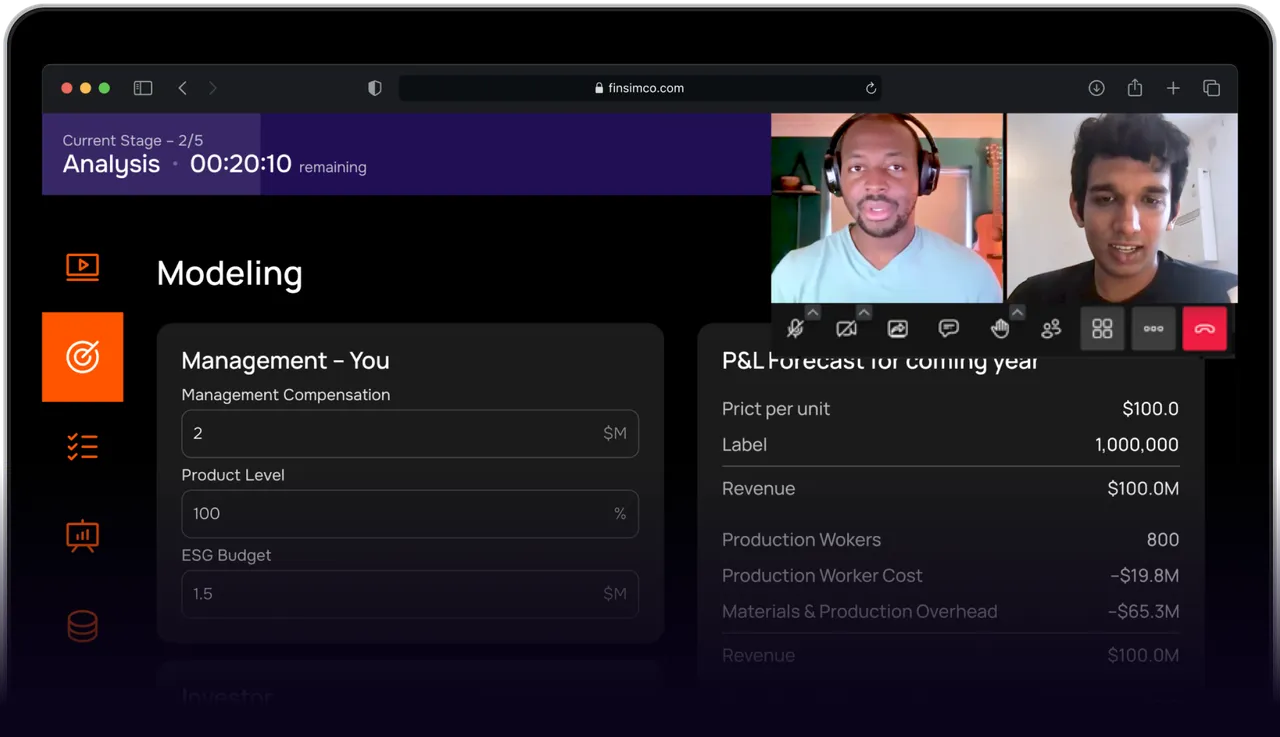
Built from real Morgan Stanley deal experience - real tasks, real sequence, real decisions. Not reconstructed from textbooks or generic scenarios.
Participants collaborate and compete against each other inside the same cohort. That is what produces engagement and surfaces performance data.
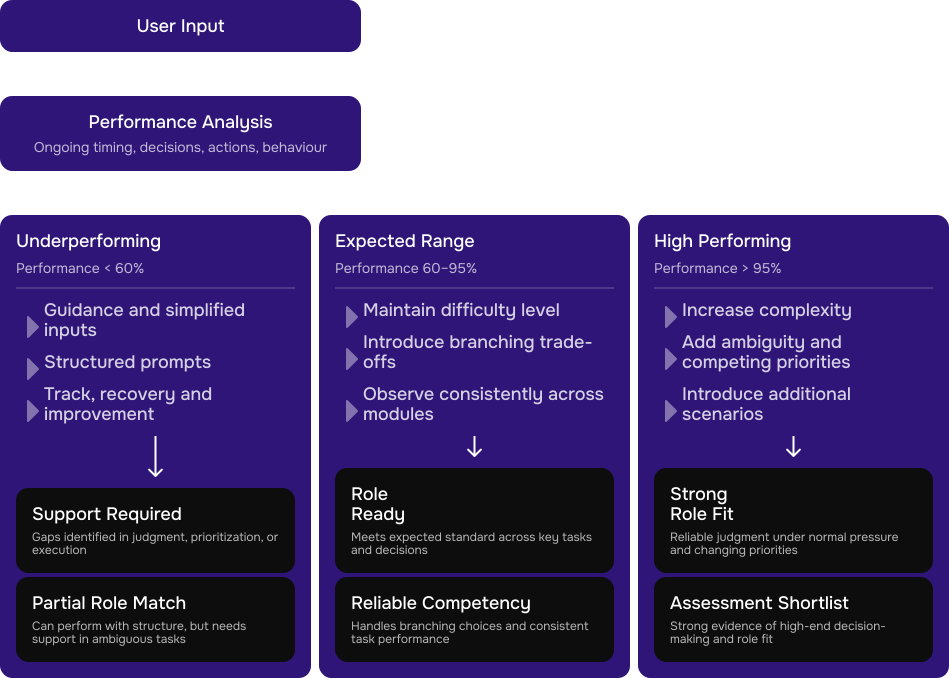
Our simulations are built on branching logic and scenario-based pathways to adjust the experience in real time based on user input and performance.
The simulation:
Calibrating an adaptive simulation is exponentially harder than calibrating a linear one. Every branch has to land somewhere challenging but plausible. Each additional layer of branching multiplies the calibration surface, and the only way to get it right is sustained iteration with real users across many cohorts. The branch library behind the platform has been built and validated that way to protect both the realism of the experience and the quality of the performance data it produces.
The placement of a curveball matters as much as the curveball itself. Introduce an event too early and the participant has not yet built the footing to engage with it. Introduce it too late and it loses its diagnostic value. The early minutes of every simulation are designed to bring the participant into flow, oriented to the role, comfortable with the interface, focused on the work, and only then do the disruptions begin. Getting this timing right inside an adaptive simulation, where every participant reaches flow at a slightly different moment, is one of the harder problems in this space.

A great simulation feels simple. That simplicity is the hardest part to build. In the opening minutes especially, the role, the objective, and the next action have to be unmistakable. We arrive at that clarity only through repeated cycles of user testing, making small adjustments to layout and pacing until the user has a clean and frictionless experience.
We gradually immerse participants into realistic workplace environments. While we aim to do this quickly to create a sense of challenge, we have to be careful not to overwhelm users too early in the experience. We use media and storytelling to make it feel as if you've stepped into your job role - whether it's through realistic graphics, authentic scenarios, or audio/visual elements that mimic the workplace. This high level of realism helps users suspend disbelief and truly invest in the scenario.
Users that feel in control rate the simulation experience much higher, we try to apply an easy-to-use design so that users can navigate confidently through the simulation.


Not every simulation uses AI. We start with a human-centered design approach and use AI only where it adds clear value to the experience. In some simulations, that means making interactions more realistic and responsive. In others, it means helping tailor challenge, pacing, and support to the user. In assessment contexts, our model analyses decisions, written inputs, communication, and behavioral patterns against a pre-trained model of correctness, strong judgment, and effective role-specific behavior.
This allows us to use AI across both training and assessment in a practical way. For learning, it helps adapt scenarios, tailor coaching, and make practice feel more dynamic and relevant. For assessment, it helps benchmark performance more consistently, evaluate how someone thinks rather than just what answer they choose, and generate clearer signals on readiness, potential, and fit.
The system analyzes how users think, prioritize, and navigate trade-offs – not just whether they reach the correct answer.
In training, AI adjusts pacing, complexity, and support to push participants to the right level. In assessment, it introduces the right level of challenge to reveal true capability.
User behavior is compared against patterns derived from high-performing professionals and role-specific expectations.
Written and conversational inputs are evaluated for clarity, structure, and effectiveness – critical for both development and hiring decisions.
The system tracks whether strong performance is repeatable or situational, and whether a participant is improving across rounds or plateauing.
For recruiters: clear signals on role fit, potential, and risk areas. For L&D teams: targeted insights on skill gaps, progression, and readiness.

96 SEC
Reach out to us to explore how we can tailor a simulation to your needs - quickly, affordably, and at scale.
Every Finsimco simulation is configured to fit your organisation: the roles, the workflows, the assessment criteria, and the situations participants will actually encounter.
New builds do not start from scratch. Simulations are assembled from pre-built, validated components. That reduces build time without reducing specificity.
Scenarios, decision trees, and performance benchmarks are configured to reflect your roles, workflows, and assessment criteria. Participants work through the situations they will actually encounter.
Every user interaction is logged, including timing, inputs, and changes across the simulation. The data is granular enough to support hiring decisions and specific enough to direct individual coaching.
Scenario paths evolve based on what each participant does. The simulation does not follow a fixed path.
Our simulations are built for finance and professional services. We try to recreate the complexity, sequence, and dependencies of actual work as closely as possible. The engine adapts in real time based on participant inputs, and every interaction feeds performance data you can act on – whether that's hiring decisions or learning feedback loops.


