Assess industry attractiveness
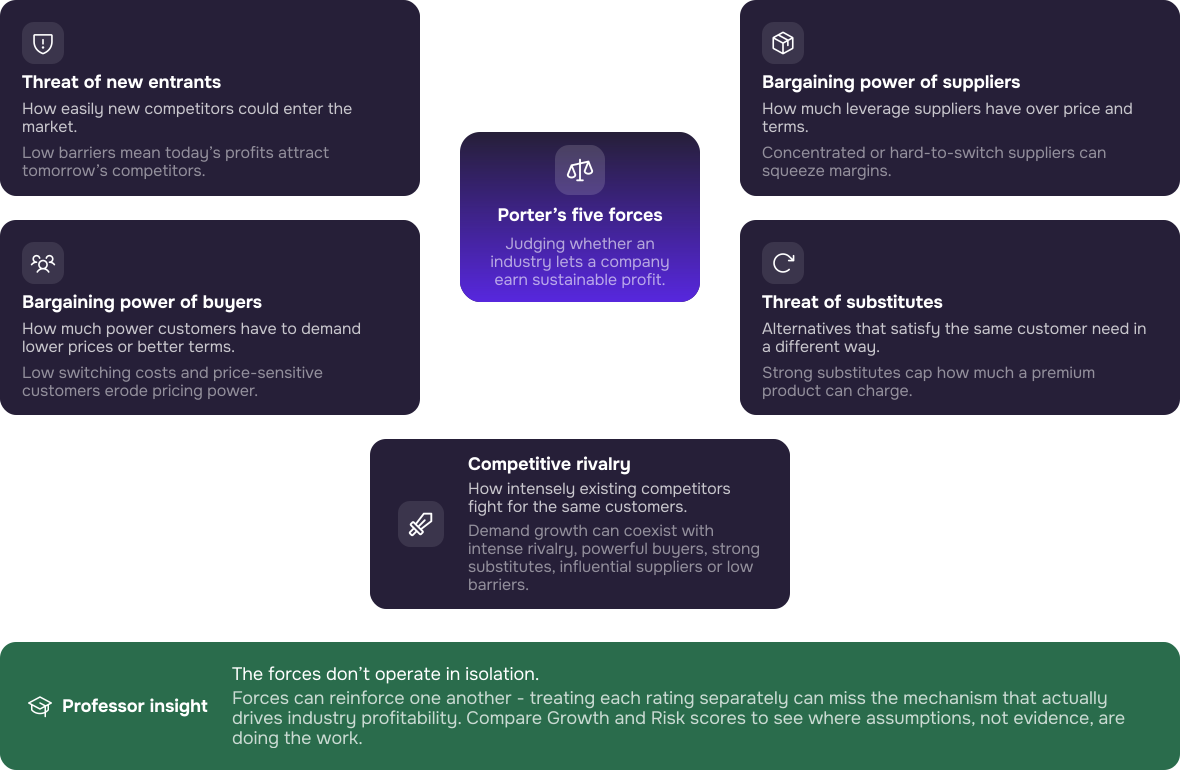
Evaluate entry, suppliers, buyers, substitutes and rivalry as one connected system.

Porter's Five Forces Simulation
Students assess the attractiveness of the US premium café industry using Porter’s Five Forces, then recommend whether a company should enter the market.
Students use the standard five-force framework, link industry structure to profitability and defend a market-entry recommendation.
Evaluate entry, suppliers, buyers, substitutes and rivalry as one connected system.
Use case evidence and concise written reasoning to support each judgement.
Challenge assumptions and determine whether the expansion should proceed.
Duration
Includes case briefing, team analysis, Investment Committee discussion and debrief.
Format
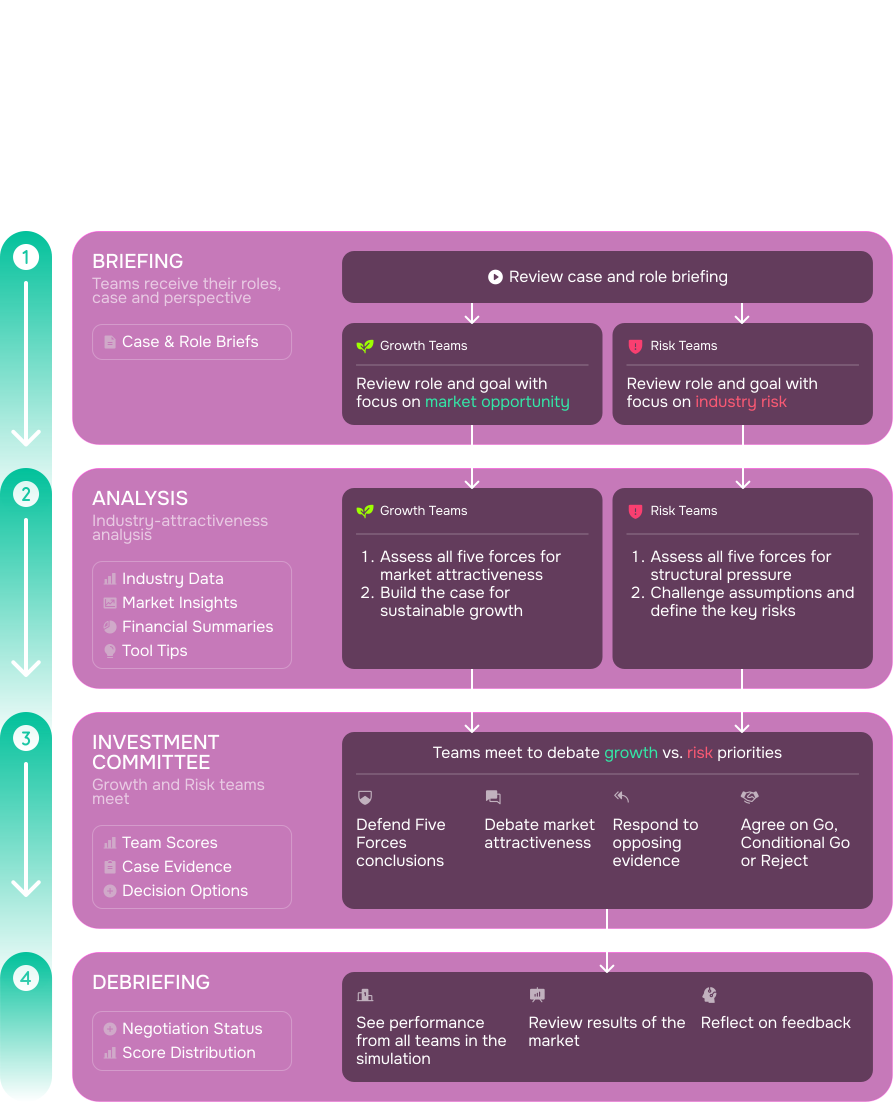
Growth and Risk teams assess the same market before comparing their recommendations.
Level
Use in strategy, marketing strategy, industry analysis or market-entry teaching.
Professor tools
The dashboard includes the Admin Guide, Teaching Notes, Player Management and Live Monitoring.
Prerequisites
Students should know the purpose and basic structure of Porter’s Five Forces.
Delivery
Use the digital interface in the teaching format that suits your module.
Assessment
Use the platform data as supporting evidence or run the simulation as an ungraded applied class.
Course Fit
Designed for Strategic Management, Competitive Strategy, Marketing Strategy, International Business and Market Entry courses.
Students assess how new entrants, suppliers, buyers, substitutes and competitive rivalry interact to influence industry profitability. The forces should be interpreted together, while comparing where Growth and Risk teams make different assumptions.

Each benefit maps to a familiar teaching need: full-framework application, links to profitability and evidence for debrief.
Students assess all five forces and bring them together in one industry-attractiveness judgement.
Teams explain how competitive pressure affects pricing power, margins and the ability to scale.
Scores, written reasoning and final recommendations give you clear points for comparison and feedback.
The professor view keeps the teaching sequence and resources in one place. The student view moves from mission to analysis to decision without adding a separate worksheet.
Configure the timing for Intro, Analysis, Investment Committee and Reflection, then manage the activity from one timeline.
Open setup guidance, teaching notes and the gameflow without leaving the professor dashboard.
Review team progress, force scores and submitted reasoning so you can identify where a timely prompt may help.
Students are introduced to BrewSphere, their Growth or Risk perspective and the decision they must make about entering the U.S. premium café market.
Students score new entrants, supplier power, buyer power, substitutes and rivalry across each of the factors, supporting each judgement with case evidence.
Teams bring their five-force analysis into the Investment Committee and argue for a Go, Conditional Go or Reject decision.
Students work with a shared business case and role-specific Growth and Risk intelligence. The documents combine market evidence, charts and strategic arguments that students must translate into force scores and a recommendation.
Evidence that supports market entry, including scale advantages, repeat demand and BrewSphere’s operating model.
Evidence that tests market entry, including low entry barriers, cost pressure, switching and persistent rivalry.

5 mins
Watch the briefing students see at the start of the simulation. In under five minutes, it introduces the case, clarifies the strategic challenge and prepares both roles to analyse evidence and defend a decision.
Assessment is optional. The simulation can be run as an ungraded applied class. Team scores, written reasoning and final outcomes can support your academic judgement, but they should not replace it.
The dashboard supports four practical tasks: organise the roles, set the timing, start the session and prepare the debrief.
Step 1
Organise the class into the two perspectives and explain the shared market-entry question.
Step 2
Review Intro, Analysis, Investment Committee and Reflection, then adjust the available time.
Step 3
Launch the simulation from the timeline and use the visible Play and Stop controls.
Step 4
Use Live Monitoring during the activity and Reflection outputs afterwards. Coaching is optional.
Everything needed to prepare, run and debrief the Porter's Five Forces Simulation is organised below.
The Porter's Five Forces simulation is designed to be integrated into existing courses, either as in-classroom or as homework.
Option 1:
3 hours in one session. The Porter's Five Forces simulation can be paused to allow short breaks. The facilitator may provide coaching during the simulation (optional).
Option 2:
Break up the simulation into smaller sessions:
• 4 x 45 min
• 3 x 1 hour
• 2 x 1.5 hours
The simulation for Porter's Five Forces can be paused at the end of each session and resumed at the next one. The facilitator may provide coaching during the simulation (optional).
Option 3:
Participants can complete the simulation as homework, with a set timeframe such as one day or one week determined by the facilitator.
Option 4:
Hybrid approach, beginning the simulation in a class setting and allowing participants to finish it independently.
These industry professionals were involved in the inception, creation, development, testing and optimisation of the simulation.

Investment banking, capital markets, PE, and corporate ratings experience at Morgan Stanley, S&P, and HPS Investment Partners. Holds a PhD in Quantitative Finance.

Over 15 years of experience across advisory, PE, VC, family offices, and entrepreneurship. Covered M&A transactions from multiple angles and holds a PhD in Corporate Finance.

Worked in the finance department of Precomp Tools. Studied Engineering and holds an MSc in Corporate Finance from Bayes.

Senior investment banker at Morgan Stanley with experience in M&A and TMT coverage across New York and San Francisco. Studied business at Kellogg.
During the call, we can: