Four perspectives
Different priorities and supporting evidence.

ESG Simulation
Students apply ESG principles to a live stakeholder discussion, connecting environmental, social and governance choices with financial and operational outcomes.
The ESG Simulation is a two to four hour, team-based simulation in which students represent Management, Investor, Regulator and Union stakeholders responding to a major sustainability challenge. Students analyse role-specific evidence, model the financial and operational impact of different choices, negotiate environmental, workforce and funding terms, and agree an ESG Policy Statement while keeping the company financially viable.
Different priorities and supporting evidence.
Funding, production, pollution, wages and ESG expenditure interact.
The final decision requires all four stakeholder teams.
Duration
Run the simulation as an intensive activity or divide it across several teaching sessions.
Format
Students prepare within stakeholder teams before negotiating one shared agreement.
Level
Vary the expected depth of analysis and reflection for the course level.
Professor tools
Control the timeline, adjust timings, manage participants, send alerts and monitor decisions.
Prerequisites
No specialist prerequisite knowledge is required.
Delivery
The web-based simulation supports several confirmed delivery formats.
Optional assessment
Run it ungraded or use decisions, final terms and comparative results as supporting evidence.
Course fit
Suitable for ESG, sustainability, responsible business, governance and stakeholder-management teaching.
Environmental, social and governance priorities are negotiated by Management, Investor, Regulator and Union teams. The central challenge is balancing stakeholder objectives with financial viability, including the requirement to keep EBITDA above $20 million.
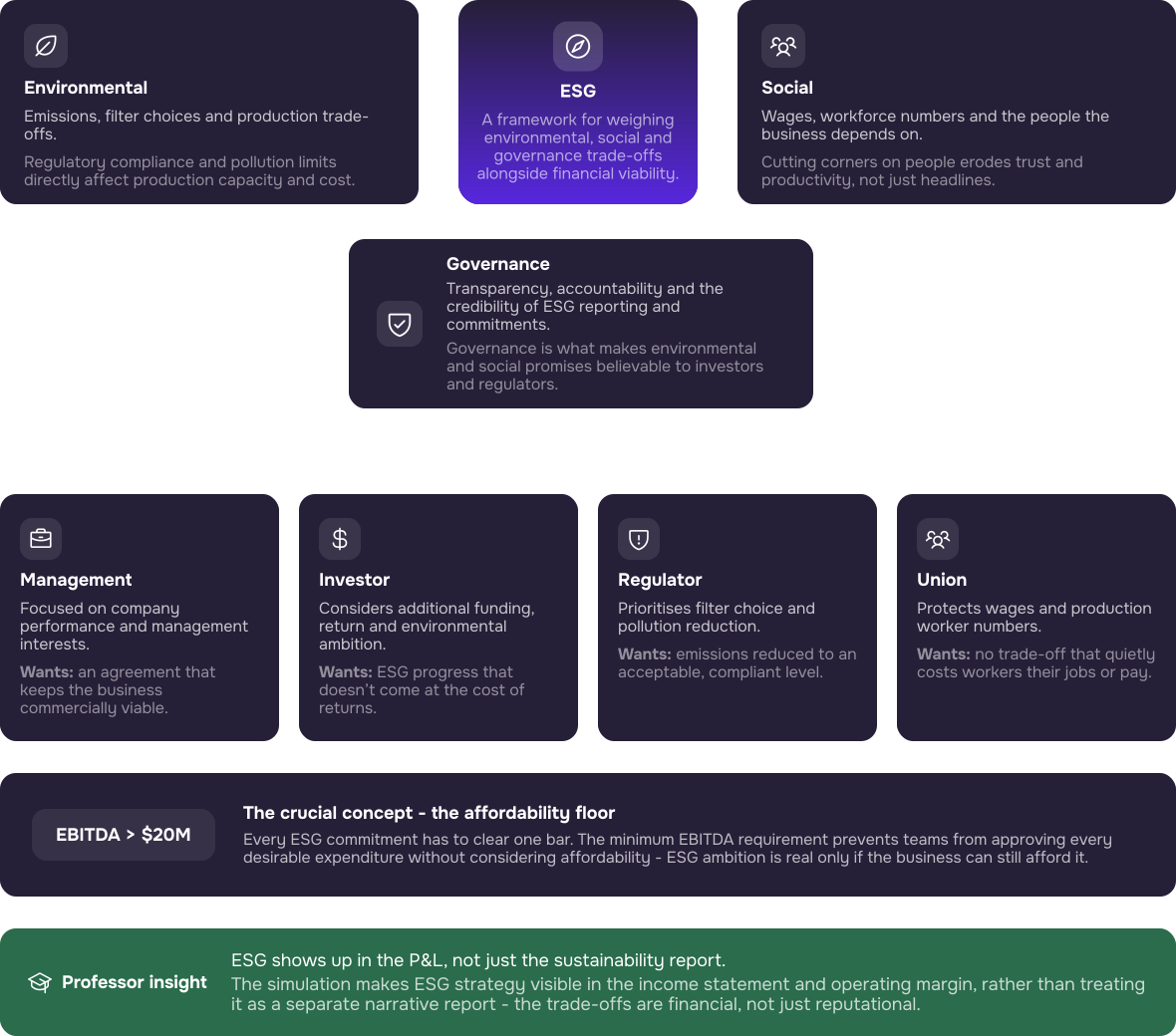


Help students apply familiar ESG concepts to a realistic stakeholder negotiation. It gives professors a structured way to teach trade-offs, financial viability, collaborative decision-making and evidence-based reflection.
Students connect environmental regulation, workforce outcomes and governance commitments with production, funding, EBITDA and investor returns.
Four stakeholder teams defend different objectives, allowing students to experience conflict, compromise and collective decision-making.
Submitted terms, agreement outcomes and same-role comparisons give you concrete evidence for a focused class discussion.
The Professor Admin Panel brings the timeline, session controls, students management and teaching guidance into one place. The Student Interface leads students from analysis to structuring and finally to the performance reflection.
Set the duration of each stage, start the activity and manage progression from one timeline.
Open the Setup & Facilitation guide and Teaching Notes directly from the Admin Panel. The Gameflow Diagram is available in the same Admin Guide area.
Play starts automatic progression. Pause holds the timer in the current stage. Stop locks student screens.
Students review their assigned role, understand the objectives they are expected to protect and identify the evidence and decisions they will need to prepare before the negotiation begins.
Teams bring prepared positions into a shared negotiation, contribute to the ESG Policy Statement and decide whether the complete package is acceptable.
At Reflection, students compare outcomes with teams that represented the same stakeholder in other negotiation groups.
Students receive a common case context and tailored role information. The materials combine quantitative evidence, such as financial and operating data, with qualitative stakeholder arguments and policy information. Teams identify the evidence relevant to their role, test its implications and use it to support a credible negotiating position.
Review how G1, G2 and G3 affect emissions, production and the terms available to the company.
Compare Innocent Corp with peer companies when assessing Management’s proposed terms.

9 mins
Students watch this short introduction to understand the ESG challenge, the stakeholder roles, objectives and key tasks before the simulation begins.
Assessment is optional. Professors may run the ESG Simulation as an ungraded applied activity focused on analysis, modelling, negotiation and reflection. Platform data can support academic judgement, but simulation results should not automatically replace a professor’s rubric, observation or review of the underlying decisions.
The simulation can progress automatically after "Play" is selected or be advanced manually through the timeline. Coaching is optional, allowing professors to intervene only when clarification or reflection would add value.
Step 1
Create negotiation groups containing Management, Investor, Regulator and Union teams. Confirm that each participant can access the correct role.
Step 2
Set the stage durations and adapt the activity for one workshop or several teaching sessions.
Step 3
Use Play to begin automatic progression. Pause for discussion, use Stop to lock student screens without resetting data, and select Play again to resume.
Step 4
Review team inputs and decision tables, coach selectively and use the final outcomes to prepare Reflection.
Everything needed to prepare, run and debrief the ESG Simulation is organised within the resources below.
The ESG simulation is designed to be integrated into existing courses, either as in-classroom or as homework.
These industry professionals were involved in the inception, creation, development, testing and optimisation of the simulation.

Former Practice Specialist in McKinsey’s Corporate Finance team in Germany and Finance professor at Aberdeen University.

Over 15 years of experience across advisory, PE, VC, family offices, and entrepreneurship. Covered M&A transactions from multiple angles and holds a PhD in Corporate Finance.

Investment banking, capital markets, PE, and corporate ratings experience at Morgan Stanley, S&P, and HPS Investment Partners. Holds a PhD in Quantitative Finance.

Structured finance, credit derivatives, and NPL expertise. Portfolio Director at a private equity impact fund and active VC investor. Holds CFA and FRM qualifications.

Senior investment banker at Morgan Stanley with experience in M&A and TMT coverage across New York and San Francisco. Studied business at Kellogg.
During the call, we can: