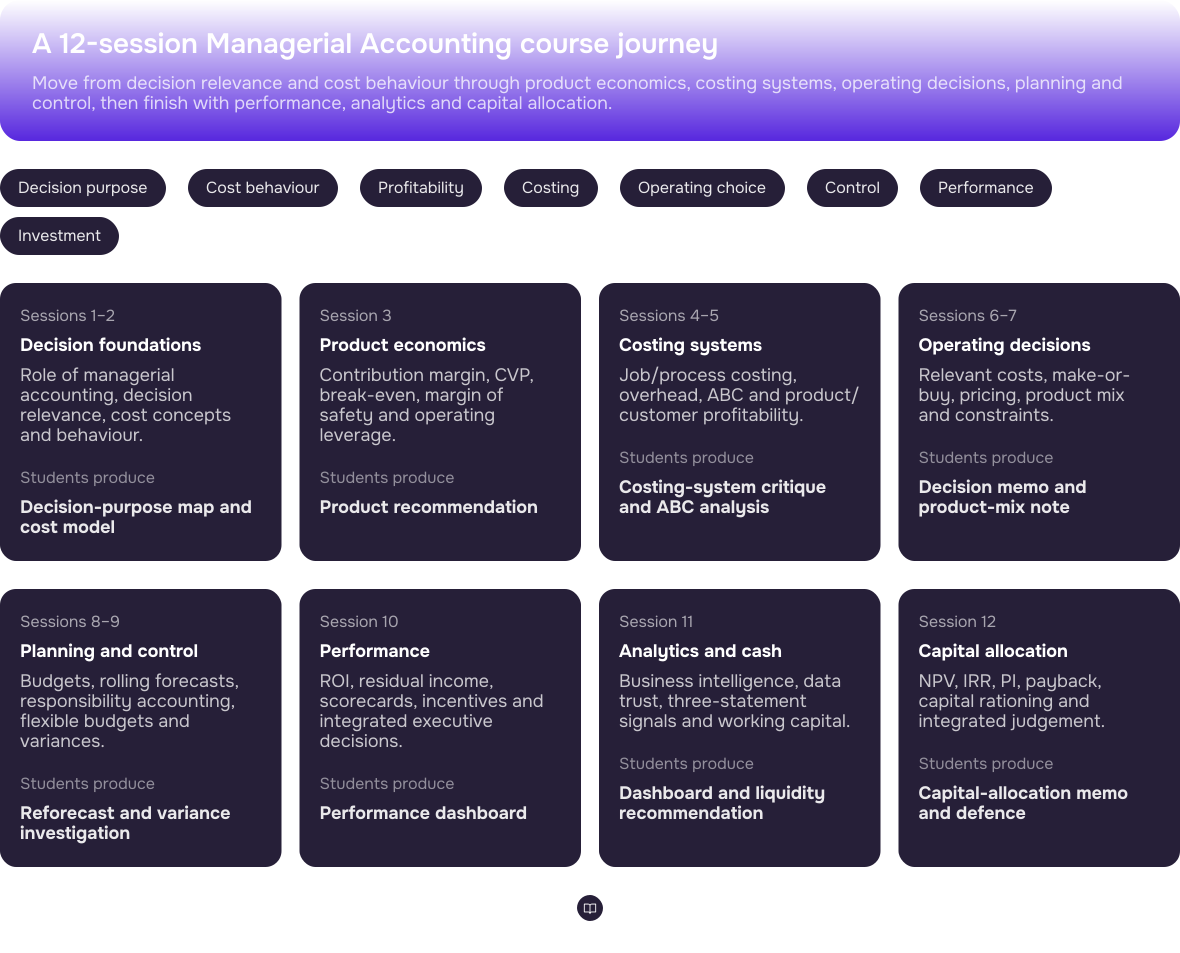
Session | Topic | Teaching focus | Student activity | Best-fitting simulation, where relevant | Assessment or output |
|---|
1 | Managerial accounting as decision support | Decision relevance, internal versus external information, ethics, planning, control and the management accountant role. | Students classify information by decision purpose and write a short management recommendation. | | Decision-purpose map and 300-word memo. |
2 | Cost concepts, behaviour and estimation | Fixed, variable, mixed and step costs; cost drivers; relevant range; basic data analytics and cost estimation. | Fit and critique a simple cost function, then identify what would invalidate it. | | Cost-behaviour model with assumptions note. |
3 | CVP, contribution margin and operating leverage | Contribution margin, break-even, target profit, margin of safety, sales mix and operating leverage. | Compare two product economics and defend a launch or discontinuation decision. | Managerial Accounting (formative option) | CVP product recommendation. |
4 | Job, process and overhead costing | Job and process costing, predetermined overhead, capacity and allocation choices. | Recalculate product costs under alternative allocation bases. | | Costing-system critique. |
5 | Activity-based costing and profitability | Activity pools, cost drivers, customer/product profitability and activity-based management. | Build a short ABC model and recommend one commercial or process response. | Managerial Accounting (optional consolidation) | ABC profitability analysis. |
6 | Relevant costs and short-term decisions | Make-or-buy, special orders, discontinuation, opportunity cost and qualitative factors. | Work through a constrained make-or-buy decision and defend the recommendation. | | Relevant-cost decision memo. |
7 | Pricing, product mix and constraints | Target costing, contribution per limiting factor, bottlenecks and strategic pricing. | Optimise a product mix under a capacity constraint, then challenge the result with a strategic condition. | | Pricing and product-mix note. |
8 | Budgeting, forecasting and responsibility accounting | Master budgets, rolling forecasts, responsibility centres, controllability and behavioural effects. | Rebuild a plan after a demand shock and separate forecast, target and control budget. | | Reforecast and responsibility map. |
9 | Flexible budgets and variance analysis | Static versus flexible budgets; materials, labour and overhead variances; management by exception. | Calculate selected variances, propose causes and specify evidence needed to test them. | | Variance investigation report. |
10 | Performance measurement and integrated managerial decisions | ROI, residual income, balanced scorecard, customer/product metrics and incentive effects. | Compare divisional and corporate investment incentives, then complete an integrated applied decision. | Managerial Accounting | Performance dashboard plus simulation decision evidence. |
11 | Analytics, financial signals and working capital | Dashboards, business intelligence, three-statement signals, cash conversion cycle and data quality. | Diagnose a profitable but cash-constrained business and redesign a six-metric dashboard. | Financial Statement Analysis / Working Capital Management (optional) | Dashboard and liquidity recommendation. |
12 | Capital budgeting, capital rationing and course integration | Relevant project cash flows, NPV, IRR, PI, payback, portfolio selection and post-audit thinking. | Appraise competing projects, allocate constrained capital and defend the portfolio. | Capital Budgeting | Capital-allocation memo and individual defence. |