Why this course matters
- Corporate finance
- Economics
- Investments
- Accounting
- Strategy
Introduction to Finance connects accounting, economics, investments, corporate finance and strategy, which is why it works as a foundational business-school course.
Course Guide
A practical, ready-to-adapt guide for designing or refreshing an Introduction to Finance course. It brings together course positioning, constructively aligned intended learning outcomes, twelve core concepts with teaching notes, a 12-session syllabus, applied simulations, recent readings, case studies and assessment guidance.
teach Introduction to Finance as a named or closely related course
sessions as the most common course-design model
taught at undergraduate level
taught at postgraduate or MBA level (levels overlap)
offered as core or foundation; the rest elective
include an applied or experiential component
Introduction to Finance connects accounting, economics, investments, corporate finance and strategy, which is why it works as a foundational business-school course.
How well this course prepares students for six role families, scored out of 10. Indicative, based on how directly the concepts map to each path - not a placement statistic.
Each is mapped to the session where students already hold the concepts to make a defensible decision, rather than added as an activity at the end.
This guide is for professors, lecturers, educators, module leaders, unit convenors, instructors of record and programme directors designing or refreshing an Introduction to Finance, Business Finance, Financial Management or finance-for-non-finance course. It is written to travel across course, module and unit terminology and across undergraduate, postgraduate and executive formats.
It is especially useful when you need a coherent set of intended learning outcomes, contact-hour logic, credit-value rationale, assurance-of-learning evidence and applied assessment. The architecture is designed so that each calculation leads to an observable decision or output rather than becoming a disconnected techniques class.
An Introduction to Finance course covers how organisations and investors allocate capital under time, risk and information constraints. Students move from the role of finance and interpretation of financial statements into time value of money, interest rates, bond and equity valuation, capital budgeting, risk and return, diversification, CAPM and the cost of capital, then into financing choices and working-capital management.
The course should repeatedly distinguish calculation from decision. NPV is not the project, WACC is not a universal hurdle rate, a ratio is not a diagnosis and debt is not automatically better because its quoted cost is lower. Students should leave able to calculate core measures, explain what drives them, identify fragile assumptions and make a defensible recommendation using financial evidence.
A one-screen planning view for a course or module approval form. The detailed teaching logic, activities and evidence sit in the sections below.
Planning area | Suggested approach |
|---|---|
Best fit | First- or second-year undergraduate business students, non-finance majors, conversion MSc or MBA foundation cohorts, and executive finance-for-non-finance formats. |
Typical length | 10, 12 or 14 teaching sessions, with 12 as the standard model. Roughly 24-36 contact hours plus independent study within about 150-180 notional learning hours for a semester module, subject to local credit rules. |
Course role | Usually a core or foundation course that prepares students for Corporate Finance, Investments, Financial Management, Accounting, Strategy and later specialist electives. |
Useful prerequisites | Basic algebra, percentages and spreadsheet use. Prior accounting is helpful but not essential if the three statements are taught early. |
Main student output | A CFO-style financial decision memo supported by calculations, assumptions, sensitivities and a clear recommendation, with applied outputs produced across the course. |
Best assessment fit | One group applied output carrying most of the summative weight plus an individual calculation, assumptions note, reflection or short oral defence that produces attributable evidence. Most courses use two assessment points rather than every format listed below. |
Best simulation fit | Time Value of Money after TVM teaching; Financial Statement Analysis after statement analysis; Capital Budgeting after project appraisal; Portfolio Management after CAPM; Debt Financing after capital structure; Working Capital Management after liquidity and CCC teaching. |
These intended learning outcomes are written for constructive alignment and use assessable verbs. Bloom's taxonomy is useful here as a check: early outcomes establish explanation and calculation, while later outcomes require analysis, evaluation and defence. Each outcome can generate evidence for course review through a problem set, case, simulation, memo or oral challenge.
The structure reflects patterns commonly seen in Ivy League and leading global business-school courses on introductory finance and related modules such as Corporate Finance, Financial Management and Investments. This is a course-design pattern, not a claim that every leading school uses the same sequence.
There are twelve core concepts in this Introduction to Finance course. They progress from the financial system and cash-flow evidence into valuation, project selection, risk, required return, financing, liquidity and an integrated decision.
1. The financial system and the role of finance
2. Financial statements and cash-flow analysis
3. Time value of money
4. Interest rates, bonds and debt securities
5. Equity valuation and market pricing
6. Capital budgeting and project appraisal
7. Risk, return and diversification
8. CAPM, required return and the cost of equity
9. Weighted average cost of capital and hurdle rates
10. Capital structure and financing choices
11. Working capital and short-term financial management
12. Integrated financial decision-making, ethics and governance
Each concept is organised around a central teaching question, observable learning outcomes, a runnable fictional mini-case and a clear route into the next decision.
The alignment map below keeps the course from becoming a sequence of unrelated calculations. Every stage leaves behind a formative or summative output that a lecturer can observe, moderate and connect to the final decision task.
Stage of financial work | Principal concepts | Expected student output | Assessment evidence |
|---|---|---|---|
Frame the finance setting | Financial system, objectives, agency and statements (1-2) | Financial system map and evidence-based business diagnosis | Low-stakes concept check plus short ratio commentary. |
Put cash flows on a common basis | TVM, rates, bonds and equity valuation (3-5) | TVM worksheet, bond price and valuation range | Individual calculations plus assumptions note. |
Choose investments | Capital budgeting and capital rationing (6) | Project ranking and CFO recommendation | Applied project appraisal or simulation evidence. |
Price and manage risk | Risk, diversification, CAPM and WACC (7-9) | Portfolio rationale and hurdle-rate note | Portfolio task plus calculation defence. |
Choose financing and protect liquidity | Capital structure, debt and working capital (10-11) | Financing recommendation and working-capital policy | Group negotiation or policy output plus individual reflection. |
Integrate the decision | Ethics, governance, incomplete information and capstone judgement (12) | Final CFO decision memo and oral defence | Summative applied output plus attributable individual evidence. |
The architecture can serve first-year or second-year undergraduates, conversion postgraduate cohorts, MBA foundations and executive education. The topics do not need to change radically. What changes is scaffolding, technical depth and the amount of ambiguity students are expected to resolve.
Undergraduates usually benefit from defined datasets, explicit timelines and formula support before judgement is introduced. MSc, MBA and executive cohorts can move faster through mechanics and spend more time defending assumptions, negotiating terms and deciding what information is missing. That raises cognitive demand without turning the course into a different subject.
Course design area | Undergraduate version | Postgraduate / MBA / executive version |
|---|---|---|
Course emphasis | Build financial intuition and reliable technique before adding ambiguity. | Move quickly through mechanics and spend more time on assumptions, evidence quality, model limits and managerial trade-offs. |
Scaffolding | Give defined datasets, formula support, worked examples and explicit questions. | Use incomplete datasets, competing assumptions and decisions in which students must decide what evidence is missing. |
Technical depth | TVM, statement analysis, project appraisal, CAPM, basic WACC, financing and working capital. | Add richer sensitivity work, capital constraints, financing negotiation, portfolio mandates and fuller scenario analysis. |
Cognitive demand | Calculate, interpret and recommend using structured prompts. | Critique, prioritise, negotiate and defend under challenge. |
Reading load | Textbook chapters, short research readings and structured preparation questions. | More journal articles, live filings, practitioner evidence and student-led source selection. |
Assessment | One applied group output plus an individual calculation or assumptions component. | Applied group decision plus individual memo, viva or oral defence with stronger weighting on judgement. |
Simulation use | Use guided preparation, clear task sequencing and a structured debrief. | Use simulations as evidence-rich decision pressure with more open-ended debrief and stronger individual attribution. |
The 12-session model follows a finance decision lifecycle: frame the purpose, read the financial evidence, put cash flows on a common basis, value securities, choose projects, price risk, set hurdle rates, choose financing, manage liquidity and integrate the decision. It can be used in weekly, intensive or blended delivery.
The design principle worth keeping if you change nothing else is to make most sessions produce something observable. A calculation, assumption note, recommendation, simulation output or short defence gives students repeated practice and gives lecturers evidence before the final summative task.
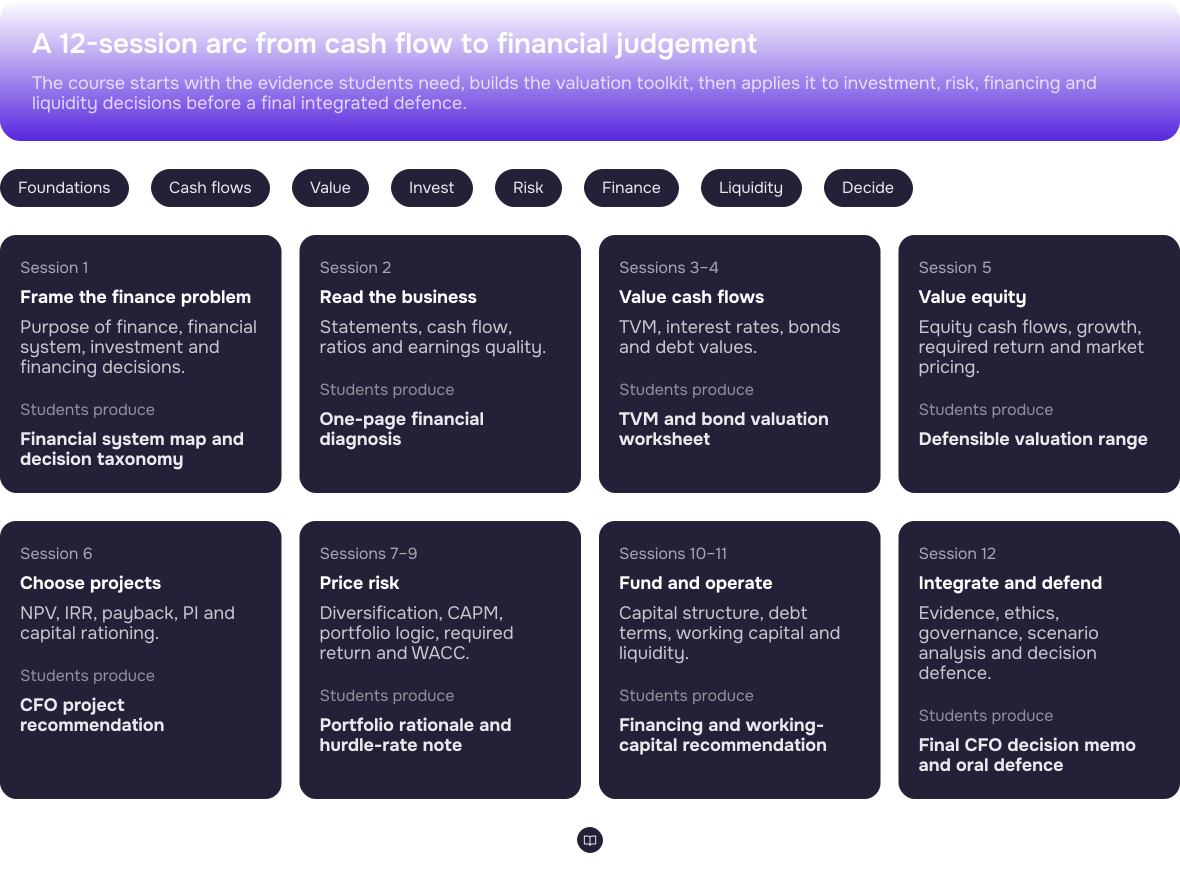
Use the visual arc above as a teaching overview and the detailed table below as the operational syllabus.
Session | Topic | Teaching focus | Student activity | Best-fitting simulation, where relevant | Assessment or output |
|---|---|---|---|---|---|
1 | Finance, the financial system and financial decisions | Purpose of finance, financial manager, markets, intermediaries, investment vs financing, agency and governance. | Map capital flows and classify a set of company decisions. | Financial system map and a short decision taxonomy. | |
2 | Financial statements, ratios and cash-flow analysis | Connect the income statement, balance sheet and cash flow statement; introduce focused profitability, liquidity, efficiency and solvency measures. | Diagnose why a profitable company is becoming cash constrained. | One-page financial diagnosis with ratios and evidence gaps. | |
3 | Time value of money | Present and future value, compounding, discounting, annuities, perpetuities and effective rates. | Draw cash-flow timelines, select methods and solve mixed TVM problems. | TVM calculation set plus an error log explaining method selection. | |
4 | Interest rates, bonds and debt valuation | Market rates, bond cash flows, yield, premium/discount pricing and interest-rate risk. | Price a bond at several yields and explain the direction of price movement. | Bond valuation worksheet and short interest-rate risk note. | |
5 | Equity valuation and market pricing | Residual claims, dividend growth, required return, multiples and valuation ranges. | Build a simple intrinsic-value range and compare it with a market benchmark. | Equity valuation note with assumptions and sensitivity. | |
6 | Capital budgeting and project appraisal | Relevant cash flows, NPV, IRR, PI, payback, mutually exclusive projects and capital rationing. | Appraise projects, rank them and allocate limited capital. | CFO project recommendation with rejected alternatives. | |
7 | Risk, return and diversification | Expected return, volatility, covariance, correlation, portfolio risk and diversifiable risk. | Construct two-asset portfolios and explain the diversification effect. | Risk-return worksheet and diversification explanation. | |
8 | Portfolio theory, CAPM and required return | Beta, systematic risk, CAPM, security market line and portfolio mandates. | Estimate required returns and construct a portfolio for a stated objective. | Portfolio recommendation and risk rationale. | |
9 | Cost of capital and hurdle rates | Cost of equity, after-tax debt, market-value weights, WACC and project-specific discount rates. | Estimate WACC, stress the inputs and decide whether one corporate hurdle rate fits two projects. | WACC assumptions note and project hurdle-rate recommendation. | |
10 | Capital structure and debt financing | Debt vs equity, leverage, interest coverage, maturity, covenants, control, flexibility and refinancing risk. | Compare financing routes and negotiate terms from borrower and lender perspectives. | Financing recommendation with coverage and flexibility analysis. | |
11 | Working capital and short-term finance | Receivables, inventory, payables, CCC, liquidity buffers and operating trade-offs. | Estimate cash release from alternative working-capital policies and decide which is sustainable. | Working-capital policy and liquidity recommendation. | |
12 | Integrated financial decision-making, ethics and governance | Bring valuation, investment, risk, financing, liquidity, evidence quality and incentives together. | Defend an integrated CFO recommendation under challenge using evidence generated through the course. | Final CFO decision memo plus individual assumptions note or oral defence. |
Introduction to Finance is a technique-heavy subject, which makes it easy for students to learn procedures without learning decisions. Applied simulations help once students already hold the relevant concept: they must choose a method, calculate, commit to a decision, respond to constraints and explain the outcome.
The accreditation case is practical rather than decorative. Experiential work can create observable evidence that students apply and evaluate rather than only recall. If you need the accreditation language itself, what AACSB and AMBA say about simulations sets it out.
Teaching format | What it does well | Limitation | Best use in this course |
|---|---|---|---|
Traditional case study | Provides a rich decision context, exhibits and a defined managerial problem. | Students can discuss the decision without committing to a timed choice or receiving immediate comparative feedback. | Best for valuation assumptions, WACC, capital budgeting, financing trade-offs and integrated CFO judgement. |
Simulation | Requires students to calculate or negotiate, make choices and produce recorded outputs under a defined process. | Needs preparation and debrief. A competitive score without interpretation can reward the wrong behaviour. | Best after students already know the concept and need to apply it independently or in teams. |
The platform can record submitted answers, decisions and comparative outcomes. That evidence supports academic judgement; it does not replace it. For team-based activities, it also does not establish which individual student made which argument, so pair group evidence with an attributable individual component where marks require it.
For this course, the two most direct deep-dive fits are Time Value of Money and Capital Budgeting. The other approved simulations extend the same foundation into statement analysis, portfolio decisions, debt negotiation and working-capital management.
Course point | Simulation | How to use it | Why it fits |
|---|---|---|---|
After Session 2 | Use once students know the three statements and a focused ratio set. | Students analyse statements across multiple reporting periods, calculate ratios and form an evidence-based view rather than treating accounting data as isolated numbers. | |
After Session 3 | Use as the principal consolidation activity for TVM. | The single-player timed format tests whether each student can diagnose the cash-flow problem, select the correct method and calculate a precise answer. | |
After Session 6 | Use after NPV, IRR, PI, payback and relevant cash-flow teaching. | Students act as CFO, appraise projects and then allocate a fixed budget across a portfolio, making capital rationing visible. | |
After Session 8 | Use after diversification, CAPM and basic portfolio metrics. | Teams manage either a hedge-fund or pension-fund mandate across multiple quarters and rebalance under a stated objective. | |
After Session 10 | Use after debt vs equity, leverage and basic credit measures. | Borrower and lender teams negotiate a complete debt package, making price, maturity, repayment, security, guarantees, seniority and covenants concrete. | |
After Session 11 | Use once students can calculate the cash conversion cycle and interpret liquidity. | Students act as CFO across a 12-month scenario and make receivables, inventory and payables decisions before an expansion recommendation. |
AI can now produce formula explanations, draft valuation commentary, summarise financial statements, suggest spreadsheet formulas and write polished recommendation memos. That reduces the value of assessing presentation alone. The durable learning signal is whether a student selected the right method, verified inputs, recognised missing information, stress-tested an assumption and can defend the resulting decision.
A permitted-use policy is more workable than silence. Let students use AI for brainstorming, structure, explanation checks, language editing and spreadsheet debugging where appropriate, require declaration under local policy, and keep the analytical choices attributable to the student. Fabricated sources, invented data and unverified calculations should remain unacceptable.
Teaching area | AI implication | Lecturer response |
|---|---|---|
Financial statement analysis | AI can summarise statements and ratios quickly but can miss accounting quality and context. | Require source-traceable numbers and ask which line item or disclosure drives the conclusion. |
TVM and valuation | AI can return formulas and answers immediately. | Assess method selection, timeline construction, reasonableness checks and the ability to reproduce the calculation. |
Capital budgeting | AI can calculate NPV and IRR from supplied cash flows. | Mark relevant-cash-flow choices, hurdle-rate logic, sensitivity and the rejected alternative. |
Risk and CAPM | AI can calculate beta-based required returns but may hide assumptions. | Ask students what CAPM omits and how estimation choices affect the benchmark. |
Financing and working capital | AI can generate generic pros and cons. | Use company-specific constraints, lender terms and operating consequences that require evidence-based judgement. |
Written memos | AI can produce polished prose. | Shift weight toward working papers, assumptions, individual defence and live challenge. |
Core textbook: Jonathan Berk, Peter DeMarzo and Jarrad Harford, Fundamentals of Corporate Finance, Global Edition, 6th edition, Pearson, 2024. It is a strong fit because the published table of contents moves from the financial manager and statements through TVM, bonds, stock valuation, capital budgeting, risk and return, cost of capital, financing and working capital.
Alternative textbook: Stephen A. Ross, Randolph W. Westerfield and Bradford D. Jordan, Fundamentals of Corporate Finance, 2024 Release, McGraw Hill. It is a strong alternative for lecturers who want a broad, well-established introductory corporate-finance treatment.
The fictional cases in the Concept Details are licence-free seminar exercises. For a longer assessed case, the two verified options below cover project appraisal and hurdle-rate decisions.
Darden School of Business - 1988
Author(s): Robert F. Bruner
Students rank eight capital projects using NPV, IRR, ROI, profitability index and payback. It is a compact way to surface conflicts among appraisal rules.
Best placement: Session 6 after students know the project-appraisal metrics.
Assessment fit: Project-ranking memo or short individual defence of the selected projects.
Harvard Business School - 1998
Author(s): Richard S. Ruback
A classic cost-of-capital case that forces students to estimate and apply hurdle rates across business segments rather than treating one corporate rate as universal.
Best placement: Session 9, with selected scaffolding for less experienced cohorts.
Assessment fit: WACC assumptions note, segment hurdle-rate recommendation or group presentation.
This sample plan assumes a 2.5-hour class after students have completed the relevant TVM preparation. It keeps the professor-facing table format used in the reference course page.
Session stage | Time | Teaching purpose | Lecturer approach | Student output |
|---|---|---|---|---|
Pre-class preparation | Before class | Refresh TVM and introduce project cash flows. | Assign core textbook Chapters 8-9 or a short technical note plus a five-question cash-flow check. | Completed preparation check and one question about a project cash flow. |
Opening frame | 10 minutes | Establish the managerial question. | Introduce a company with two competing projects and ask what evidence should determine the choice. | Initial ranking and the metric each student expects to trust. |
Mini-lecture | 25 minutes | Connect relevant cash flows to NPV, IRR, PI and payback. | Work one project live, flag sunk costs and opportunity costs, then show where ranking rules may disagree. | Annotated calculation template. |
Paired analysis | 30 minutes | Move from mechanics to comparison. | Give pairs two projects with different scale, timing and risk. Challenge them to calculate at least three metrics. | Project comparison table and two disputed assumptions. |
Decision memo preparation | 20 minutes | Force a recommendation. | Require a two-paragraph CFO note: choose, reject, and state what evidence could reverse the choice. | Short CFO recommendation. |
Capital Budgeting Simulation | 45-60 minutes | Apply appraisal and capital rationing independently. | Run the simulation after students understand the measures; monitor progress and save teaching points for the debrief. | Individual Capital Budgeting calculations, choices and portfolio allocation. |
Debrief | 20 minutes | Connect outcomes back to decision rules. | Compare why students selected different projects, where the budget constraint mattered and which assumption drove reversals. | Individual reflection: one decision they would change and why. |
Follow-up | After class | Create attributable evidence. | Ask for a one-page assumptions note or short oral defence attached to the CFO recommendation. | Summative-ready assumptions and judgement evidence. |
The intended learning outcomes reward judgement as well as technique, so assessment should ask students to calculate, recommend and defend. A common defensible design is one group applied output carrying most of the summative weight plus an individual calculation, assumptions note, reflection or oral defence. Local regulations should control exact weighting, resit design and moderation.
Assessment option | Indicative weighting | What students do | Why it fits |
|---|---|---|---|
Group CFO decision memo | 40-60% | Teams evaluate an investment, financing or liquidity decision and submit a concise recommendation supported by calculations, assumptions, risks and rejected alternatives. | Best as the main summative output because it rewards integration and judgement. |
Individual calculation and assumptions note | 20-40% | Each student completes selected calculations and explains two assumptions that materially affect the result. | Produces attributable evidence and reduces free-riding. |
Short oral defence / viva | 10-25% | Students defend one recommendation and respond to challenge about evidence, model limits and a downside scenario. | Useful when AI can produce polished written copy and when individual judgement matters. |
Simulation-based applied task | Formative or 10-30% | Use a relevant simulation output as evidence, then assess a written or oral interpretation rather than raw leaderboard position. | Works best when paired with explicit criteria and a debrief. |
Case analysis or exam problem | 20-50% | Students calculate, interpret and recommend from a controlled dataset. | Useful for individual assurance-of-learning evidence and core technical competence. |
The strongest courses use calculations to support decisions. They repeatedly ask students what the number means, what assumption drives it and what would make the recommendation change.
Common mistake | Why it weakens the course | Better approach |
|---|---|---|
Turning the course into formula rehearsal | Students may learn to operate functions without recognising the underlying cash-flow, risk or decision problem. | Start every technique with the economic question and require an interpretation after the number. |
Teaching accounting as a detached prerequisite | Students fail to see how statements feed valuation, credit and liquidity decisions. | Use financial statements early and repeatedly as evidence for finance decisions. |
Teaching TVM as labelled problem types | Students learn pattern matching rather than diagnosing timelines and unknowns. | Mix question types and require students to name the method before calculating. |
Treating NPV, IRR and payback as equally authoritative | Students become confused when rankings disagree. | Use NPV as the value anchor, then show what the other measures reveal and where they mislead. |
Presenting valuation as one correct number | False precision hides uncertainty and assumption risk. | Require valuation ranges, sensitivities and a written assumptions note. |
Teaching CAPM without its limitations | Students can mistake a benchmark model for a law of returns. | Mark interpretation of beta, estimation choices and model limitations as well as calculation. |
Using one WACC for every project | Riskier projects may be approved simply because they clear an inappropriately low hurdle. | Separate corporate financing cost from project-specific risk and justify the discount rate used. |
Treating debt as simply cheaper than equity | Students miss fixed obligations, covenants, refinancing risk and loss of flexibility. | Compare financing choices using cash commitments, control, downside resilience and lender perspective. |
Optimising the cash conversion cycle mechanically | Aggressive working-capital targets can damage customers, stock availability or suppliers. | Attach an operating consequence and commercial trade-off to every liquidity improvement. |
Leaving application until the final session | Students can pass technique quizzes without proving they can make a decision. | Create a markable output in most sessions and use simulations only after students hold the relevant concepts. |
For deeper capital budgeting, valuation, financing, payout and capital-structure teaching after the foundation course.
For fuller statement preparation, reporting mechanics and accounting standards behind the evidence used in finance.
For deeper security valuation, markets, portfolio analysis and investment recommendations.
For internal decision systems, costing, planning and performance measures that complement finance decisions.
Use after TVM teaching to test method selection and calculation independently.
Use after project appraisal to move from metrics into project selection and capital rationing.
Use these options to explore the teaching materials, speak with the team, or see how the simulations would fit into your course.
Start
A practical introduction for lecturers running a simulation for the first time.
Operate
See the lecturer workflow for setup, delivery, dashboards, debriefs and student support.
During the call, we can: