Duration
About 2-3 hours
You set every stage timing from the professor panel, so it fits one block or splits across two sessions.

Reconciliation of Accounts Simulation
The Finsimco Reconciliation of Accounts Simulation gives each student books saying $240,000 and a bank statement saying $268,000. They match the two line by line, agree a figure, then explain the one item that does not belong.
Duration
You set every stage timing from the professor panel, so it fits one block or splits across two sessions.
Format
Each student works alone and asynchronously, taking the bookkeeper, bank and reviewer roles in turn.
Level
Adjustable to the level you teach. The same activity suits a first-year class or an MBA group.
Professor tools
Manage students, adjust stage timings, control progression and monitor individual inputs.
Prerequisites
No accounting experience is needed. What a bank statement is and what a ledger is are explained inside.
Delivery
The web-based simulation supports in-person, remote, blended and homework-supported delivery.
Assessment
Every submission is individual, so each student's decisions and reasons export for grading, or run it ungraded.
Course fit
Designed for Financial Accounting, Auditing, Business and Financial Management degree courses.
The topics a reconciliation module has to cover: why a ledger balance and a bank balance differ, cheques written but not yet presented, deposits made but not yet credited, charges and direct credits the business has not recorded, adjusting both sides to one agreed figure, and why an unexplained item is the point of the exercise rather than an inconvenience.
Written to drop into your module descriptor without rewriting. On completing the simulation, your students will be able to:
Each student works alone, holding the bookkeeper, bank and reviewer roles in turn. All three want something different from the same two records, and only one reconciliation gets submitted.
Students keep the ledger, know every payment that was authorised, and have to accept that the bank has seen things the books have not and the other way round.
Students hold the statement, show only what has actually cleared, and cannot explain a cheque that was written 3 weeks ago and has still not been presented.
Students sign the reconciliation off, will not accept a balancing figure, and have to decide what to do about the one item that matches nothing on either side.
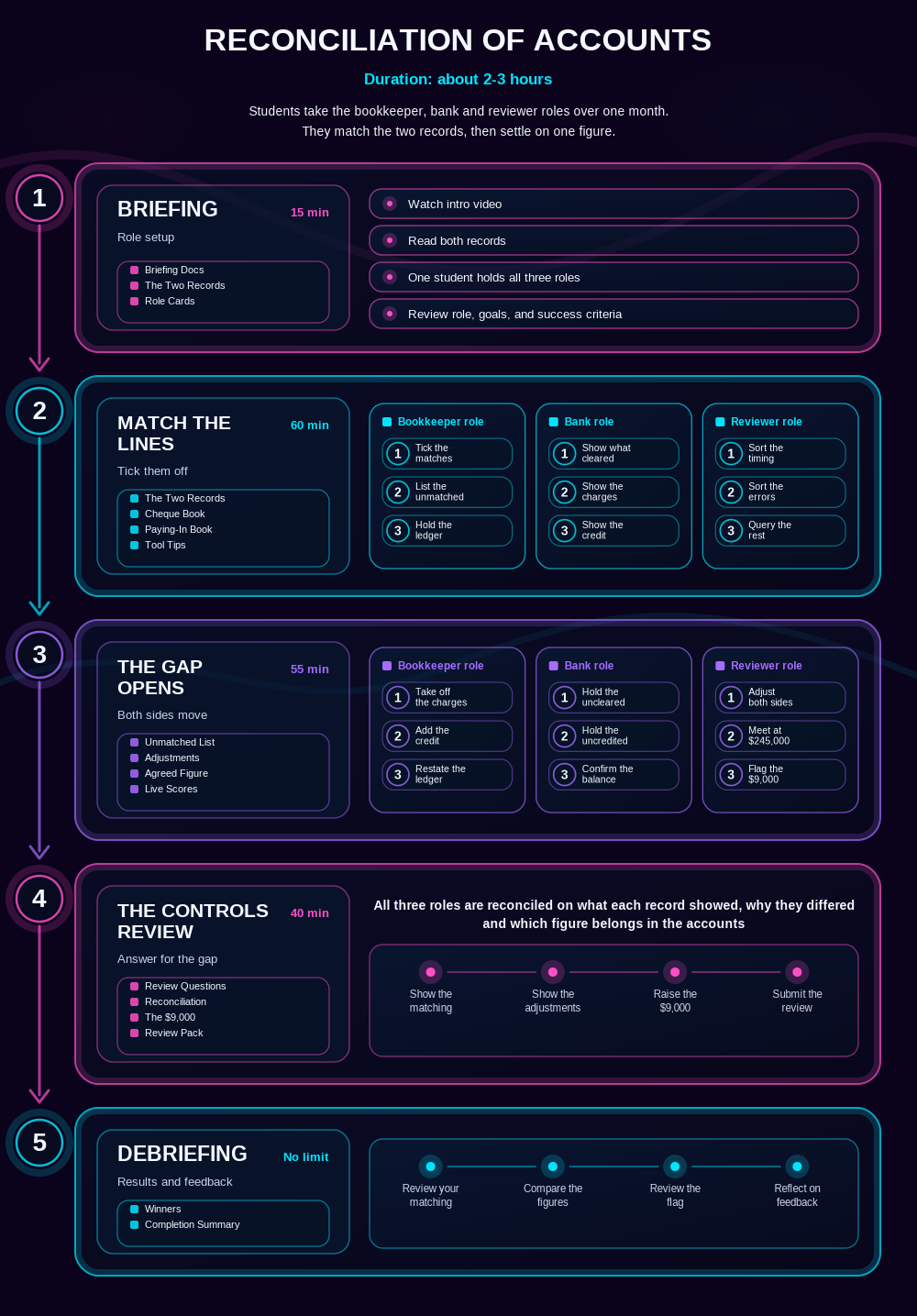
Five stages. Students match the records, adjust both sides, then flag what is left.
Stage 1 · 15 min
briefing docs · the two records · role cards
Students watch the intro video, read a ledger saying $240,000 and a bank statement saying $268,000, and take on all three roles, checking what each one is judged on before anything is matched.
Stage 2 · 60 min
the two records · cheque book · paying-in book · tool tips
The two records get matched line by line. Working as bookkeeper, the student ticks off everything that appears on both; as bank, shows $1,500 of charges and a $6,500 direct credit the books have not got; as reviewer, sorts timing from error. One matching is submitted.
Stage 3 · 55 min
unmatched list · adjustments · agreed figure · live scores
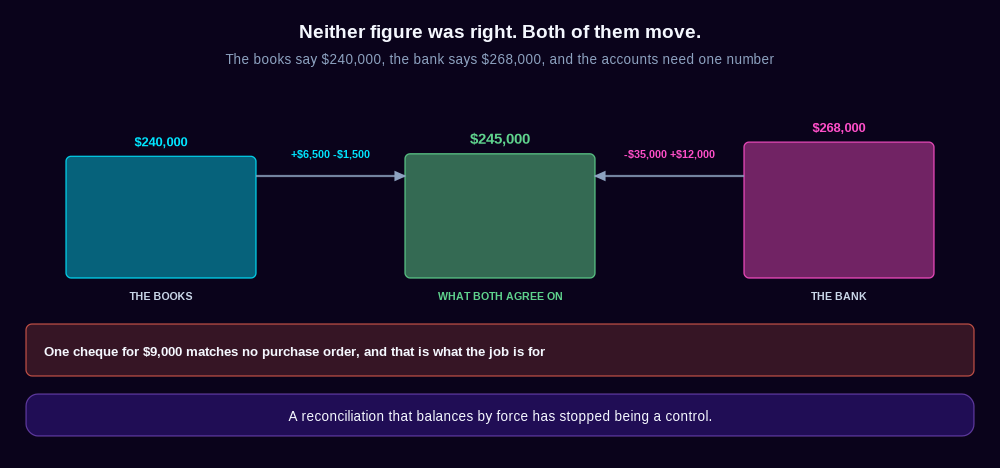
Both figures move. The bank's $268,000 less $35,000 of uncleared cheques plus $12,000 not yet credited is $245,000. The books' $240,000 less $1,500 of charges plus $6,500 paid in directly is also $245,000. One cheque for $9,000 matches no order.
Stage 4 · 40 min
review questions · reconciliation · the $9 · 000 · review pack
Students are asked why neither original figure was right, which adjustments belong to the bank and which to the books, what $245,000 represents, and what they would do about a $9,000 cheque with no purchase order behind it.
Stage 5 · No limit
winners · completion summary
Students review their own matching, compare the agreed figures across the cohort, revisit how each handled the unexplained cheque and reflect on the feedback. Winners and the completion summary give you a structure for the discussion.
The student interface carries the two records, the adjustments and the reasoning. The professor panel carries the timeline, the controls and every individual reconciliation.
Students tick off every item that appears on both records, with what is left on each side sitting next to the box they type into.
Each row is a difference. Two of them move the bank and two move the books, and both sides arrive at the same figure.
Your view. Adjust any stage timing, start or stop the session, and see which students raised the item that does not belong.
Explore the student and professor experience, and discuss timing, setup and syllabus fit.
It works best once students know that a business keeps its own record of money as well as the bank.
Adding and subtracting. What a ledger is, what a bank statement is and why the two are kept separately are all explained inside the activity.
Early module, typically weeks two to five, as a foundation for controls and auditing.
Internal controls, auditing, fraud detection, cash forecasting, and any assessment asking students to explain a difference between two records.
The financial accounting course guide sets out where it sits in a full module.
The three mistakes students make on this topic almost every time. Recognising them is usually the moment the subject lands, and it is the core of the learning science behind it.
1
The bank is an outside institution with no reason to be wrong, so students take $268,000 and adjust the books to it. The bank has not seen the $35,000 of cheques that were written 3 weeks ago, and those are real payments the business has committed. Treating either record as the truth produces a figure that is wrong by the other side's timing differences every single month.
2
Students find the four differences and apply them all to the books, or all to the bank, and the two still do not meet. Two of them are the bank not having caught up, which adjusts the bank. Two are the books not knowing, which adjusts the books. Sorting which side each belongs to is the entire skill, and a reconciliation that balances with everything on one side has balanced by accident.
3
The figures are close, so a difference gets posted to sundry expenses and the statement is signed. That $9,000 cheque has no purchase order behind it, and the reason anybody does this job every month is to find exactly that. A reconciliation is a control, not an arithmetic exercise, and a balancing figure is how the control gets switched off.
The debrief runs itself. Every student sees their results, the cohort comparison and the decisions that produced them, with nothing for you to prepare. If you would rather lead the discussion, these five questions work straight from a slide, and they use what your cohort actually did.
Assessment is optional. Run the simulation ungraded as an applied activity, or use platform data as supporting evidence. Every student generates a matched list, a set of adjustments, an agreed balance, a flagged item and written reasons. Because the simulation is single-player, every input belongs to one named student, so there is no group-work marking to untangle. All of it exports as CSV or PDF, per student, so you can assess reasoning rather than a result.
On generative AI: written rationales are exactly what marking teams now worry about. Because every rationale here is tied to an item the student matched inside the platform, with both records sitting next to it, the reasoning can be checked against the evidence rather than taken on trust.
93% of students rate Finsimco simulations Excellent, across more than 30,000 responses.
Teaching notes, a setup and facilitation guide and a gameflow diagram come with it, and we support your first delivery directly.
Run it ungraded the first time. Assessment is optional and can be added once you have seen how your cohort responds.
Pause or stop at any point and resume later without losing submitted data, so an overrun costs you a timetable slot, not the activity.
Read what lecturers say.
Ron Tuninga, Managing Director for EMEA at AACSB, and Victor Hedenberg, Membership Director at AMBA, on why simulation-based learning belongs in business education. Watch both interviews.
If this one is not quite right for your module, these are the closest alternatives.

Turning the ledger into statements.
Learn More
Which year each entry belongs to.
Learn More
Following the item that is flagged.
Learn More
Managing the cash this confirms.
Learn More
Reading the accounts this protects.
Learn More
Using the figures to decide.
Learn MoreA one-page summary of this simulation, covering stages and timings, roles, concepts, learning outcomes and the debrief questions, plus a full sample teaching pack from one of our live simulations, so you can see exactly what you would be running.
During the call, we can: