Absolutely. The simulation is designed with a learning curve in mind, starting with fundamental transactions and progressively introducing more complex concepts. It serves as an excellent practical application for introductory financial accounting courses.

Accrual Accounting Simulation
The Accrual Accounting Simulation throws students into the heart of a company's financial operations, challenging them to apply accounting principles in a dynamic, competitive environment.

Accrual Accounting Simulation Overview
Traditional accounting education often focuses on memorizing rules and completing isolated journal entries. This simulation transforms the learning experience by placing participants in the role of accountants for a simulated company operating in a competitive market.
Teams must analyze business transactions, make strategic decisions, and correctly apply accrual accounting principles (like revenue recognition and matching) to create accurate financial statements. The simulation unfolds over several operating periods, reflecting the continuous nature of business. Participants will see the direct consequences of their accounting choices on profitability, financial position, and key performance metrics.
This hands-on, experiential learning approach ensures that students don't just learn accounting rules—they learn to think like accountants, developing the critical judgment and analytical skills required in the real world.

Accrual Accounting Simulation Concepts
Participants work through realistic scenarios, which can be customized to emphasize or exclude specific topics depending on the learning goals. This modular structure allows the simulation to be tailored to any type of session. Key concepts include:
- Accrual vs. Cash Accounting
- Revenue Recognition Principle
- Matching Principle
- Adjusting Journal Entries
- Financial Statement Preparation (Income Statement, Balance Sheet, Statement of Cash Flows)
- Accounting Cycle (from transaction to financial statements)
- Depreciation and Amortization
- Accruals for Expenses and Revenues
- Impact of Accounting Choices on Financial Ratios
- Working Capital Management

Gameflow
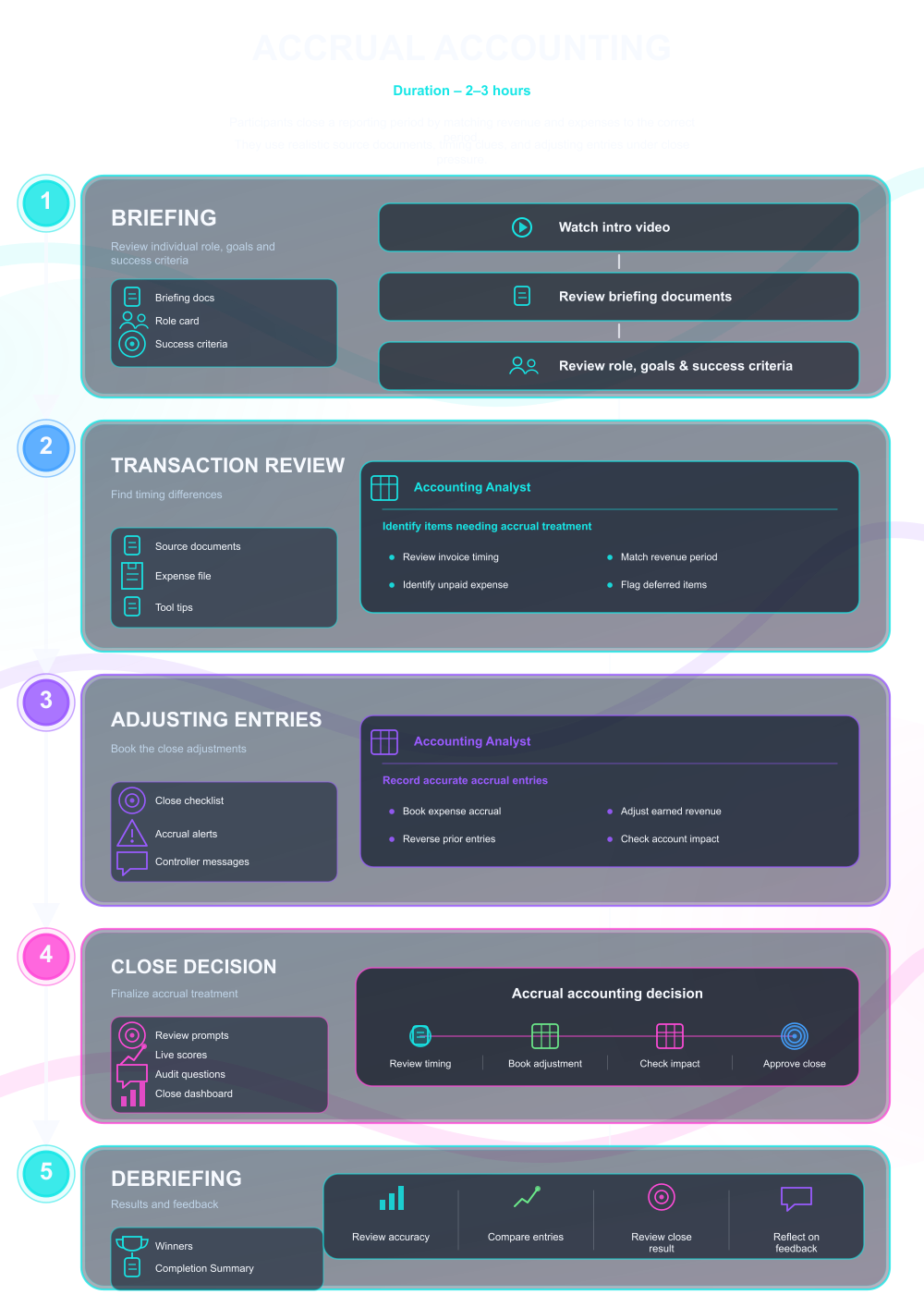

What Participants Do
In the simulation, participants will:
- Analyze and record a variety of business transactions using double-entry accounting.
- Choose between different operational strategies that have direct accounting implications.
- Execute necessary adjusting entries for accruals, deferrals, and depreciation.
- Generate accurate and GAAP-compliant Income Statements, Balance Sheets, and Statements of Cash Flows.
- Review the financial statements of competing teams within the simulation.
- Use financial ratios and trends to assess their company's performance and health.
- Strive to achieve the most profitable and financially sound company in the simulated market

Learning Objectives
By the end of the simulation, participants will be able to:
- Differentiate clearly between cash and accrual accounting and explain the superiority of accrual accounting for measuring performance.
- Apply the revenue recognition and matching principles to complex, real-world business scenarios.
- Execute the full accounting cycle, from journalizing transactions to preparing and analyzing financial statements.
- Construct a Statement of Cash Flows from the changes in Balance Sheet and Income Statement accounts.
- Analyze the impact of business decisions and accounting choices on a company's financial health and reported earnings.
- Develop critical thinking and professional judgment in selecting appropriate accounting treatments.
How the Accrual Accounting Simulation Works
This simulation can be run individually or in teams in academic or corporate contexts. Each cycle represents a stage of getting through a pressing financial situation.
1. Team Formation and Introduction Participants are divided into teams, each managing their own company. They receive the initial scenario and company financials.
2. Decision Periods The simulation is run over multiple rounds, each representing an accounting period. In each round, teams analyze new transactions and make strategic decisions.
3. Accounting Processing Teams record all transactions and must identify and post the necessary adjusting entries before closing the period.
4. Financial Statement Generation The simulation platform generates financial statements based on the teams' entries, providing feedback on their accuracy.
5. Results and Analysis After each period, teams receive a detailed performance report. They can compare their financial results and key ratios against other teams.
6. Instructor Debrief The instructor leads a discussion on the results, highlighting common pitfalls, strategic insights, and the core accounting principles at play, solidifying the learning experience.
Frequently Asked Questions
Assessment
Assessment of participant performance can be tailored according to the host institution’s objectives (business school, corporate training, assessment centre). Typical assessment criteria include:
- The correctness of the prepared Income Statements, Balance Sheets, and Statements of Cash Flows at the end of each period.
- Accuracy in recording both standard and adjusting journal entries.
- The team's success in managing profitability, liquidity, and solvency, as reflected in key financial ratios and company valuation.
- A short quiz on the core concepts reinforced by the simulation.