Basic statistical concepts (mean, standard deviation, correlation) are useful. No coding is required - the course calculates models automatically and provides visual breakdowns.

Course Guide
Value at Risk Course
Participants take control of portfolios under pressure - quantifying risk, stress-testing positions, and setting capital buffers - in our Value at Risk Course.
Value at Risk Course Overview
The Value at Risk (VaR) Course immerses participants in the role of financial risk managers, giving them real-time responsibility for quantifying potential losses, interpreting VaR models, and making capital allocation decisions in response to market movements.
Developed by risk professionals and financial educators, this course brings statistical concepts into a practical setting. Participants must not only calculate risk - but act on it - adjusting portfolios, responding to shocks, and preparing reports for internal and regulatory stakeholders.
Ideal for courses in financial risk management, trading, or banking regulation, this course builds intuitive understanding of how VaR informs real-world decisions.
Value at Risk Course Concepts
Participants gain applied experience with key risk management principles, including:
- Value at Risk (VaR): Historical, variance-covariance, and Monte Carlo methods
- Confidence Intervals and Holding Periods: Interpreting 95% vs 99% VaR
- Portfolio Risk Aggregation: Diversification effects and correlation structures
- Stress Testing: Evaluating the impact of extreme but plausible events
- Capital Adequacy and Risk Limits: Setting limits and calculating economic capital
- Backtesting VaR Models: Comparing predicted vs actual losses
- Regulatory Context: Basel guidelines and internal model validation
Gameflow
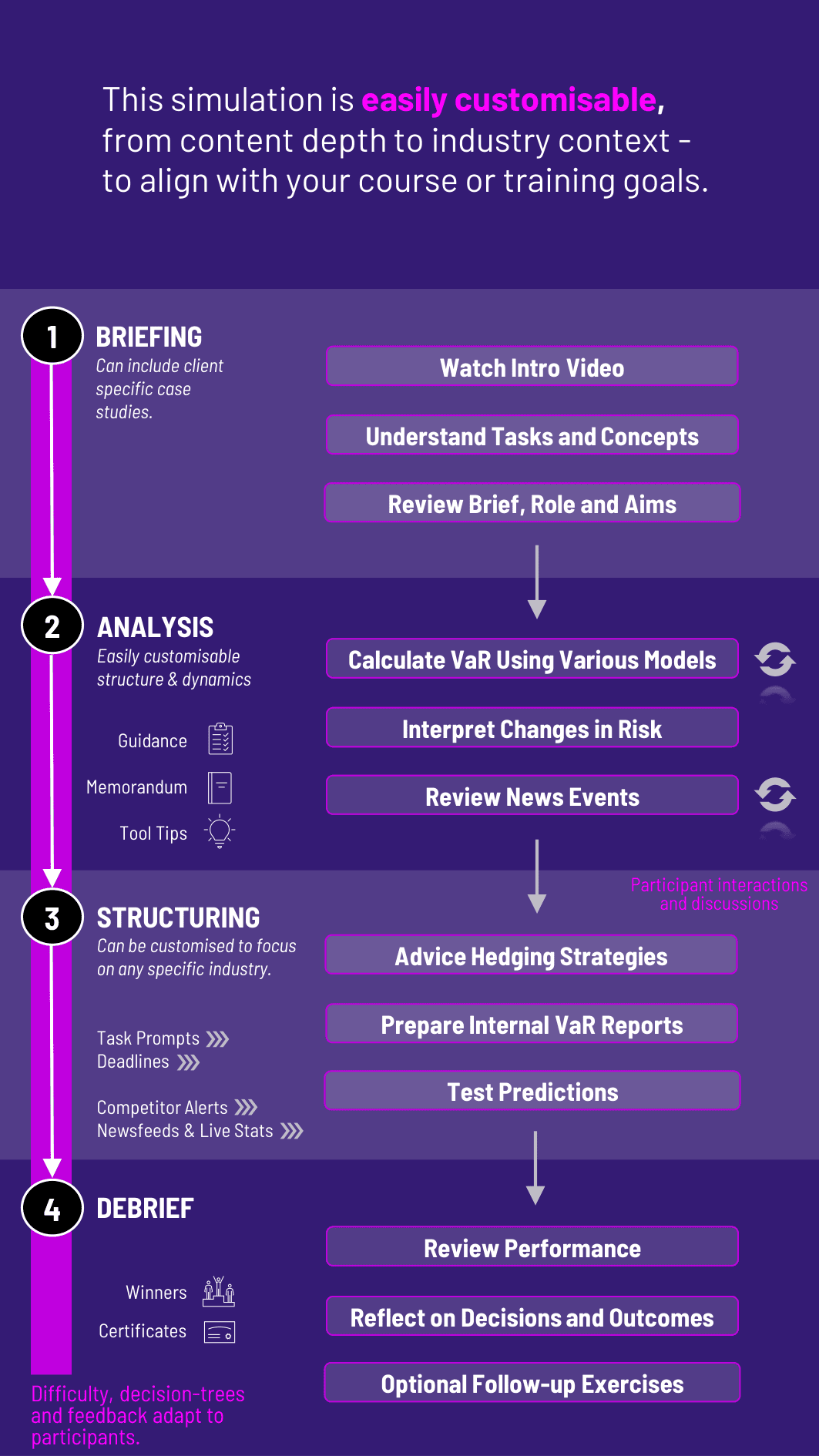
What Participants Do
Participants act as risk managers overseeing a trading portfolio at a financial institution. Across multiple course rounds, they will:
- Calculate VaR using different models and data sets
- Interpret and explain changes in portfolio risk
- Advise on hedging strategies or exposure reduction
- React to news events and apply stress scenarios
- Prepare internal VaR reports for simulated stakeholders (e.g., CRO, regulator)
- Backtest VaR predictions against realized portfolio performance
What Participants Learn
This course transforms VaR from a static formula into a living risk management tool. Participants will learn how to:
- Understand and compare multiple VaR methodologies
- Use VaR to identify vulnerable exposures in a portfolio
- Make portfolio-level decisions under uncertainty
- Justify capital buffers based on market volatility and correlation
- Communicate technical results to non-technical audiences (boards, regulators)
- Recognize the limitations and blind spots of VaR-based models
Why This Value at Risk Course Works
VaR is often taught through equations and spreadsheets - but in real firms, it drives high-stakes decisions.
This course brings context, urgency, and consequence to statistical risk concepts. By managing portfolios in changing markets and seeing how risk metrics hold up - or break down - participants internalize how VaR supports (but doesn’t replace) human judgment.
Perfect for advanced undergraduates, MBA participants, and executive learners, this course prepares future risk professionals to navigate both model output and market reality.