No. A basic understanding of interest rates and cash flow is helpful, but the course includes onboarding to money market instruments and decisions.

Course Guide
Money Markets Course
Participants take control of short-term funding and investment decisions - balancing liquidity, interest rates, and institutional risk - in our Money Markets Course.
Money Markets Course Overview
The Money Markets Course immerses participants in the real-time operations of institutional treasury desks and short-term debt markets. Built by financial markets professionals and academic economists, this course replicates how banks, corporates, and funds manage liquidity, short-term borrowing, and overnight lending in fast-moving environments.
Participants must respond to interest rate shifts, central bank actions, and market volatility as they decide how to invest surplus funds or raise capital via commercial paper, repos, or interbank lending. The course emphasizes timing, pricing, and risk calibration in high-frequency markets.
Ideal for courses in treasury management, financial markets, or macro-financial policy, this course brings an often-overlooked corner of finance to life.
Money Markets Course Concepts
Participants engage with key ideas underpinning the functioning of short-term financial markets, including:
- Money Market Instruments: Treasury bills, commercial paper, certificates of deposit, repos, and interbank loans
- Interest Rate Mechanics: Benchmark rates (e.g., LIBOR, SOFR), yield curves, and rate spreads
- Liquidity Management: Forecasting inflows/outflows and maintaining solvency buffers
- Credit and Counterparty Risk: Evaluating borrower risk and setting exposure limits
- Monetary Policy Transmission: How central bank operations affect short-term funding markets
- Pricing and Settlement: Day counts, discounting, and settlement timing
Gameflow
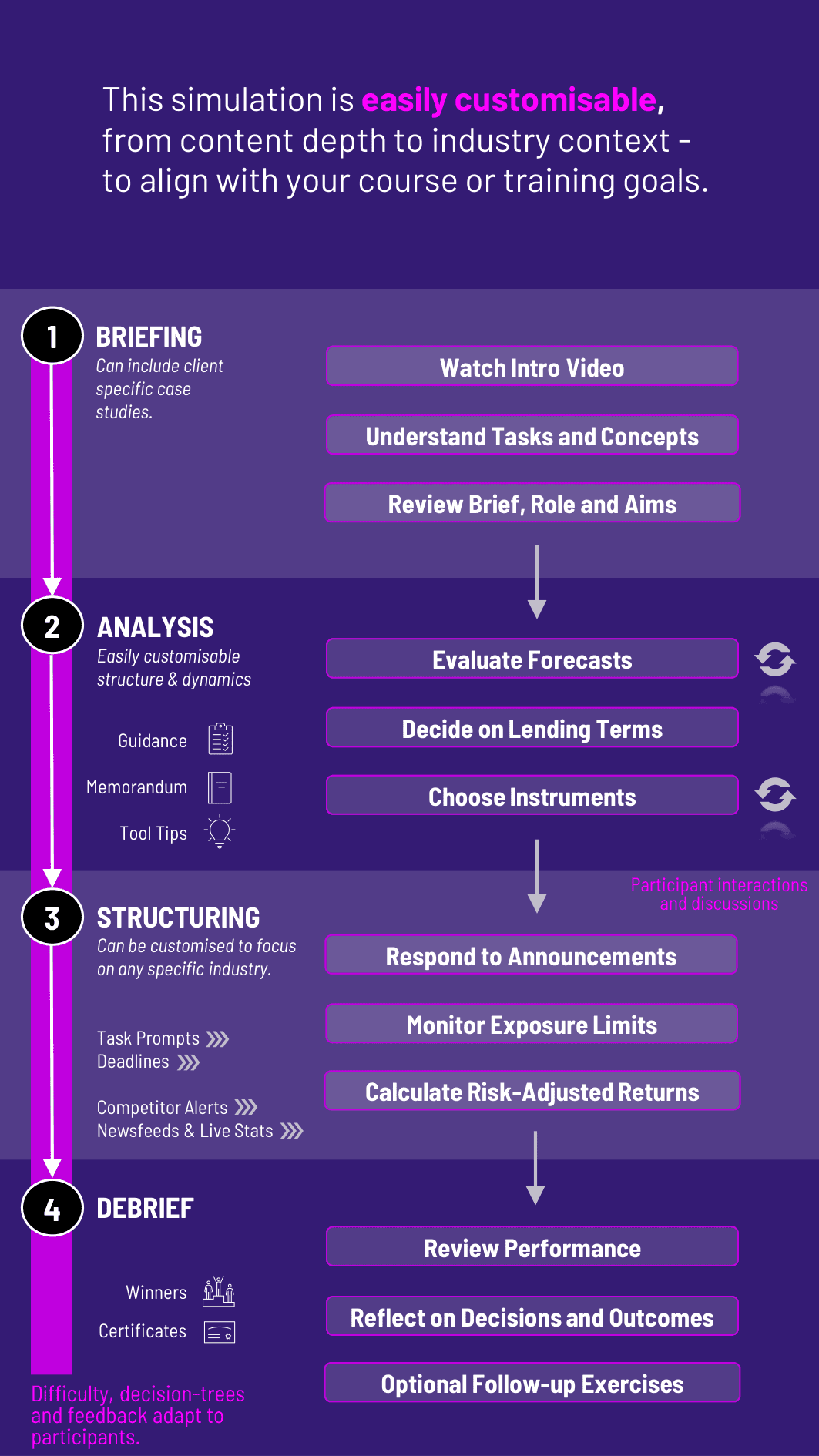
What Participants Do
In this course, participants act as treasury managers or institutional investors, tasked with deploying or sourcing funds in the money market. They will:
- Evaluate cash positions and liquidity forecasts
- Decide how to invest surplus funds or meet shortfalls through borrowing
- Choose between instruments with varying rates, durations, and risk
- Respond to central bank announcements, credit events, or liquidity shocks
- Monitor exposure limits and manage counterparty relationships
- Calculate returns, costs, and risk-adjusted decisions under time pressure
What Participants Learn
Participants learn how short-term markets function at the operational level - and why they matter. They will develop:
- A working knowledge of major money market instruments and their use cases
- The ability to make time-sensitive funding and investment decisions
- Practical understanding of how monetary policy influences short-term rates
- Risk awareness in assessing counterparties and balancing duration with liquidity
- A systems-thinking view of how individual actors affect market-wide liquidity
Why This Money Markets Course Works
Money markets are foundational to the global financial system - but participants often never “see” them. This course makes them visible, accessible, and urgent.
By placing participants in control of short-term capital decisions, the course transforms abstract topics into strategic dilemmas with real financial trade-offs. It emphasizes judgment, timing, and the interconnectedness of institutions under central bank oversight.
Whether in a finance, economics, or central banking course, this course helps participants connect monetary theory to daily practice.