Basic knowledge of Excel and financial statements is recommended. The course includes built-in guidance for valuation techniques.

Course Guide
Equity Valuation Course
Participants step into the role of equity analysts, valuing listed companies using real financial data, forecasting performance, and defending investment theses in our Equity Valuation Course.
Equity Valuation Course Overview
The Equity Valuation Course gives participants a realistic, hands-on experience in determining what a company is truly worth.
Developed by valuation experts and equity research professionals, this course guides participants through the process of analyzing business models, interpreting financial statements, and applying valuation techniques like discounted cash flow and multiples-based analysis.
Rather than just plugging numbers into models, participants must make assumptions, build forecasts, and justify them under scrutiny. The course creates a fast-paced yet thoughtful environment where analytical precision and sound reasoning are key.
Equity Valuation Course Concepts
Participants will apply and deepen their understanding of key valuation principles, including:
- Valuation Methodologies: DCF, relative valuation (P/E, EV/EBITDA), dividend discount models
- Forecasting: Revenue, margins, capex, working capital, and terminal value
- Cost of Capital: WACC calculation, beta, risk-free rate, and market premium
- Capital Structure Analysis: Debt vs equity impact on valuation
- Scenario Analysis and Sensitivity Testing
- Investment Thesis Construction: Qualitative and quantitative alignment
- Market Comparables and Peer Benchmarking
Gameflow
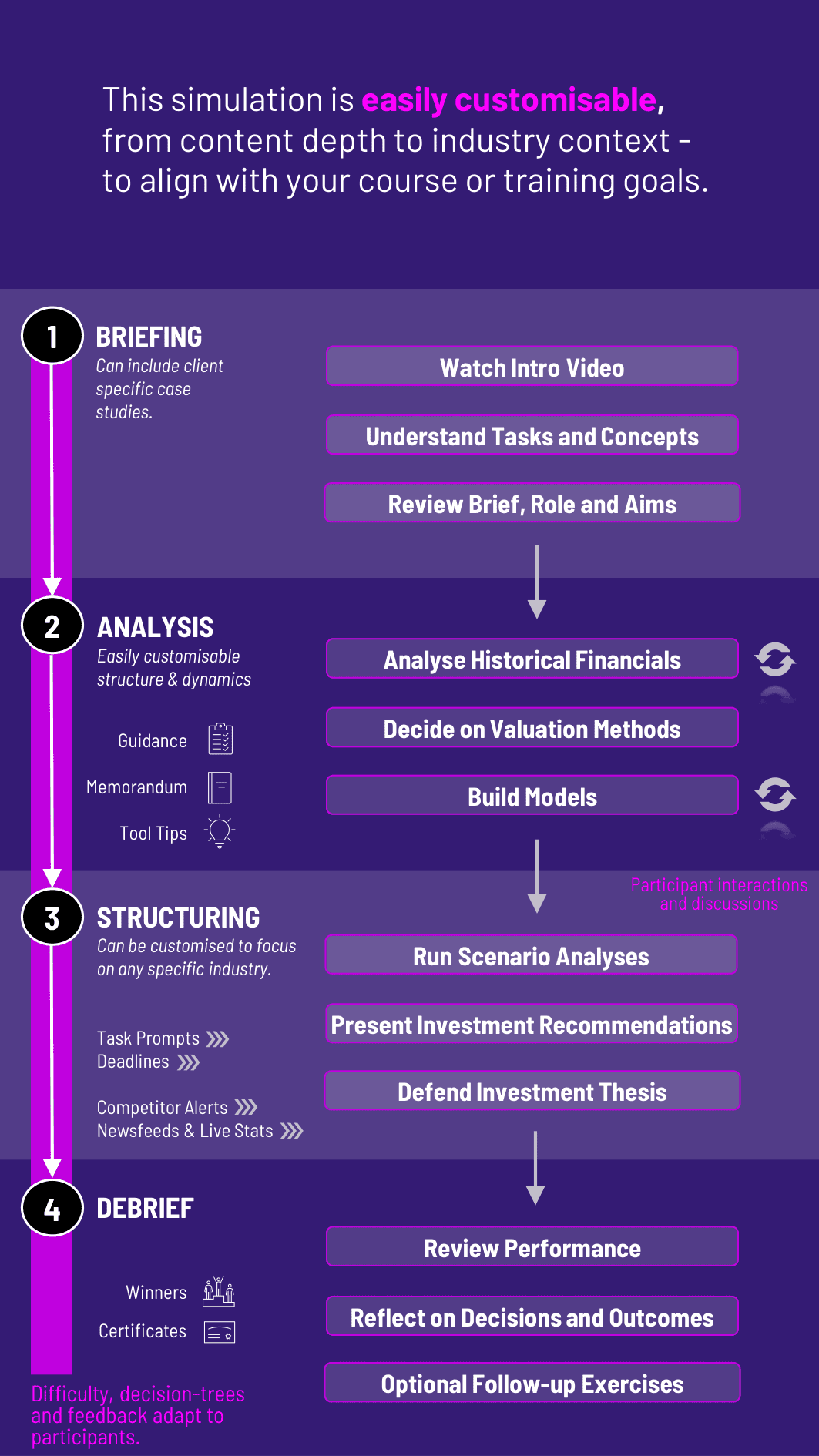
What Participants Do
In this single- or multiplayer course, participants act as equity analysts preparing a valuation report for a company. They will:
- Analyze historical financials and competitive positioning
- Build forward-looking models and justify key assumptions
- Choose appropriate valuation methods based on industry and data
- Run scenario and sensitivity analyses to stress-test valuations
- Present a final valuation range and investment recommendation
- Defend their methodology and conclusions in front of peers or instructors
What Participants Learn
The course cultivates the mindset and toolkit of a professional equity analyst. Participants learn how to:
- Think critically about business assumptions and translate them into forecasts
- Select valuation methods suited to specific industries or cases
- Apply and interpret DCF and multiples-based models
- Balance precision with practicality in financial modelling
- Communicate a valuation case clearly and persuasively
- Recognize that valuation is both art and science—and justify their judgments
Why This Equity Valuation Course Works
Valuation often appears formulaic in class, but this course reveals its strategic and judgment-driven nature.
Rather than memorizing inputs and outputs, participants must grapple with real uncertainties: Is this forecast realistic? Which peer companies are truly comparable? What does the market already price in?
The course builds confidence through repetition, feedback, and presentation - giving participants not just knowledge, but conviction.
It’s ideal for advanced undergraduates, MBAs, or finance-focused professionals preparing for roles in equity research, investment banking, or portfolio management.