Ideal for participants interested in investment banking, capital markets, corporate finance, or asset management careers.

Course Guide
Capital Markets Course
Participants take on the role of capital markets professionals, structuring equity and debt offerings, analyzing investor demand, and executing deals under real-world pressures with our capital markets simulator.
Capital Markets Course Overview
The Capital Markets Course immerses participants in the dynamic environment of global financial markets. Participants take on roles such as investment bankers, traders, sales professionals, or market strategists - making fast-paced decisions that mirror the pressures and complexity of real capital market activity. They’ll issue securities, analyze investor behavior, respond to market movements, and manage deal flow across equity, debt, and hybrid instruments.
Built to replicate the structure and volatility of real capital markets, this capital markets course challenges participants to interpret economic signals, structure capital raises, price deals, and react to investor sentiment in real time. Whether negotiating IPO terms, managing a bond issuance, or adjusting to central bank announcements, participants gain the real-world mindset and financial acumen essential for careers in capital markets and institutional finance.
Capital Markets Concepts
- Equity Capital Markets (ECM)
- Debt Capital Markets (DCM)
- Primary and Secondary Market Dynamics
- IPO and Bond Issuance Structuring
- Investor Sentiment and Demand Analysis
- Yield Curves and Interest Rate Movements
- Capital Structure Considerations
- Market-Moving News and Announcements
- Trading and Execution Strategies
- Regulatory Frameworks and Compliance
- Financial Statement and Prospectus Analysis
- Bookbuilding and Deal Syndication
Gameflow
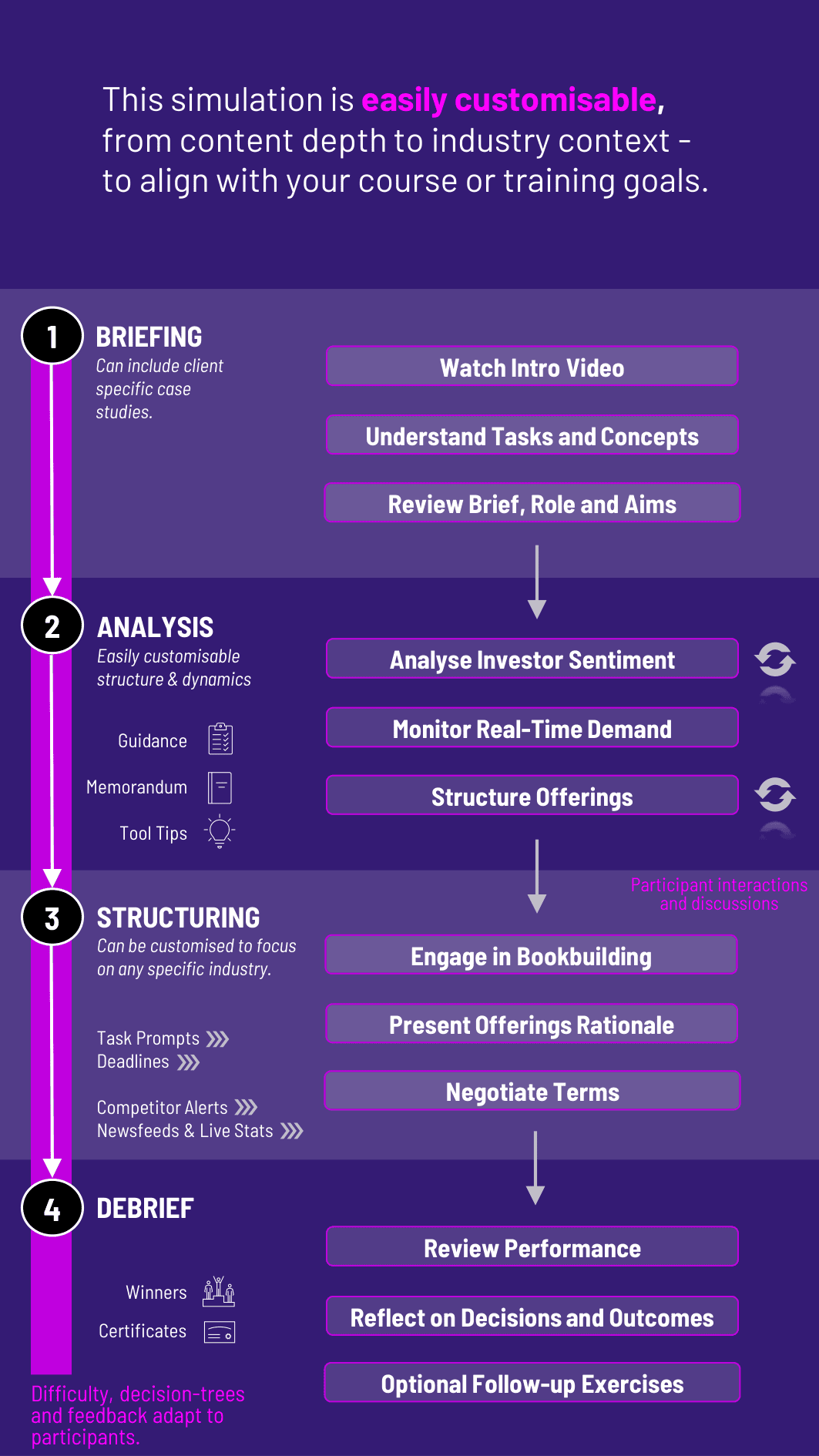
What Participants Do
During the capital markets course, participants engage in the following tasks to develop and apply capital markets skills:
- Manage IPOs and Bond Issuances: Determine timing, pricing, and syndication strategy.
- Respond to Market Conditions: Adjust issuance plans in reaction to economic news and investor feedback.
- Analyze Investor Sentiment: Monitor real-time demand curves and order books.
- Structure Offerings: Customize capital structure decisions based on risk, cost, and shareholder expectations.
- Engage in Bookbuilding: Simulate investor outreach and allocation decisions.
- Monitor Secondary Market Performance: Track and respond to price fluctuations post-issuance.
- Forecast Market Movements: Analyze yield curve shifts and policy announcements.
- Negotiate with Counterparties: Coordinate with underwriters, investors, and internal stakeholders.
- Communicate Strategy: Present offering rationale and execution plans to a simulated board or client.
- Debrief Deal Outcomes: Evaluate results based on financial success and market response.
What Participants Learn
- Market Functionality: Understand the mechanics of primary and secondary capital markets.
- Deal Structuring: Learn to design offerings that align with issuer needs and investor appetite.
- Investor Behavior Analysis: Interpret market demand and tailor offering terms accordingly.
- Financial Modeling and Valuation: Support issuance strategy with valuation metrics.
- Macro-Financial Insight: Develop awareness of how macro events shape issuance decisions.
- Risk Mitigation: Recognize and manage regulatory, execution, and reputational risks.
- Dynamic Decision-Making: Make high-stakes choices in fast-moving environments.
- Team Collaboration: Simulate working within a capital markets or advisory team.
- Regulatory Acumen: Gain exposure to capital markets regulation and disclosure requirements.
- Communication of Market Strategy: Articulate strategic decisions clearly to stakeholders and clients.
Why The Capital Markets Course Works
The Capital Markets Course offers a hands-on, real-time environment that captures the energy, pressure, and complexity of global markets. It bridges academic concepts with institutional realities, helping participants build a working understanding of capital raising, investor relations, and market behaviour. By experiencing everything from pitch to pricing to post-deal analysis, participants emerge with practical readiness for careers in banking, markets, and finance.
This capital markets course is especially powerful because it’s not just about making financial decision - it’s about understanding capital market dynamics holistically. Participants must integrate technical, strategic, and behavioral insights to succeed, all while navigating a fast-paced and evolving scenario. The result is a truly immersive experience that builds skill, confidence, and career relevance.