Basic familiarity with balance sheet and cash flow concepts helps, but the training is beginner-friendly and fully guided.

Working Capital Management Training
In this hands-on Working Capital Management Training, participants are financial decision-makers responsible for managing liquidity, improving cash flow, and balancing operational efficiency.

Working Capital Management Training Overview
The Working Capital Management Training places participants in the role of a CFO or corporate finance team member of a mid-sized company operating in a fast-moving industry. Across several dynamic rounds, participants respond to shifting sales forecasts, supplier pressures, customer behavior, and operational challenges that affect day-to-day liquidity.
Their goal: to optimize working capital without compromising growth, customer satisfaction, or supplier relationships.
Participants must interpret financial metrics, negotiate with stakeholders, and make trade-offs between liquidity, profitability, and risk. The training emphasizes real-world complexity - balancing internal constraints, seasonal swings, and external shocks that test even the most robust policies.
Co-developed with finance practitioners and educators, this training helps learners see how every operational decision has a cash flow impact.

Working Capital Management Training Concepts
Participants are exposed to the strategic levers and tensions of working capital management, including:
- Cash Conversion Cycle: Interplay of inventory, receivables, and payables
- Accounts Receivable: Credit policies, collections, and DSO
- Inventory Management: EOQ, safety stock, and stockout risk
- Accounts Payable: Payment terms, supplier negotiations, and DPO
- Liquidity Management: Cash forecasting and short-term funding
- Cost of Capital: Trade-offs between liquidity and profitability
- Crisis Response: Managing disruptions in supply, demand, or credit
- Stakeholder Communication: Justifying changes to procurement, sales, or operations teams

Gameflow
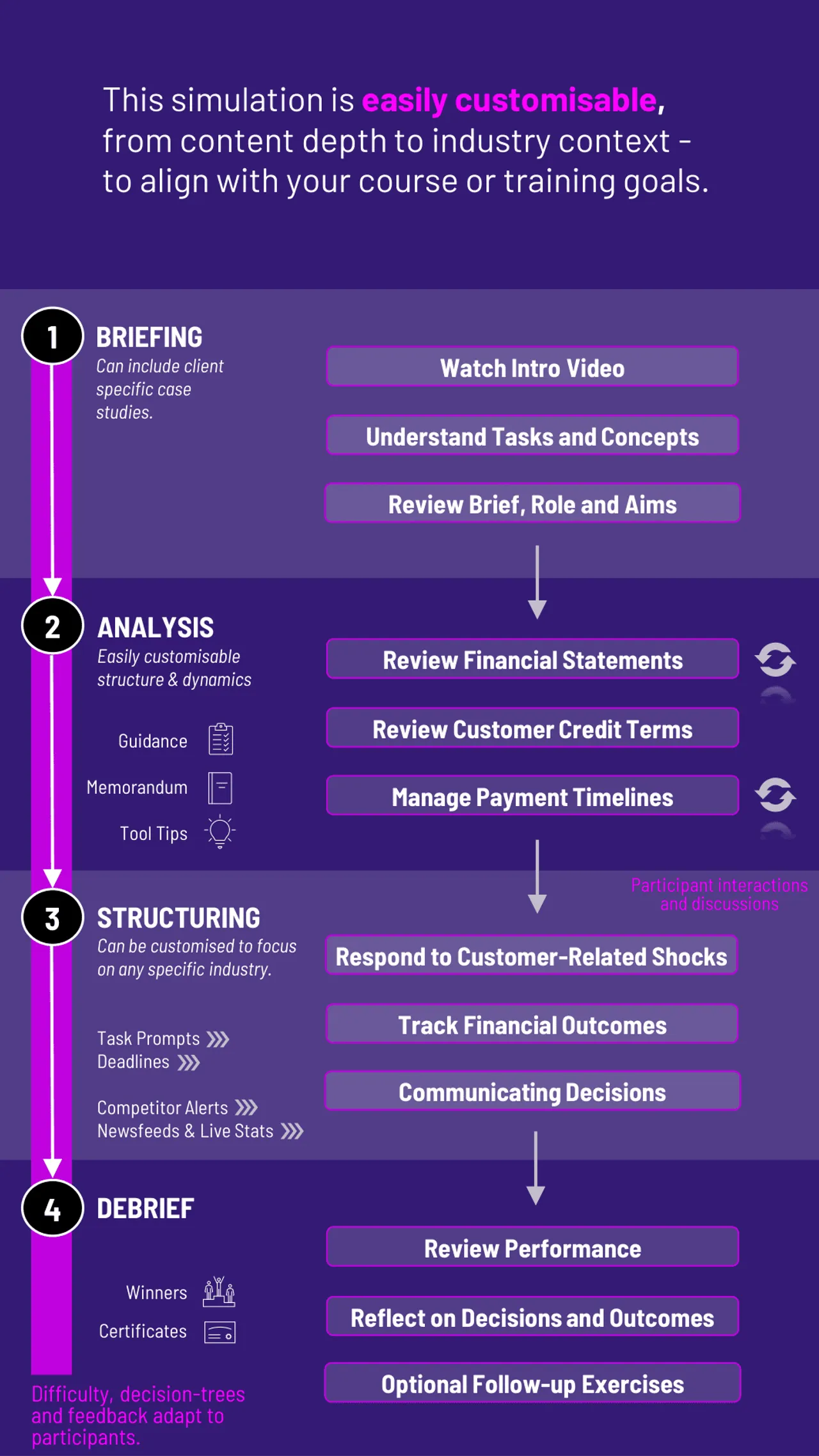

What Participants Do
In each training round, participants are given updated business conditions and financials. Their tasks include:
- Reviewing cash flow statements, working capital ratios, and performance metrics
- Adjusting credit terms for customers to influence receivables
- Managing payment timelines with suppliers
- Deciding how much inventory to hold across product lines
- Responding to unexpected shocks (e.g. customer default, supplier delay)
- Communicating decisions to sales, operations, and senior management
- Tracking outcomes such as free cash flow, customer satisfaction, and supplier stability
- Revising policies to meet evolving targets across training rounds

Learning Objectives
By the end of the training, participants will:
- Understand how operational decisions affect cash flow and financial health
- Learn to calculate and optimize the cash conversion cycle
- Gain fluency in liquidity metrics like DSO, DPO, and inventory turnover
- Balance competing priorities (growth vs. cash preservation, sales vs. credit risk)
- Learn how to negotiate better terms with suppliers and customers
- See how external events (macroeconomic shifts, seasonality) affect short-term financing needs
- Communicate finance decisions effectively across business functions
- Apply working capital knowledge in a strategic, cross-functional context
This training is ideal for students in finance, accounting, and operations, as well as professionals in treasury, FP&A, or supply chain roles.
How the Working Capital Management Training Works
The training can be run individually or in small teams. Each cycle simulates a quarter or season of business operations.
1. Receive Company Brief and Objectives Each round begins with a scenario: declining cash flow, supplier delays, growing sales pipeline, or unexpected expenses.
2. Analyze Metrics and Risk Participants review key indicators - current ratios, turnover metrics, projected liquidity gaps - and assess risks and opportunities.
3. Make Strategic Adjustments They fine-tune payment terms, credit policies, inventory holdings, and purchasing strategies based on priorities.
4. Evaluate Results The training calculates the effects of their decisions on financial performance and stakeholder sentiment.
5. Communicate and Justify Participants must explain their logic in team discussions, board memos, or stakeholder presentations.
6. Adapt in Subsequent Rounds New developments (e.g. interest rate changes, supplier exits, customer churn) challenge participants to evolve their approach.

Why This Working Capital Management Training Works
Working capital is often taught as a formula - but experienced managers know it’s a moving target with many trade-offs. This training brings those trade-offs to life, pushing participants to think holistically about cash, strategy, and stakeholder management.
It’s experiential finance education that mirrors the real-world messiness of managing liquidity, making it highly effective in both classroom and corporate settings.
Frequently Asked Questions
Assessment
Participants are evaluated on:
- Financial performance (cash flow, liquidity ratios, working capital turnover)
- Strategic alignment of their decisions
- Justification and communication of trade-offs
- Team collaboration and stakeholder negotiation
- Adaptability in response to new conditions
- Written or verbal presentation quality (e.g., CFO memo or stakeholder debrief)
Optional components like reflection essays or group presentations can also be included for deeper learning.