It’s ideal for finance, sustainability, economics, and business participants aiming to work in ESG, impact investing, or corporate responsibility roles.

Sustainable Finance Training
Participants take on the role of sustainable finance professionals, evaluating ESG data, allocating capital, and balancing impact with returns under real-world pressures with our sustainable finance training.

Sustainable Finance Training Overview
The Sustainable Finance Training empowers participants to navigate the intersection of finance and sustainability, simulating the challenges of aligning investment and capital allocation decisions with environmental, social, and governance (ESG) objectives.
Participants take on the role of financial professionals in investment firms, development banks, or corporate finance teams, where they must analyze opportunities, manage stakeholder expectations, and evaluate impact alongside financial returns.
It’s designed to give learners a grounded understanding of how sustainability is reshaping global finance, preparing them for roles in ESG investing, green finance, corporate sustainability, and beyond.

Sustainable Finance Concepts
- ESG Integration in Investment Decisions
- Impact Investing Strategies
- Sustainable Development Goals (SDGs)
- Carbon Accounting and Emissions Metrics
- Green Bonds and Climate Finance Instruments
- ESG Risk Analysis and Ratings
- Corporate Sustainability Disclosures
- Double Materiality and Stakeholder Reporting
- Sustainable Capital Allocation
- Climate Scenario Stress Testing
- Regulatory Frameworks for Sustainable Finance
- Social Impact Metrics and Governance Factors

Gameflow
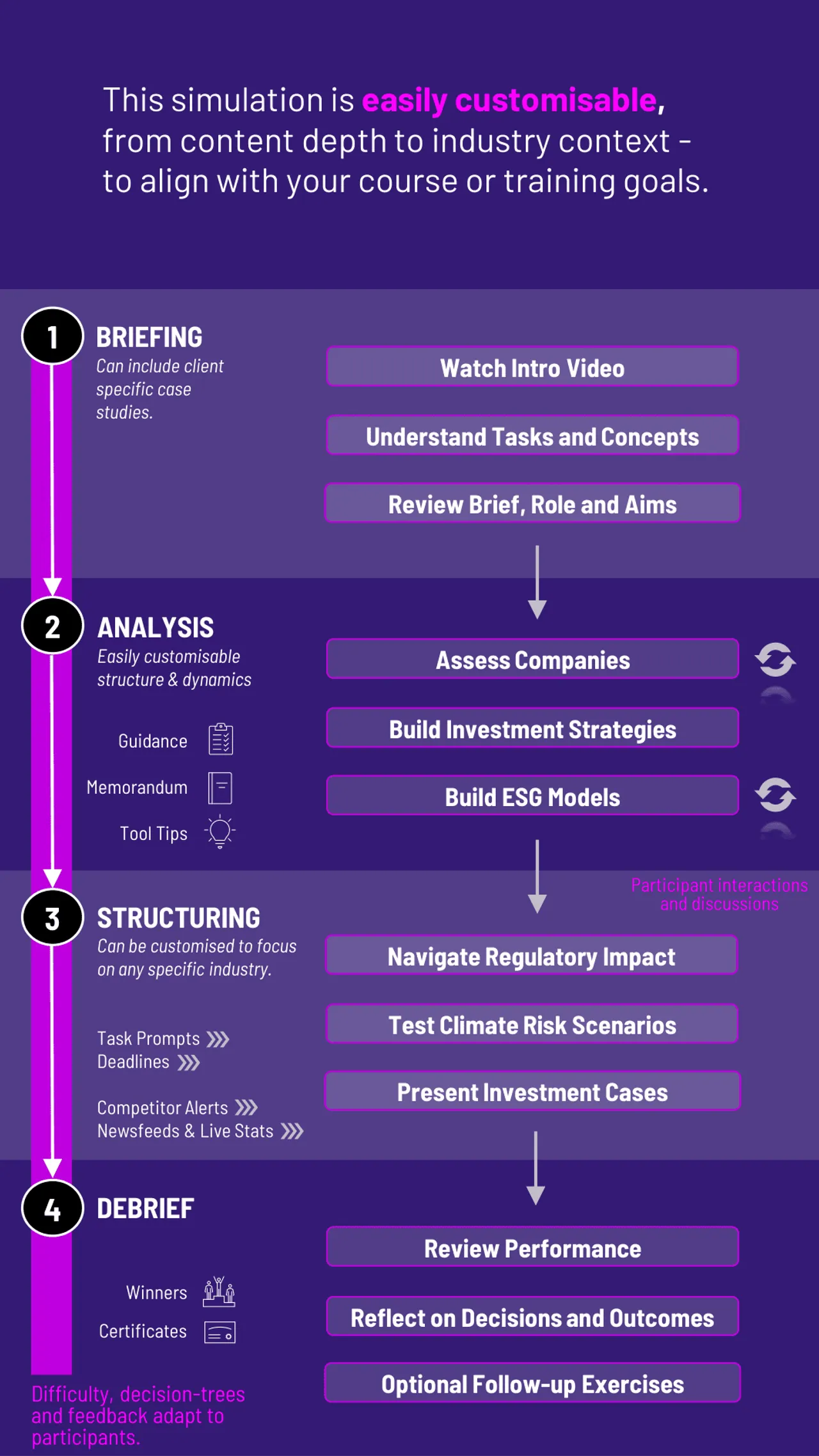

What Participants Do
During the sustainable finance training, participants engage in the following tasks to develop and apply sustainable finance skills:
- Evaluate ESG Profiles: Assess company or project-level ESG data and performance indicators.
- Allocate Capital Sustainably: Make investment decisions considering both financial and sustainability goals.
- Design Green Instruments: Structure and issue green bonds or sustainability-linked loans.
- Analyze Climate Risk Scenarios: Stress test portfolios against future climate projections.
- Integrate ESG into Valuation Models: Adjust financial projections based on ESG performance and risks.
- Engage in Impact Reporting: Draft sustainability reports and communicate trade-offs to stakeholders.
- Navigate Regulatory Environments: Apply real-world compliance standards to investment cases.
- Debate Ethical Dilemmas: Weigh the financial and ethical implications of ESG-related decisions.
- Forecast Long-Term Impact: Evaluate the lifecycle impact of projects and assets.
- Present Investment Cases: Justify sustainable investments to simulated investment committees or boards.

What Participants Learn
- ESG Fundamentals: Understand the environmental, social, and governance dimensions of finance.
- Sustainable Investment Strategy: Learn to design portfolios and projects aligned with sustainability goals.
- Impact Evaluation: Gain skills in measuring non-financial outcomes alongside financial returns.
- Risk-Adjusted ESG Valuation: Integrate sustainability into financial analysis and pricing models.
- Stakeholder Analysis: Navigate complex relationships between investors, regulators, and society.
- Climate Risk Awareness: Learn how to evaluate and mitigate financial exposure to climate events.
- Regulatory Understanding: Familiarize with sustainable finance regulations and disclosure standards.
- Sustainability Communication: Develop clear, compelling ESG reporting and investor messaging.
- Ethical Decision-Making: Build confidence in resolving trade-offs between profit and impact.
- Systems Thinking: Understand how sustainability challenges intersect across finance, environment, and society.

Why The Sustainable Finance Training Works
The Sustainable Finance Training offers a real-world lens into how modern finance is evolving to meet global challenges. Rather than abstract discussions, participants face decisions involving actual ESG metrics, real-time regulatory developments, and complex investment dilemmas. They must weigh short-term returns against long-term risks and stakeholder impacts, mirroring the growing demands on today’s financial leaders.
This sustainable finance training is designed to prepare the next generation of professionals for roles in which finance serves not only shareholders, but broader social and environmental objectives. By immersing participants in high-stakes sustainability decisions, the training cultivates strategic, forward-thinking skills that align with the financial industry's transformation toward impact and accountability.