No. The training abstracts the coding so participants can focus on interpretation, strategy, and business decisions.

Machine Learning Training
In this Machine Learning Training, participants are data-driven decision-makers, applying real-world ML models to solve strategic business and finance problems. They explore how machine learning impacts finance, and business decisions.

Machine Learning Training Overview
The Machine Learning Training places participants in a modern business setting where they must interpret data, build models, and use machine learning to drive better decisions. Whether predicting customer churn, optimizing pricing, or automating credit scoring, participants experience the trade-offs and challenges of real-world ML deployment.
Acting as data product managers or business analysts, participants work with datasets to choose the right ML approach, balance accuracy with interpretability, and defend decisions to business and technical stakeholders. Across multiple decision rounds, they respond to changing market conditions, data quality issues, and organizational constraints.
Co-developed by ML practitioners and business educators, this training bridges the gap between technical knowledge and practical application.

Machine Learning Training Concepts
Participants work through realistic ML scenarios, which can be customized to emphasize or exclude specific topics depending on the learning goals. This modular structure allows the training to be tailored for business-heavy or other types of sessions. Key concepts include:
- Supervised Learning Models: Linear regression, decision trees, random forests, classification algorithms
- Model Selection & Evaluation: Accuracy, precision, recall, AUC, and overfitting
- Interpretability vs. Performance: Trade-offs in stakeholder trust and model complexity
- Bias and Fairness: Recognizing and mitigating ethical concerns
- Data Quality: Handling missing values, outliers, and noisy inputs
- ML in Business Contexts: Applying models to real problems in marketing, finance, HR, and operations
- Cross-Functional Communication: Translating model outputs for decision-makers
- Model Monitoring: How model performance degrades or changes over time

Gameflow

What Participants Do
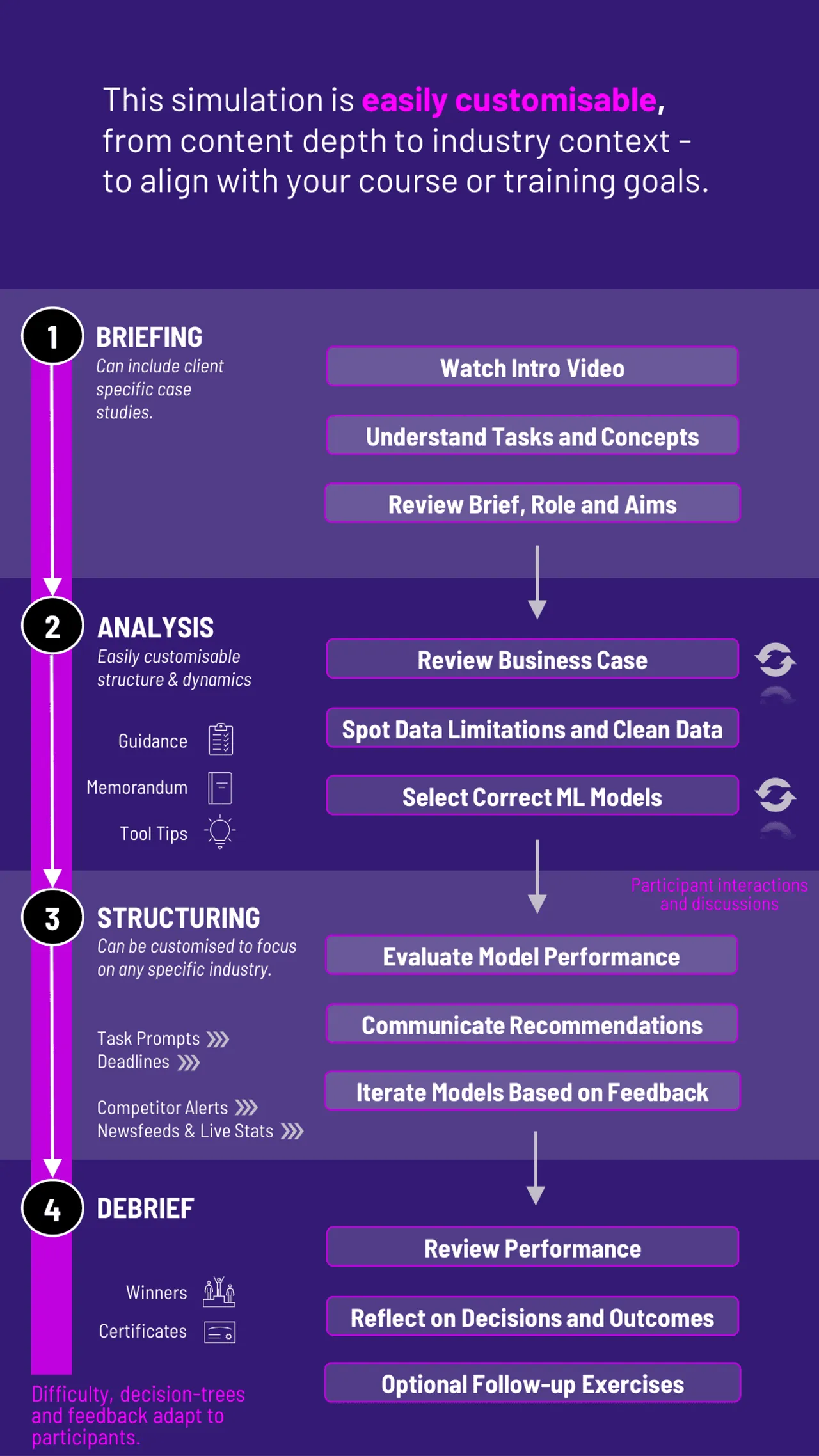
Participants act as business or product leaders working with ML tools to solve problems. In each round, they:
- Receive a business case (e.g., predict customer churn, score loan applications, recommend products)
- Review available datasets, spot data limitations, and clean the data
- Select the right ML model(s) for the task
- Evaluate model performance across metrics like accuracy, F1 score, or confusion matrix
- Balance model complexity with interpretability, and choose what to deploy
- Communicate recommendations to both business and technical teams
- Receive feedback on the results and iterate based on model drift or stakeholder feedback

Learning Objectives
By the end of the training, participants will be more confident in:
- Understanding key machine learning models and their strengths/weaknesses
- Making strategic decisions using predictive analytics
- Communicating ML results clearly to non-technical stakeholders
- Applying machine learning to solve business problems, not just theoretical exercises
- Navigating the ethics and risks of automated decision-making
- Collaborating across technical and business roles
- Understanding how to test, deploy, and monitor models over time
- Becoming data-literate decision-makers in any role
The training is ideal for business students, product managers, consultants, and finance professionals looking to upskill in applied data science. Its flexible structure ensures that these objectives can be calibrated to match the depth, duration, and focus areas of each program.
How the Machine Learning Training Works
The training runs individually or in teams, perfect for executive education, MBA courses, or corporate workshops.
1. Receive a Business Problem Each round presents a real-world decision challenge where ML can help - such as reducing churn, increasing credit approvals, or improving customer targeting.
2. Explore the Dataset Participants review a simplified dataset, checking for data quality, identifying variables, and understanding the context.
3. Choose and Train a Model Participants select one or more ML models, compare outcomes, and avoid common pitfalls like overfitting.
4. Deploy and Act They make business decisions based on model insights, then justify and communicate those decisions to key stakeholders.
5. Receive Feedback and Iterate They learn from training results - like missed targets, stakeholder concerns, or model drift - and refine their approach.

Why This Machine Learning Training Works
Most machine learning courses focus on coding and math. This training focuses on what business leaders and analysts actually need: how to use machine learning to make decisions that matter.
It brings ML into boardrooms, not just data labs - helping participants think critically about automation, trust, and the strategic use of data. Perfect for MBA programs, corporate innovation labs, or upskilling programs for non-technical professionals.
Frequently Asked Questions
Assessment
Participants are assessed on:
- Accuracy and strategic relevance of model selection
- Interpretation and explanation of model performance
- Ethical reasoning and fairness consideration
- Quality of business decisions based on ML insights
- Clarity of communication to non-technical stakeholders
- Responsiveness to feedback or changing data dynamics
Assessment formats include in-simulation metrics, peer and instructor feedback, and optional debrief presentations or memos. This flexibility allows the training to be easily integrated by HR at assessment centres at companies.