This international finance training is ideal for participants and professionals interested in global finance, multinational operations, or international investment.

International Finance Training
Participants take on the role of international finance professionals, managing currency risks, evaluating global investments, and navigating geopolitical challenges under real-world pressures with our international finance training.

International Finance Training Overview
The international finance training places participants in the role of global financial decision-makers, navigating the complex terrain of international markets, exchange rates, cross-border investments, and geopolitical risk. Participants are challenged to make strategic financial decisions in real time, adapting to volatile currency fluctuations, shifting trade policies, and global economic trends.
Through a series of practical, scenario-based challenges, the international finance training enhances understanding of how financial principles operate across borders. Participants gain a deeper appreciation of the interconnectivity of global markets and develop essential skills in foreign exchange risk management, international capital budgeting, and international financing strategies, preparing them for roles in multinational finance, global investment, and treasury functions.

International Finance Concepts
- Exchange Rate Determination
- Currency Risk Management
- International Capital Budgeting
- Global Financing Decisions
- Cross-Border Taxation and Regulation
- Transfer Pricing Strategies
- Multinational Capital Structure
- Political and Sovereign Risk
- Balance of Payments Analysis

Gameflow
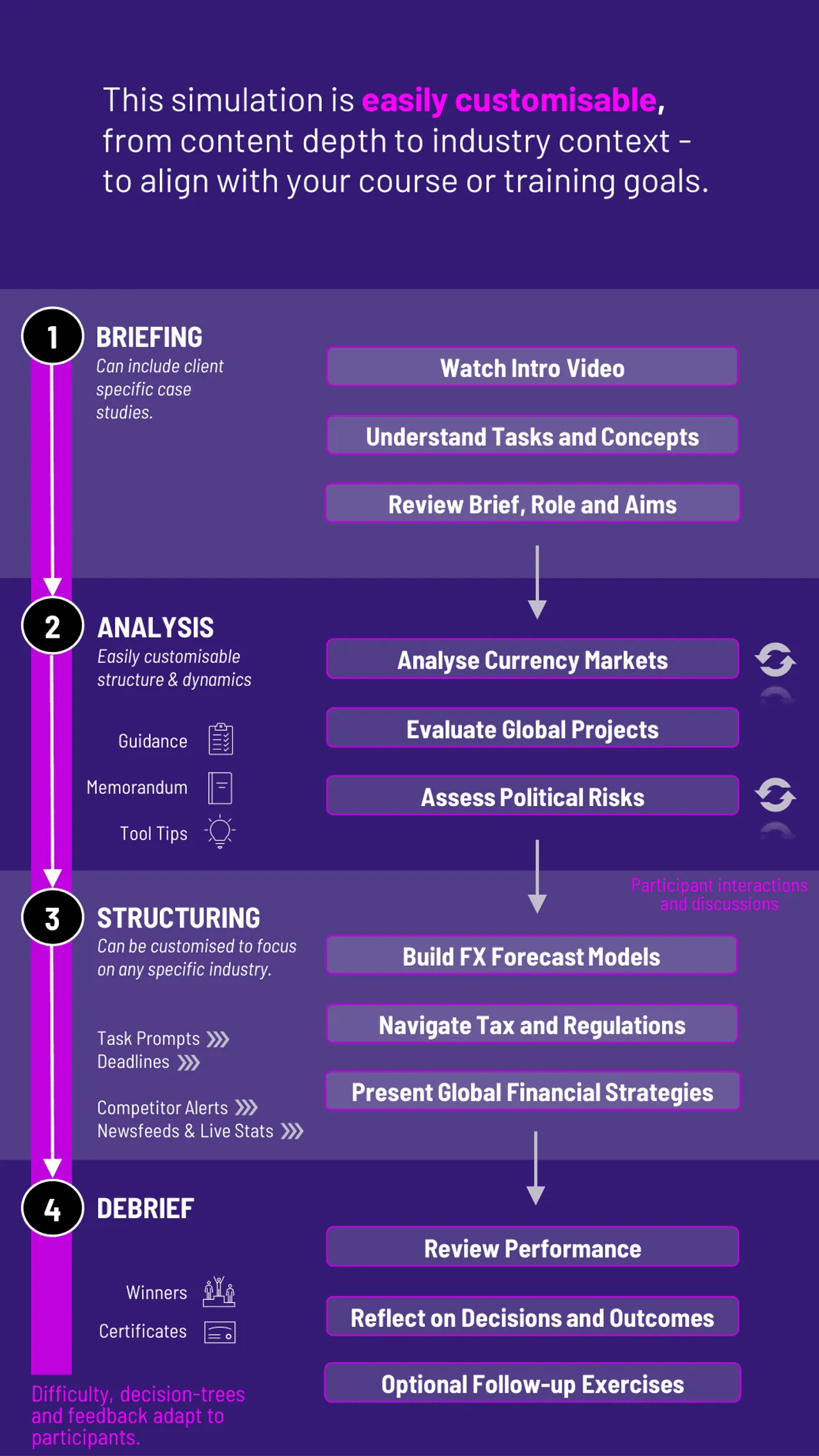

What Participants Do
During the international finance training, participants engage in the following tasks to develop and apply international finance skills:
- Analyze Currency Markets: Evaluate real-time exchange rate data and predict future movements.
- Hedge Currency Exposure: Use financial instruments to manage risk in international transactions.
- Evaluate Global Projects: Conduct capital budgeting for multinational investments.
- Assess Political Risk: Analyze geopolitical trends and assess their financial impact.
- Manage International Cash Flows: Optimize working capital across different currencies and jurisdictions.
- Structure Cross-Border Financing: Choose between debt, equity, and hybrid instruments for international projects.
- Develop FX Forecasting Models: Build models to anticipate exchange rate movements.
- Navigate Tax and Regulation: Consider international tax treaties and compliance issues in strategy.
- Design Transfer Pricing Policies: Create pricing strategies for intra-company transactions.
- Present Global Financial Strategies: Communicate decisions and outcomes to stakeholders effectively.

What Participants Learn
- Currency Market Understanding: Learn how global currency markets operate and influence financial strategy.
- Risk Hedging Techniques: Master the use of derivatives to protect against currency and political risk.
- Cross-Border Valuation: Develop skills in valuing international investments under uncertainty.
- Multinational Budgeting: Understand how to evaluate foreign projects using adjusted cash flows.
- Strategic Global Financing: Learn to assess financing options in multiple currencies and jurisdictions.
- Transfer Pricing and Tax Optimization: Understand the role of tax efficiency in international finance.
- Political Risk Assessment: Build frameworks for evaluating and responding to geopolitical risks.
- Regulatory and Ethical Insight: Gain familiarity with cross-border financial regulation and ethical considerations.
- Communication in Global Contexts: Improve ability to explain international strategies to diverse audiences.
- Decision-Making Under Volatility: Strengthen confidence in navigating fast-changing international financial environments.

Why The International Finance Training Works
The International Finance Training is uniquely designed to provide a real-world learning experience that reflects the complexity of global financial management. It challenges participants to think strategically and analytically while navigating the unpredictable nature of currency fluctuations, regulatory landscapes, and geopolitical pressures. This makes it ideal for developing well-rounded professionals ready to work in multinational organizations.
Through interactive decision-making, participants develop not just technical proficiency, but also the adaptability and global awareness essential for international financial roles. The international finance training’s focus on scenario-based learning ensures that theory is reinforced with practical, memorable experiences.