This fixed income securities training is ideal for banking professionals, financial analysts, portfolio managers, and anyone transitioning into fixed income roles or bond markets.

Fixed Income Securities Training
Participants act as fixed income analysts, navigating bond markets, managing interest rate risks, and optimising portfolios to achieve financial goals in dynamic scenarios.

Training Overview
The Fixed Income Securities Training immerses participants in the intricate world of bond markets, equipping them to analyse and manage fixed-income portfolios under varying economic conditions. Participants take on the roles of fixed income analysts, developing strategies to optimise portfolio performance while navigating real-world challenges such as interest rate fluctuations, credit risks, and macroeconomic shifts.
This training provides a hands-on experience in understanding how fixed income securities behave in diverse market environments. Participants gain valuable insights into pricing, yield calculations, and risk management strategies, preparing them for roles in investment management, corporate finance, and treasury operations.

Fixed Income Securities Training Concepts
- Bond Pricing and Valuation
- Yield to Maturity and Yield Curve Analysis
- Duration and Convexity
- Interest Rate Risk Management
- Credit Risk Assessment
- Fixed Income Portfolio Diversification
- Economic Indicators and Bond Markets
- Inflation-Linked Securities
- Callable and Convertible Bonds
- Structured Fixed Income Products
- Fixed Income Derivatives
- Regulatory and Compliance Issues in Fixed Income

Gameflow
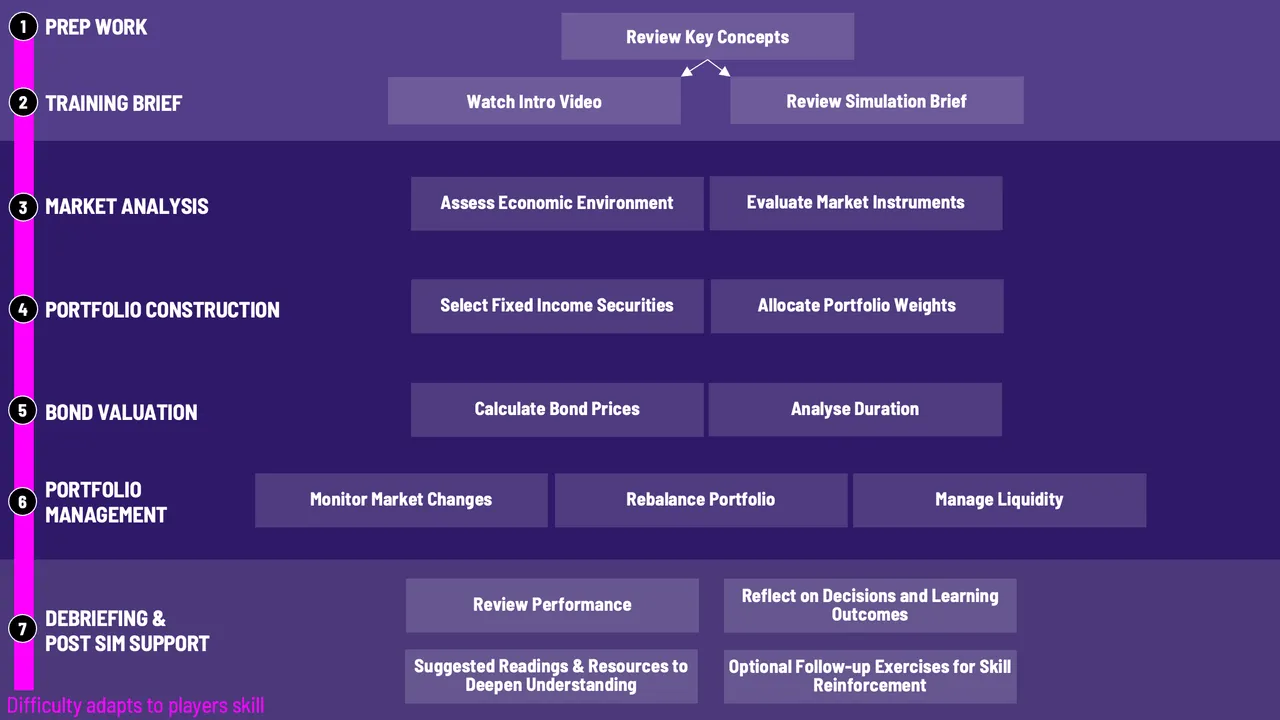

Where Fixed Income Securities Skills Are Used
Throughout the fixed income securities training, participants apply a broad range of skills that are directly transferable to real-world roles in fixed income. The training acts as a practical training ground where they can refine their abilities and gain confidence in areas such as:
- Portfolio Management: Apply strategies to balance risk and return in diverse fixed income portfolios.
- Credit Risk Analysis: Evaluate the creditworthiness of issuers to minimise default risks.
- Interest Rate Forecasting: Use macroeconomic data to anticipate rate movements and adjust strategies.
- Yield Curve Construction: Analyse and interpret yield curves to inform investment decisions.
- Hedging Strategies: Implement derivatives to hedge interest rate and credit risks effectively.
- Pricing Complex Securities: Calculate the value of callable, convertible, and structured bonds.
- Macroeconomic Analysis: Incorporate economic trends into fixed income decision-making.
- Compliance and Regulation: Ensure portfolio strategies meet legal and regulatory requirements.
- Scenario Testing: Simulate how economic shocks impact portfolio performance.
- Client Advisory Skills: Communicate insights on bond markets to stakeholders.

What Participants Do
In the fixed income securities training, participants immerse themselves in tasks that closely mirror the day-to-day duties in the world of fixed income. This hands-on experience allows them to step into various roles and actively participate in realistic scenarios. Some of the core activities involve:
- Analyse Bond Markets: Study market trends and evaluate opportunities across different bond categories.
- Construct Portfolios: Build and optimise fixed income portfolios to align with specific investment goals.
- Assess Creditworthiness: Analyse issuer financials to identify high-quality investment opportunities.
- Perform Risk Analysis: Measure interest rate and credit risks for diverse bond instruments.
- Model Yield Curves: Use data to construct and interpret yield curves for strategic decisions.
- Implement Hedging Strategies: Utilise swaps and options to mitigate risk exposure.
- Adapt to Market Conditions: Respond to simulated economic shifts, including rate hikes or recessions.
- Evaluate Performance Metrics: Monitor portfolio returns and adjust for underperforming assets.
- Navigate Regulations: Make compliance-informed decisions within the training environment.
- Present Recommendations: Summarise findings and propose strategies to peers or stakeholders.

What Participants Learn
- Bond Pricing Techniques: Master calculations for valuing fixed income securities.
- Understanding Yield Dynamics: Explore the relationships between price, yield, and interest rates.
- Risk Mitigation: Develop hedging strategies to safeguard investments.
- Portfolio Construction: Gain skills in diversifying and managing fixed income portfolios.
- Macroeconomic Integration: Learn to incorporate economic indicators into financial decision-making.
- Duration and Convexity: Understand these key measures for interest rate sensitivity.
- Credit Risk Evaluation: Assess issuer risk profiles to minimize defaults.
- Scenario Planning: Simulate responses to various economic scenarios.
- Ethical Decision-Making: Navigate the balance between profitability and regulatory compliance.
- Effective Communication: Present complex fixed income strategies clearly and persuasively.

Why This Fixed Income Securities Training Works
The Fixed Income Securities Training stands out due to its ability to blend theoretical knowledge with practical application. By immersing participants in realistic market scenarios, it ensures they gain a holistic understanding of how fixed income securities operate. This hands-on approach bridges the gap between classroom learning and real-world challenges.
Participants are continually challenged to analyse market data, make decisions under pressure, and adapt to evolving economic conditions. This dynamic learning environment cultivates critical thinking, analytical skills, and confidence - key attributes for any aspiring finance professional.