No, the training provides guided onboarding and explanation of key concepts. Familiarity with basic financial statements is helpful.

Equity Research Training
Participants take on the role of equity analysts, evaluating companies, forecasting performance, and pitching stock recommendations. They build valuation models, craft investment theses, and communicate insights under real-world time pressure.

Equity Research Training Overview
Participants take on the role of equity research analysts, responsible for developing and presenting stock recommendations to a simulated investment committee. They must assess historical financials, forecast future performance, evaluate competitive positioning, and apply valuation methods such as discounted cash flow and relative multiples.
Through realistic earnings releases, news updates, and industry briefings, participants experience the speed and scrutiny of working in sell-side or buy-side research roles. The training presents fresh challenges across each round - such as market volatility, management guidance changes, or macroeconomic surprises - requiring analysts to adjust their models and narratives accordingly.
Co-developed by investment professionals and academic experts, the training is adaptable for undergraduates, MBAs, or corporate training. It builds analytical depth, persuasive writing, and real-world presentation skills.

Equity Research Training Concepts
Participants work through realistic equity research scenarios, which can be customized to emphasize or exclude specific topics depending on the learning goals. This modular structure allows the simulation to be tailored for finance-heavy or research-focused sessions. Key concepts include:
- Financial Statement Analysis: Interpreting income statements, balance sheets, and cash flows
- Forecasting: Projecting revenue, margins, and capital expenditure
- Valuation Techniques: DCF, trading comparables, and target price setting
- Investment Thesis Building: Identifying key drivers and risks
- Market Sentiment Analysis: Reacting to real-time news, earnings calls, and sector trends
- Research Communication: Writing research notes and presenting buy/sell/hold recommendations
- Ethical Considerations: Transparency, compliance, and conflicts of interest

Gameflow
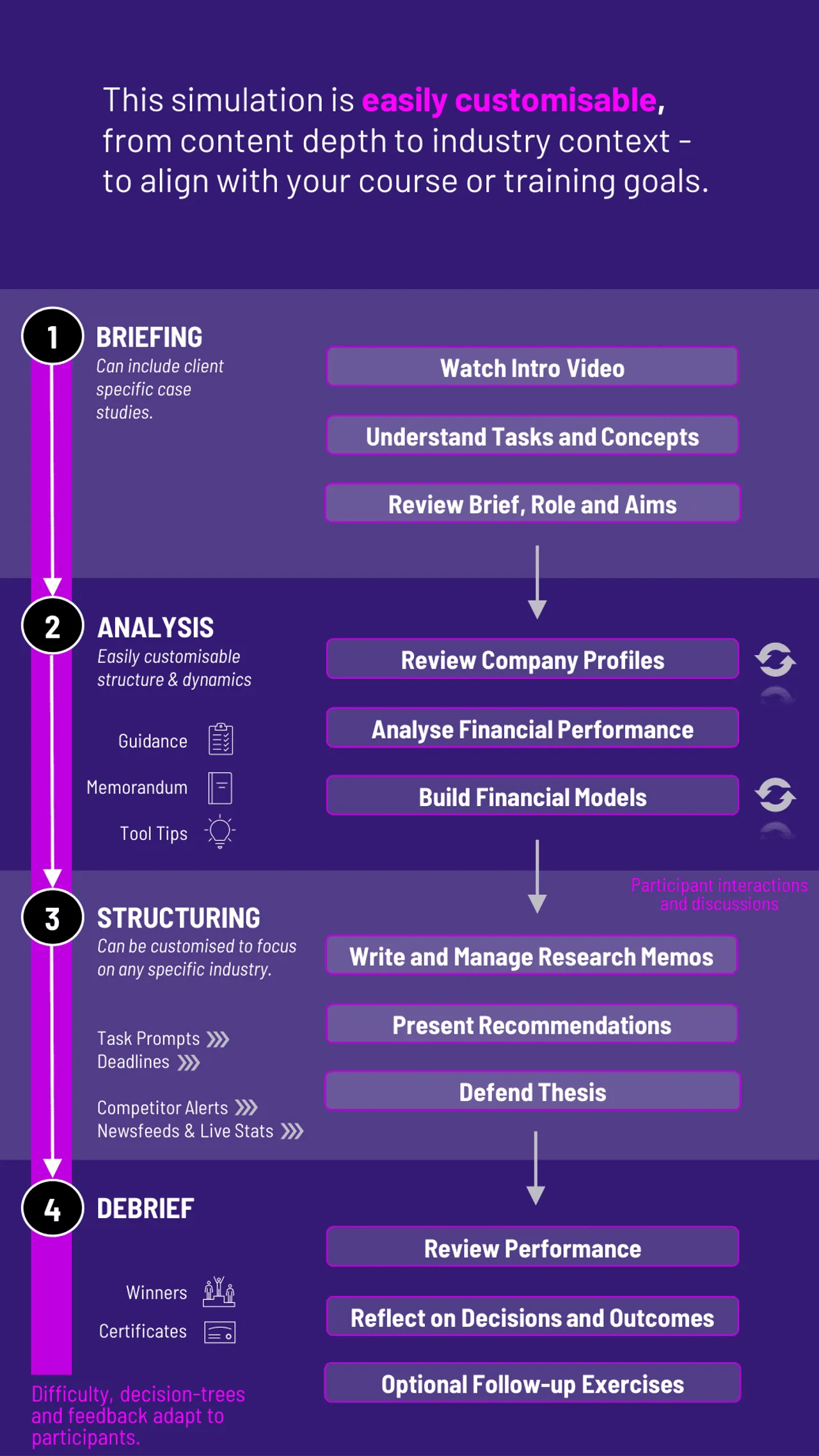

What Participants Do
Participants act as equity research analysts in a simulated investment firm. Over multiple rounds, they:
- Review company profiles and sector outlooks
- Analyze financial performance and KPIs
- Build and adjust a financial model
- Apply valuation methods to derive a stock price target
- Write a professional-grade research memo
- Present recommendations in a live (or recorded) committee format
- Defend their thesis under questioning from peers or simulated stakeholders

Learning Objectives
By the end, participants will be more confident in:
- Analyzing company performance using real data
- Building credible financial forecasts and valuations
- Communicating investment ideas with clarity and confidence
- Navigating uncertainty and conflicting data
- Making decisions under pressure and defending them
- Writing professional research notes for real-world audiences
- Differentiating between story-driven and data-driven analysis
- Responding to real-time market developments with agility
- Understanding the buy-side vs sell-side research perspectives
- Practicing presentation skills in high-stakes financial environments
The training is highly flexible and can be scaled for entry-level students or advanced learners preparing for finance roles.
How the Equity Research Training Works
The training can be run individually or in teams. Each decision-making cycle mimics the flow of a real analyst’s workflow. Here’s how the experience unfolds:
1. Receive a Scenario or Brief Each round begins with a new company case, market update, or event (e.g., earnings release). Participants receive a research task - such as a valuation update, downgrade memo, or new coverage report.
2. Analyse the Situation Participants evaluate available data: company financials, analyst estimates, macro headlines, peer performance, etc. They interpret key drivers and risks.
3. Build a Model and Make Decisions Using training tools or guided templates, participants forecast financials and apply valuation logic to form a view on fair value and investment direction.
4. Write and Present Research Participants write a short-form memo and deliver a pitch presentation (live or recorded), defending their rating and rationale to the committee.
5. Engage in Peer/Committee Review Teams or individuals receive feedback from instructors, peers, or AI-simulated investment committee members.
6. Repeat the Cycle Subsequent rounds introduce new variables (e.g., macro changes, earnings beats/misses, industry regulation), requiring revisions to analysis and narrative.
Throughout, participants are guided to reflect on their strategy, defend their assumptions, and iterate on their work.

Why This Equity Research Training Works
Equity research is where numbers meet narrative - and this training brings that intersection to life. Participants learn how real investment professionals think, write, and defend their views.
Rather than focusing only on technical modeling, the training emphasizes judgment, communication, and real-time thinking. It helps learners build the core toolkit for success in investment banking, asset management, and finance interviews, while also developing broader decision-making and presentation skills.
Frequently Asked Questions
Assessment
Assessment is flexible and customizable. Participants may be evaluated on:
- Forecast accuracy and valuation integrity
- Structure and clarity of research notes
- Presentation and persuasion skills
- Strategic response to new information
- Peer feedback or committee questioning
- Reflection logs and memo drafts
Optional peer/self-assessment tools can also be integrated to measure collaboration, analytical depth, and improvement over time. The training’s format allows easy inclusion in both academic courses and professional assessment centres.