No. The training includes onboarding content that introduces each asset class, their risks, and typical fund structures.

Alternative Investments Training
Participants build and manage portfolios across private equity, hedge funds, real assets, and more - navigating illiquidity, risk, and return—in our Alternative Investments Training.

Alternative Investments Training Overview
The Alternative Investments Training places participants in the role of institutional investors and asset allocators making strategic investment decisions across non-traditional asset classes.
Developed by industry professionals and academic specialists, the training challenges participants to evaluate opportunities in private equity, hedge funds, real estate, infrastructure, and commodities. They must balance return expectations with liquidity constraints, risk limits, and regulatory guidelines - just as pension funds, endowments, and sovereign wealth funds do in the real world.
With time-bound decisions and shifting market conditions, participants experience the complexity of building resilient, diversified portfolios beyond the public markets.

Alternative Investments Training Concepts
The training introduces participants to the diverse and often opaque world of alternative investments, covering:
- Asset Class Fundamentals: Private equity, hedge funds, venture capital, real assets, and commodities
- Liquidity and Time Horizons: Capital calls, lock-ups, and exit timelines
- Due Diligence and Manager Selection: Track records, alignment of interest, and strategy differentiation
- Risk and Return Profiles: Understanding downside protection, volatility, and alpha generation
- Portfolio Construction: Strategic vs tactical allocation, correlation, and diversification
- Fee Structures: 2/20 models, hurdle rates, and carried interest

Gameflow
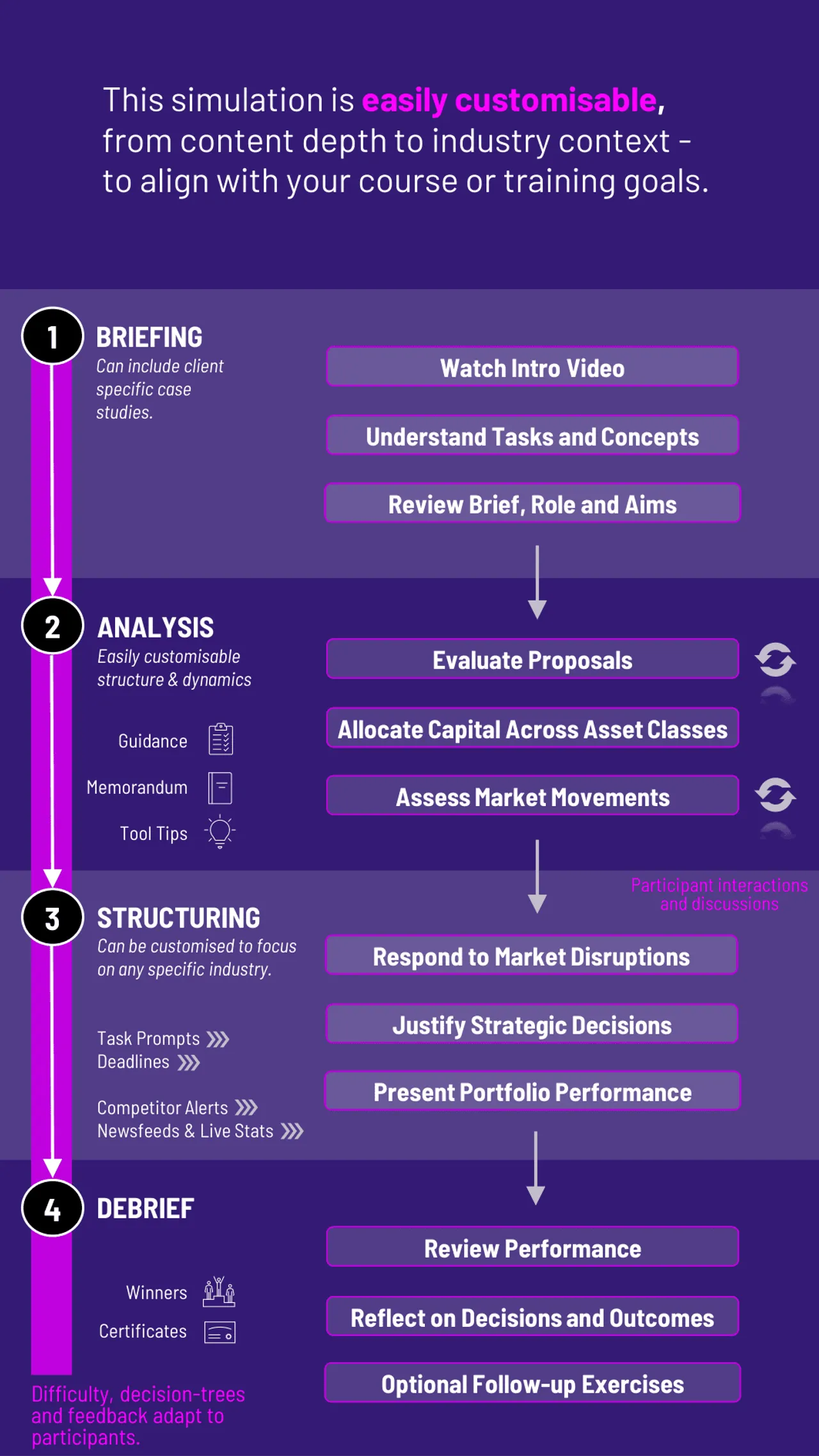

What Participants Do
In this training, participants act as chief investment officers or asset allocation committees for a large institutional fund. Over multiple training rounds, they:
- Evaluate proposals from alternative investment managers
- Allocate capital across multiple asset classes under risk and liquidity constraints
- Respond to simulated macroeconomic scenarios and market disruptions
- Reassess portfolios based on fund performance and capital call timing
- Justify strategic decisions to a simulated investment board or peer review panel
- Reflect on trade-offs between diversification, illiquidity, and long-term returns

What Participants Learn
Participants gain a nuanced understanding of how institutional investors approach alternative investments. They learn to:
- Distinguish between alternative asset classes and assess their role in a broader portfolio
- Evaluate fund manager pitches and identify red flags
- Allocate capital with an understanding of liquidity risks and drawdown schedules
- Defend investment decisions in terms of strategic fit and expected risk-adjusted return
- Track performance over time and manage rebalancing decisions
- Think long-term under uncertainty and real-world operational constraints

Why This Alternative Investments Training Works
Alternative investments are a growing part of global portfolios - but they often remain abstract in traditional classrooms. This training gives participants a hands-on, institutional perspective, teaching them to think like asset owners, not just asset pickers.
Rather than focusing on financial theory alone, the training emphasizes judgment, discipline, and long-term thinking. It highlights that returns in alternatives often come with trade-offs: complexity, illiquidity, and imperfect information.
Perfect for courses in investment strategy, asset management, or institutional finance, this training prepares participants for the frontier of modern portfolio construction.