Definition
Investment banking is advisory work for major financial transactions, mainly M&A and raising capital. You help clients make high-stakes decisions and execute deals.

Career Path
Overall
7.4/10Career attractiveness score
Best for
Ambitious StudentsComfortable with pressure
Workload
70+Hours per week can be normal
Upside
HighCompensation and exits
Core work
DealsM&A, capital raising, restructuring
Practice
SimsBuild realistic transaction experience
Definition
Investment banking is advisory work for major financial transactions, mainly M&A and raising capital. You help clients make high-stakes decisions and execute deals.
Junior day-to-day
What you do day-to-day on a junior level: You build and update Excel models, create PowerPoint pitch materials, run valuation analysis, research and due diligence, and turn work with messy inputs, often on tight deadlines.
Fit test
Is it for you? If you’re very ambitious and willing to work 70+ hours a week, enjoy structured problem-solving, and perform well under time pressure, investment banking can be a great fit. If you need a predictable schedule or dislike repetitive iteration on details, it is a poor match.
7.4/10
Work-Life Balance
2.8/10
Compenstation
9.2/10
Development
8.8/10
Prestige
9.0/10
Exit Opportunities
9.3/10
Job Security
5.8/10
AI Replacement Risk
7.5/10
Hiring Outlook
6.8/10
Investment banking scores highly on compensation, training density, prestige, and exit opportunities, but the workload and lifestyle trade-off keep the overall attractiveness score from being higher.
Despite the name, investment banking isn’t about managing investments. It’s a client-service business helping companies and investors execute major financial transactions. Most commonly those are mergers & acquisitions, raising capital, and restructuring when things go wrong. Many investment banks are household names: for example, Goldman Sachs, Morgan Stanley, J.P. Morgan, Bank of America, and Deutsche Bank are known as large “bulge bracket” investment banks.
There are also elite boutique banks and mid-market banks focusing on specialized sectors or smaller deals.
Investment banking involves handling financial challenges for clients, raising hundreds of millions in new funding or advising on the purchase of one company by another. Because of the complexity and impact of these deals, bankers need a mix of financial expertise and strategic acumen, just as well as strong client skills.
One of the biggest draws of investment banking is the generous compensation packages. Banks pay high salaries to attract top talent and to make the brutal hours a bit more bearable. For all those benefits - money, prestige, experience - there are serious challenges. Work-life balance is notoriously poor, with 80-100 hour weeks common for analysts with frequent all-nighters and tight deadlines imposed by clients or senior bankers. Both the stakes and the competition are very high.
Burnout is a real risk, and not everyone finds the rewards worth the sacrifices. It’s important to go in with your eyes open.
Typical path
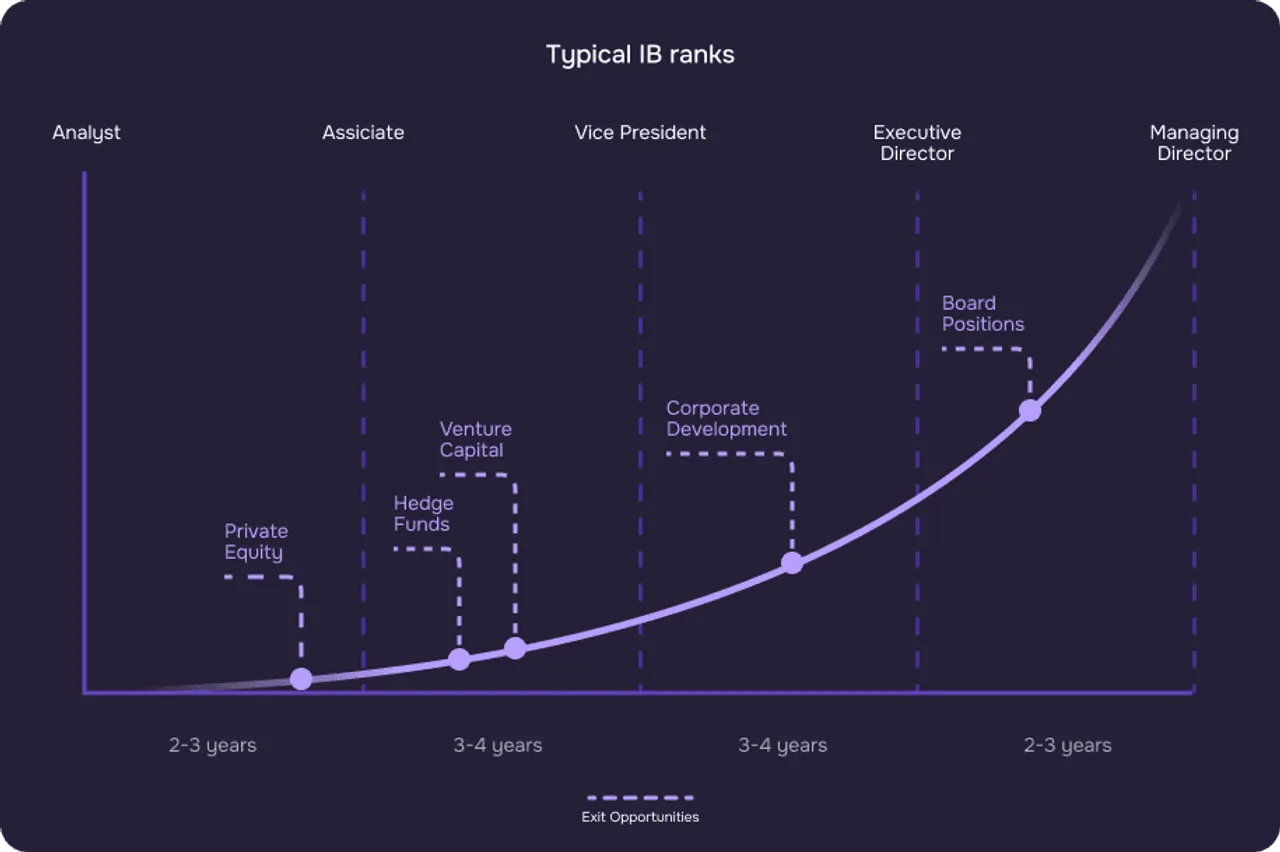
Investment banking careers usually move from Analyst or Intern to Associate, Vice President, Director or Executive Director, and finally Managing Director. Title names vary by bank, but the broad responsibility curve is similar.
Common exits
A lot of bankers pivot into private equity, hedge funds, corporate development, venture capital, or strategy roles before reaching the most senior positions, often for a different lifestyle or a more investing-focused career.
How the work changes
You typically start in research, Excel modelling, valuation, diligence, and PowerPoint. As you progress, the work shifts toward managing analysts, running processes, handling clients, originating deals, and leading relationships.
Bank differences
Some banks use Executive Director or Senior Vice President titles between VP and MD, while others skip those names. The important point is not the exact title, but how responsibility increases over time.
Fit check
If you enjoy the analytical side, you may prefer exits where analysis remains central. If you like advising, negotiation, relationship-building, and commercial pressure, the senior banker path may appeal more. Internships, first-hand stories, transaction research, and simulations are all useful ways to test the path before committing.
Investment banking pay is attractive because total compensation can rise quickly, but it is not fixed in the way many candidates expect. Base salary provides stability, while annual bonus depends on market conditions, firm performance, group performance, senior feedback, and individual contribution.

Analyst compensation ranges by market.
Location | Base salary | Bonus | Total compensation |
|---|---|---|---|
London | 50-70k GBP | 20%-50% | 70-100k GBP |
New York | 100-125k USD | 50%-100% | 165-225k USD |
Singapore | 160-220k SGD | 30%-40% | 210-310k SGD |

Your start as a financial workhorse for the many deals: pitch books, marketing materials, valuation models, urgent requests and emails. As a junior banker, you’ll know Excel shortcuts better than most people know their neighbours’ names, and come to understand the phrase “quick turnaround” as meaning anything between 10 minutes and going home at 4:00am.
Analysts also do a lot of the administrative grunt work like managing due diligence trackers or coordinating internal processes. Typically this position is filled by undergraduates on an internship or those with 1-2 years of experience in a related field. Many banks hire analysts straight from undergrad or equivalent. Some analysts join after a master’s in finance, but generally analysts are the youngest in the firm.
Analysts need to master the fundamentals of finance: accounting, valuation, Excel. Also, develop great work habits - organization, responsiveness, and not overlooking details. Soft skills like communication start to develop too: even as an analyst you may occasionally speak on calls or contribute ideas, and you’ll certainly interact with peers and associates, so professionalism and teamwork count.
Top analysts also learn to manage upwards, keeping your associate/Vice President informed of your progress and flagging issues early. A strong analyst is like a reliable machine: if you produce quality work consistently and show a good attitude, you’ll get staffed on the best deals and earn strong recommendations.
So, what should you focus on as an aspiring Analyst?
Recruiting readiness
Show that you understand the job, can handle technical work, and can explain why banking is the right platform for you.
Practical edge
Use deal simulations, valuation exercises, transaction write-ups, and networking notes so your answers sound grounded rather than generic.

If you’re considering this path, honestly assess yourself on these dimensions. You don’t need to be a 10/10 on all, few are, but you should be strong in several and willing to improve in others. For example, you might be smart and very hard-working, but your communication skills are not great. You will need to work on that to successfully get through the interviews.
The tried and true method to break into investment banking is to attend a top university, Russell Group, Ivy League, etc., win summer internships very early and then apply to a job after graduating. Graduates of top MBA programs have a decent possibility of winning an offer, too.
Breaking into investment banking is highly competitive, but it’s certainly achievable with the right approach. In this section, we’ll cover the typical pathways into IB and specific advice for different scenarios, whether you’re at a target school or a non-target, an undergrad or a career changer. Key areas we’ll touch on: education, internships, networking, and strengthening your profile.
IB interviews typically have multiple components:
You should prepare a set of personal stories that highlight your skills: a story of you solving a problem, a story of overcoming a challenge, a story of a success you’re proud of. Use the STAR method - Situation, Task, Action, Result - to structure these.
Come across as enthusiastic, humble, and someone who’d be pleasant to work with on a long project.
One way to prepare more effectively is to work through a realistic deal scenario rather than relying only on question banks. In the Finsimco Career Launch simulation, students work on a M&A transaction under intense time pressure, which helps them develop concrete examples they can later reference in interviews. This kind of experience often makes answers to technical and behavioral questions more grounded and also helps clarify whether the role itself is a good fit.

M&A advisory involves helping companies buy, sell, or merge businesses. Investment bankers advise on valuation, transaction structure, buyer or target selection, negotiation strategy, and execution. This work can be sell-side, advising a company being sold, or buy-side, advising an acquirer.
Work typically includes:
All this might seem intimidating, but in truth it’s all a matter of practice. If you wish to pursue investment banking, then having experience in handling transactions, building spreadsheet models, and handling negotiations would give you an edge over other applicants. Finsimco’s simulations are one way of gaining such experience.
If you’re still in college, ask your professor about incorporating one of the latter simulations in your curriculum:
For those already out of college or wishing to partake in the simulation solo, we’ve created Career Start Simulation. In this simulation you will partake in one of the standard operations, conduct due diligence, and partake in negotiation. Based on your performance, we would assess your skills and provide that data to the recruiters. That would provide you with an easier start for your career, while also learning some basics.
Join other students building their future careers now with simulations. Take your first flight with Finsimco. For free.