Short of landing an internship, the best way to get a feel for IB work is to simulate it. This can be done through realistic financial simulations and virtual experience programs. For example, Finsimco’s 2-hour M&A simulation lets you run through a mock deal: you value a company, react to urgent client requests, and make decisions under time pressure, very much like a real analyst would. Completing such a simulation gives you tangible experience you can discuss in interviews and the confidence of having “done it before.” The key is to go beyond just reading guides: actually build a DCF, draft a pitch slide, or analyze a case yourself. By practicing the work in a hands-on way, you’ll improve your technical skills and be far better prepared when recruiting or when you start the job. Finsimco’s simulation in particular is designed to be an interview-grade experience, so it’s an excellent preparation tool (and top performers even get noticed by employers!). In summary, immerse yourself in any realistic finance work scenarios you can find – it will pay dividends in both your performance and your confidence.

Career Path
Investment Banking Career Path
What is Investment Banking? (In Short)
Investment banking is advisory work for major financial transactions, mainly M&A and raising capital. You help clients make high-stakes decisions and execute deals.
What you do day-to-day (on a junior level): You build and update Excel models, create PowerPoint pitch materials, run valuation analysis, research & due diligence, and turn work with messy inputs - often on tight deadlines.
Is it for you? If you’re very ambitious and willing to work 70+ hours a week, enjoy structured problem-solving, and perform well under time pressure, investment banking can be a great fit. If you need a predictable schedule or dislike repetitive iteration on details, it is a poor match.
Career Attractiveness Score: 7.4/10
SCORE
7.4/10
Work-Life Balance
2.0/10
Compenstation
10.0/10
Development
9.0/10
Prestige
10.0/10
Exit Opportunities
10.0/10
Job Security
5.0/10
AI Replacement Risk
7.0/10
Hiring Outlook
6.0/10
While the hours are long and the stress is ever-present, a career in investment banking provides a compelling compensation and a lot of lucrative exit opportunities. Having lost some prestige in the last years, a job in investment banking is still a very respectable job and has reasonable security relative to other banking spheres. The environment is highly competitive, leading to a lot of opportunities for growth, some are career-related, others in personal life.
What does an Investment Banker do?
Despite the name, investment banking isn’t about managing investments. It’s a client-service business helping companies and investors execute major financial transactions. Most commonly those are mergers & acquisitions, raising capital, and restructuring when things go wrong. Many investment banks are household names: for example, Goldman Sachs, Morgan Stanley, J.P. Morgan, Bank of America, and Deutsche Bank are known as large “bulge bracket” investment banks. There are also elite boutique banks and mid-market banks focusing on specialized sectors or smaller deals.
Investment banking involves handling financial challenges for clients, raising hundreds of millions in new funding or advising on the purchase of one company by another. Because of the complexity and impact of these deals, bankers need a mix of financial expertise and strategic acumen, just as well as strong client skills.
One of the biggest draws of investment banking is the generous compensation packages. Banks pay high salaries to attract top talent and to make the brutal hours a bit more bearable. For all those benefits (money, prestige, experience), there are serious challenges. Work-life balance is notoriously poor, with 80-100 hour weeks common for analysts with frequent all-nighters and tight deadlines imposed by clients or senior bankers. Both the stakes and the competition are very high. Burnout is a real risk, and not everyone finds the rewards worth the sacrifices. It’s important to go in with your eyes open.

What is the Investment Banking Career Progression?
Throughout a career an investment banker changes a few titles - from an Analyst/Intern to a Managing Director. For simplicity’s sake career path can be outlined in three stages broadly: an Analyst, an Associate, and Senior Positions. The latter ones include Vice President, Senior Vice President, and Managing Director. Most people choose to pivot to adjacent fields (like Private Equity, Hedge Funds, Corporate Development, etc) before reaching a Senior Position, as working hours outside the investment banking tend to be more predictable and some jobs hold even higher prestige.
You typically start as an Analyst (doing research and lots of analytics in Excel), become an Associate (managing projects and Analysts), then a Vice President (running deals and handling clients day-to-day), next a Director/Executive Director (originating and executing larger deals, almost an Managing Director), and finally a Managing Director (bringing in business and leading the franchise). Title structures and sometimes names may vary by bank. For example, at Morgan Stanley the typical progression is Analyst to Associate to a Vice President and then Executive Director to a Managing Director, whereas at Goldman Sachs it is Analyst to Associate to a Vice President, finishing off with a Managing Director, skipping the Executive Director Entirely. Despite the differences in titles, the responsibilities at each level are broadly comparable across banks.
Understanding this career path can help you set expectations and goals. For instance, if you’re an analyst now and thinking “Do I want to be a Managing Director someday?”, consider whether the Managing Director’s role appeals to you – it’s much more sales and relationship-driven. Some people realize they love the analytical side more and might stop earlier or move to a hedge fund where analysis remains key. Others relish the idea of advising and will push on.
To assess if this specific career is right for you, you can try out internships, search for first-hand stories or you can research specific tasks you're going to handle on the job: M&As, restructuring, etc. and try to play them out by the book. Finsimco provides such simulations for different types of financial tasks. They serve as an interactive and very real experience (but ultimately in a safe and non-committal way) of trying out careers.
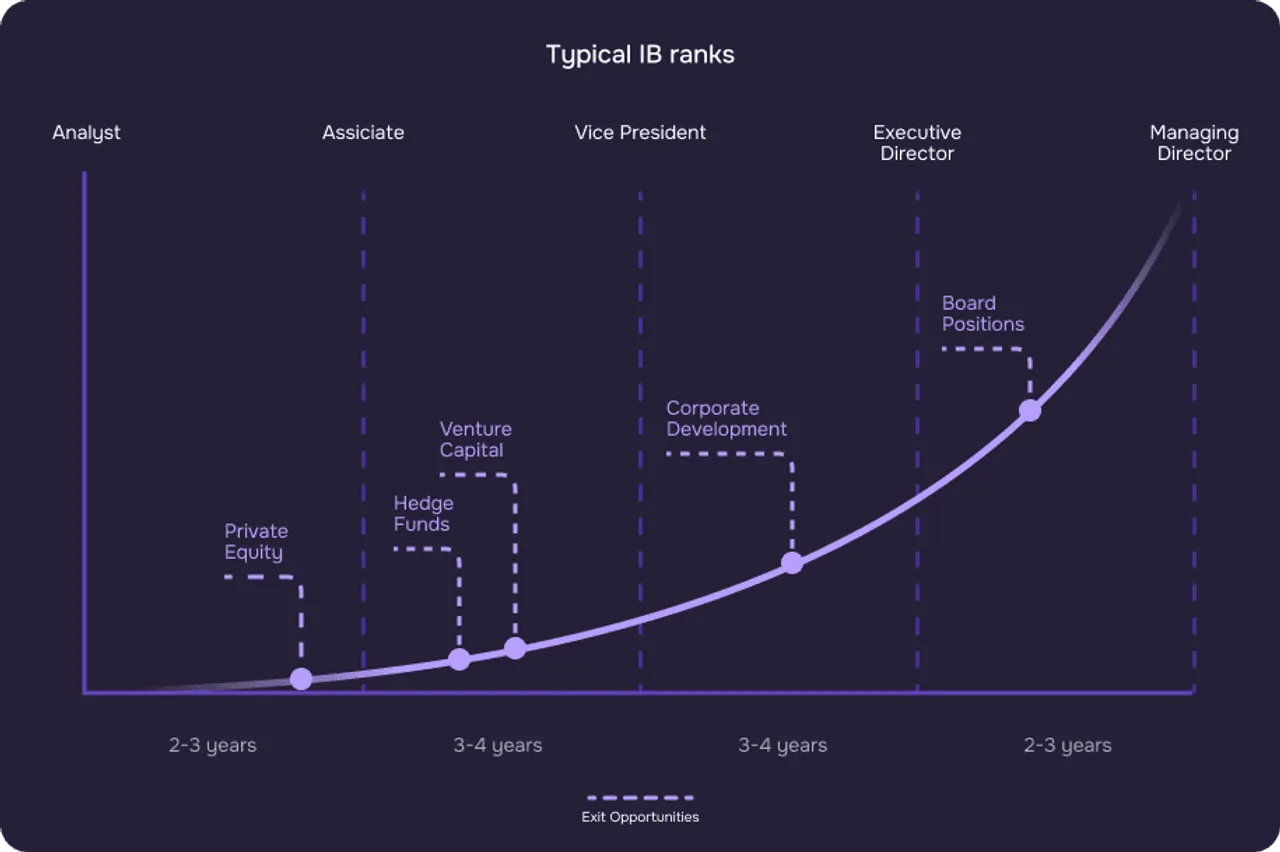
Investment Banking Career Ladder and Common Exit Routes
The most common exits for analysts cluster into buy-side investing roles (private equity, growth equity, hedge funds), corporate development/strategy inside companies, and MBA/further study. In a typical analyst class, it’s common to see a meaningful minority leave after the second year, with exits accelerating around the point when analysts decide between pushing for promotion or switching into a role with a more predictable lifestyle.
IB Level | Typical Experience | What You Do | Common Exit Routes |
|---|---|---|---|
Intern / Analyst | 2-3 years | Modeling, valuation, pitchbooks, execution support | Private Equity, Hedge Funds, Corporate Development, Strategy, Venture Capital, FinTech, MBA |
Associate | 3-4 years | Manage analysts, own workstreams, client interaction | Private Equity (post-MBA), Corporate M&A, Strategy, CFO-track roles |
Vice President | 3-4 years | Run deals, manage teams, client execution | Corporate leadership, capital markets, senior finance roles |
Director / ED | 2-3 years | Support origination, lead major workstreams | Advisory, senior corporate roles |
Managing Director | no data | Originate business, senior client relationships | Board roles, senior leadership, entrepreneurship |
How will AI Impact Investment Banking Careers?
Dealmaking depends on trust, judgment, and personal networks, so it's hardly possible for AI to replace human investment bankers. As AI frees up bankers’ time on the analytics’ side, the personal touch is going to become even more important, with even more client interaction and an even stronger focus on relationships.
Where AI is having the biggest impact:
- Automation of groundwork: Research, financial modelling, valuation updates, and data-heavy analysis are increasingly AI-assisted.
- Faster execution: Generative AI can produce first-draft models and pitchbooks in minutes rather than days, handling formatting, updates, and repetitive calculations.
- Smarter junior roles: Instead of spending nights tweaking Excel, junior bankers will prompt AI tools, verify outputs, and turn analysis into clear, client-ready insights.
Morgan Stanley seems to be at the forefront in embedding AI into daily workflows. Analysts use the firm’s proprietary AI, reducing time spent working on documents. This signals that junior-level ground work is being compressed, while judgment, storytelling, and client trust remain firmly human.
Five years from now, an investment banking analyst’s desk may include an AI teammate handling much of the Excel sheets, while the analyst focuses on formulating insights and nurturing client relationships. For those entering the field, this is an exciting prospect: less mind-numbing toil and more time to learn the art of the deal. Embracing AI will be key to thriving, and the bankers who combine high-tech tools with high-touch client service are likely to close the biggest deals in the years ahead.

How Does Investment Banking Compensation Work?
Investment banking compensation is one of the main attractions of the career, but it’s often misunderstood. It’s built around a structure where total pay depends heavily on performance. Every banker receives a base salary, which is fixed and predictable, and a bonus, which is variable and typically paid annually. The base provides stability, but the bonus is where most of the upside sits.
At the junior level, base salaries tend to be relatively similar across banks, especially within the same region. The real variation comes from bonuses, which depend on several factors. Firm performance plays a major role: strong deal years lead to larger bonus pools. Group performance also matters, as teams that close more deals tend to be rewarded more. On top of that, individual contribution influences outcomes, particularly how reliable and valuable you are perceived to be within your team.
As you start your career most of your pay will be composed from a base salary with a bonus coming up from 50% to 100% of the base salary. Progressing further into the ranks, you’ll notice that bonuses will quickly outpace the base salary. Compensation also greatly varies geographically and by bank’s prestige. Bulge Bracket’s is outclassed only by Elite Boutiques’, and below them is pretty much everything else. Below are approximated compensations in the biggest banks for US, Europe and APAC regions.
Salary Guide for 2026
| Bonus | Total | Base Salary | |
|---|---|---|---|
| London | 20%-50% | 70-100k GBP | 50–70k GBP |
| New York | 50%-100% | 165-225k USD | 100-125k USD |
| Singapore | 30%-40% | 210-310k SGD | 160-220k SGD |
Ready to fly Elite Finance?
Take your first flight in Finance with Simulations today. Be ahead of the curve on job market.

Going Up the Ladder
Your start as a financial workhorse for the many deals: pitch books, marketing materials, valuation models, urgent requests and emails. As a junior banker, you’ll know Excel shortcuts better than most people know their neighbours’ names, and come to understand the phrase “quick turnaround” as meaning anything between 10 minutes and going home at 4:00am. Analysts also do a lot of the administrative grunt work like managing due diligence trackers or coordinating internal processes.Typically this position is filled by undergraduates on an internship or those with 1-2 years of experience in a related field. Many banks hire analysts straight from undergrad or equivalent. Some analysts join after a master’s in finance, but generally analysts are the youngest in the firm.
Analysts need to master the fundamentals of finance (accounting, valuation, Excel). Also, develop great work habits – organization, responsiveness, and not overlooking details. Soft skills like communication start to develop too: even as an analyst you may occasionally speak on calls or contribute ideas, and you’ll certainly interact with peers and associates – so professionalism and teamwork count. Top analysts also learn to manage upwards – keeping your associate/Vice President informed of your progress and flagging issues early. A strong analyst is like a reliable machine: if you produce quality work consistently and show a good attitude, you’ll get staffed on the best deals and earn strong recommendations.
So, what should you focus on as an aspiring Analyst?
- Research: an Analyst spends a considerable amount of time preparing documents and models, so an ability to analyze enterprises, industries, and opportunities is indispensable.
- Financial Modeling: baseline financial and technical knowledge to create assessment models is must, too.
- Presentation: skills to prepare and showcase information effectively and reliably will come handy a lot during presentations.
- Soft Skills: while most of the administrative tasks (scheduling a meeting, preparing reports, etc) do not require specific knowledge, to complete them effectively you must hone your Soft Skills.
How to get into Investment Banking?
If you’re considering this path, honestly assess yourself on these dimensions. You don’t need to be a 10/10 on all (few are), but you should be strong in several and willing to improve in others. For example, you might be smart and very hard-working, but your communication skills are not great - you will need to work on that to successfully get through the interviews.
The tried and true method to break into investment banking is to attend a top university (Russell Group, Ivy League, etc), win summer internships very early and then apply to a job after graduating. Graduates of top MBA programs have a decent possibility of winning an offer, too.
Breaking into investment banking is highly competitive, but it’s certainly achievable with the right approach. In this section, we’ll cover the typical pathways into IB and specific advice for different scenarios – whether you’re at a target school or a non-target, an undergrad or a career changer. Key areas we’ll touch on: education, internships, networking, and strengthening your profile.

The tried-and-true method
Investment banks historically recruit heavily from “target schools,” which are universities they consider top-tier for talent (in the U.S., examples include Stanford, MIT, University of Chicago, etc.; in the UK, Oxbridge and top LSE/Imperial; across Europe and Asia, certain prestigious universities). If you’re at one of these schools, banks often come on campus for presentations, networking events, and first-round interviews. The typical timeline is:
Second year: apply for summer internships (sometimes called Summer Analyst programs). These are usually 10-week programs between school years where you essentially try out the role. Performance in a summer internship is the single most important factor for getting a full-time offer. Banks often fill the majority of full-time analyst slots from their summer intern pool. So, aim to land an IB summer internship after your junior year (or penultimate year). Some banks even offer “sophomore internships” or shorter off-cycle internships earlier – if you can get one, it helps but not mandatory.
Internship to Full-time offer: If you do well in the internship, you will probably get a return offer for after graduation. If not, you can still recruit in your final year for any open positions (less common to find spots, but still possible).
Grades and coursework: Keep your GPA strong (generally 3.5+ on a 4.0 scale is advisable for the U.S., or a 2:1 or First in the UK system). While banks aren’t purely academic, a low GPA can raise red flags about your diligence or aptitude. They also like to see relevant coursework. However, you can be any major as long as you can demonstrate the skills/interest.
If you’re at a target school, use your on-campus recruiting resources: attend bank info sessions, network with alumni who work at banks, and practice interviewing early (your school’s career center may have guides or mock interviews). The competition among target school candidates is fierce, everyone has high grades and some finance experiences, so you need to stand out by either stronger leadership roles, unique internships, or exceptional networking.

How do you get into investment banking from a non-target school?
If you’re not at a traditional feeder school, don’t be discouraged – many have broken into IB from non-targets, but it requires extra hustle. These days Investment Banks try to broaden their recruitment fields, searching even outside of top pick universities. Here’s what you can do:
- Get relevant experience elsewhere: Try to get internships in finance or related fields even if not at a bulge-bracket bank. For example, intern at a boutique investment bank, a valuation firm, a Big 4 accounting firm (in deals advisory), a corporate finance department, or even a startup’s finance team. Showing you have practical experience is key. If you can’t get IB right away, corporate finance or Big 4 Transaction Advisory can be a stepping stone – you build valuation and modeling skills there that banks appreciate.
- Off-cycle internships: Unlike target school students who follow the structured summer schedule, you can pursue off-cycle internships (during the school year, winter). Smaller banks or local firms often take interns year-round. Even an unpaid internship at a small advisory firm can give you deal exposure and something to talk about in interviews.
- Network, network, network: This is your lifeline. Start by finding alumni from your university who work in banking (even if your school isn’t a target, you might have some alumni in the industry – use LinkedIn). Reach out politely, express your interest and ask for advice (maybe a 15-minute call). Many will be willing to help if you show genuine motivation. Networking can lead to referrals, or at least someone flagging your CV in the pile. Don’t forget to network with professionals through industry events or student finance conferences. Don’t underestimate the power of a personal connection: a single alumnus advocating for you can sometimes get you an interview shot that you otherwise wouldn’t have.
- Consider an MBA or Master’s: If you’re already past undergrad and trying to switch into IB, an MBA from a top business school is a common route. Banks recruit heavily from top MBA programs for associate positions. However, this practice has become less prominent in recent years. For the undergrads, if you feel like you missed the window, working a couple of years in a related field then doing an MBA might reset your chance. There are also specialized Master’s in Finance programs; In this case you’ll have to get to the top ones to even the score.
- Display self-initiated finance skills: Perhaps participate in financial case competitions, join a student investment club, get involved in CFA Research Challenge or similar events. You can also take courses, there are many great options that are free. You could also start studying for the CFA. Even CFA Level 1 if you have time – though CFA is more for asset management, it still signals interest and knowledge). After completing a Finsimco Career Launch simulation, students can access discounts with selected CFA preparation providers as an optional next step for structured exam preparation.
Be persistent and don’t get discouraged by rejection: It’s common to send dozens of networking emails and maybe get a handful of responses. That’s okay and you’ll have to get used to it; keep refining your approach. Always be respectful of people’s time in networking, and grateful if they help. When applying, cast a wide net: include middle-market banks, boutiques, regional offices, etc., not just Goldman and Morgan Stanley. Sometimes starting at a smaller bank and lateraling is easier than getting into a top bank straight away from a non-target.
Keep networking: there are examples of bankers with unexpected backgrounds. A notable example is Dr. Alexander Dibelius, who originally studied medicine and worked as a heart surgeon before switching into consulting and finance. He left medicine to join McKinsey consulting and later moved into investment banking with Goldman Sachs' M&A, where he spent over 20 years. At Goldman Sachs he became CEO of the bank’s DACH operations and served in senior global investment banking roles.

What should an investment banking resume look like?
Your CV should be polished, clear, and focused on relevant skills. Use a clean, ATS friendly format (banks prefer one-page CVs that are easy to scan). Highlight any finance experience prominently. Use action verbs and quantify achievements (“Analyzed 3 potential acquisition targets, built DCF models leading to recommendation adopted by firm”). If you did a school project valuing a company, you can include that under an “Academic Projects” section to show you know valuation. List strong GPA, test scores if good (some include SAT/GMAT if impressive). Also list relevant skills (Excel, PowerPoint, perhaps programming if applicable, any language fluencies). No typos, no formatting errors – attention to detail starts with your CV. For cover letters, keep them short and personalized: state why IB, why you, and why that bank. Honestly, many recruiters only glance at cover letters, but occasionally they do matter – especially if you have an unusual background, the cover letter can preempt questions by explaining your story and motivation.
After completing a Finsimco Career Launch simulation, students can access optional next-step resources to further refine their application materials.
Notes on getting your first Invetsment Banking job
The good news is, you don’t have to be perfect at everything. If you know you have a weakness (say, less prestigious school), you can counter it by excelling in something else (great internship and strong networking). Use the strategies below selectively based on what fits your situation. By going the extra mile in preparation, networking, and skill-building, you demonstrate the kind of initiative and excellence banks want on their teams. It shows you’ll likely go the extra mile too when you’re an intern or analyst.
- Secure internships: This is the easiest way to get in. Ideally you want to intern at bulge bracket firms or the well known corporate finance boutiques but smaller firms are also fine.
- Go for the alternative route: If you don’t get an internship junior year, you can try for a full-time job directly (it is hard, but some smaller firms might hire off-cycle) or consider related fields first.
- Gain first IB experience: Recruiters value candidates who have engaged with realistic deal work - even in simulated settings - where they analyze information, make decisions, and explain their reasoning under time constraints. Finsimco simulations are designed to help students understand finance fundamentals and deal-making in practice. You can participate in the LBO simulation, IPO simulation, Investment Banking simulation through your university.
- Practise with our Career Launch simulation: This immersive simulation places you in a M&A deal environment, helping you assess whether investment banking is the right fit while practicing interview-relevant tasks. - Your performance under time pressure is evaluated, and top performers may be recommended to leading employers.
- Use cold emailing effectively: If there’s a smaller bank or group you want, a well-written cold email to an Managing Director or Vice President outlining your interest and relevant skills can occasionally yield an opportunity. Focus on what you can offer (keen to work 100 hours a week to support the team, relevant experience, etc.), and keep it short. There is plenty of free advice on how to approach cold emailing.
- Consider geographic flexibility: It might be easier to land an IB role in a smaller financial hub (Houston for energy banking, Dublin, etc., or in Asia/Middle East if you have language skills) and then later transfer to NYC or London if desired. Once you have that IB on your CV, doors open wider.

How to Ace the Interview?
IB interviews typically have multiple components:
- Technical questions: These test your finance knowledge. Valuation methods, maybe a DCF walkthrough, connecting three financial statements, what happens on the financial statements if X changes, basic accounting (like what is working capital?), maybe some brainteasers or simple math (like mental math or probability).
- General Awarenes: You might be asked about recent deals in the news or tested on a quick case (“How would you value a coffee shop?”). Know key formulas (enterprise value vs equity value, WACC, CAPM, etc.) and practice clear explanations. If you claim something on your CV (like you did a valuation), be ready to discuss it in depth.
- Behavioral questions: Banks want to see that you’re motivated, have teamwork skills, handle pressure, and have a genuine interest in finance. Common questions: “Why investment banking?”, “Why our bank?”, “Tell me about a time you worked on a team under a tight deadline,” “Give an example of a leadership experience,” “What’s your biggest weakness?”, etc. You should prepare a set of personal stories that highlight your skills: a story of you solving a problem, a story of overcoming a challenge, a story of a success you’re proud of. Use the STAR method (Situation, Task, Action, Result) to structure these.
- “Story of your CV” question: a 2-minute walkthrough of your background and why it led you to banking. Show passion for finance – maybe mention how you started investing in college or enjoyed your finance classes or an internship sealed your interest. Fit is crucial; many candidates are technically competent, so banks often decide based on whom they personally like and trust to put in front of clients at 2 AM. So come across as enthusiastic, humble, and someone who’d be pleasant to work with on a long project.
One way to prepare more effectively is to work through a realistic deal scenario rather than relying only on question banks. In the Finsimco Career Launch simulation, students work on a M&A transaction under intense time pressure, which helps them develop concrete examples they can later reference in interviews. This kind of experience often makes answers to technical and behavioral questions more grounded and also helps clarify whether the role itself is a good fit.
What do investment banking recruiters look for?
Recruiters are often less focused on whether an answer is “impressive” and more on how it feels to work with the candidate under pressure. Clear structure and accuracy reduce cognitive load for the interviewer and signal that the candidate would make senior bankers’ lives easier during busy periods. Judgment shows whether the candidate can prioritize when everything seems important.
Communication and composure matter not just for clients, but internally, people who stay calm, absorb feedback, and adjust without defensiveness are easier to trust. Ultimately, recruiters are asking themselves a simple question: Would I be comfortable putting this person forward or will others think that person is not a fit? Investment Banking recruiters often apply a simple scoring rubric:
Criterion | How it’s tested | What “strong” looks like | "Weak" signals | How to train effectively |
|---|---|---|---|---|
Structure | “Walk me through…” questions; case prompts; CV walkthrough | Clear logic; headline first; easy to follow | Rambling; jumping around; no clear conclusion | Practice structuring answers as: context → drivers → options → recommendation |
Accuracy | Technical questions; math checks; quick drills; fact checks on your CV | Correct mechanics; clean assumptions; no basic errors | Confident but wrong; hand-waving; contradictions | Practice producing final-ready outputs, not rough drafts. |
Composure | Interruptions; challenge questions; pressure prompts | Flustered; defensive; visibly rattled | Calm under follow-ups; not defensive | Record 60–90 second answers and score yourself against a rubric. |
Judgment | “What matters most?” “Biggest risk?” “What would you do next?” | Prioritizes drivers/risks; makes trade-offs explicit | Obsessing over minor details; missing key risk | Write short investment or deal memos highlighting key risks and mitigants |
Communication | Time-boxed questions (video/interview); presentation prompts | Concise, human language; answers within time | Overlong; jargon-heavy; unclear point | Practicing answering general questions with your peers can help here. The task is to run your answers by other people to see if they seem off or at least get comfortable with being interviewed. |
Coachability | Interviewer corrects you / changes assumptions / adds a twist | Absorbs feedback; adjusts quickly; stays constructive | Arguing; rigidly sticking to a bad answer | Recruiters are looking for team players, so expect to be judged as one. Learn to adapt fast and be respectful when receiving feedback. |
Dealing with AI video interviews
These are becoming more common, and they reward a very specific kind of preparation. You’re not being evaluated on what you say, but on how clearly and efficiently you deliver it under time pressure. The format is usually timed and one-directional, so you don’t get feedback or clarification in the moment. That makes structure and pacing critical. You should prepare short, repeatable answers for the standard questions: “Tell me about yourself,” “Why investment banking,” “Why this bank,” as well as one strong example each for teamwork, leadership, and overcoming a challenge. Try to get comfortable delivering clear, structured responses within 60–90 seconds. Recording yourself is one of the most effective ways to improve: most candidates think they are concise until they actually watch themselves back.
Long introductions or slow setups hurt you. Strong candidates get to the point quickly, then support it. That’s why a “headline first” approach works well. Start with your conclusion, then give two or three supporting points. For example: “I’m interested in investment banking for three reasons…” or “My recommendation would be X, based on these key factors…” This makes your answer easier to follow, especially when time is tight.
In terms of prioritization, focus first on your “walk me through your resume” answer. This is the anchor for most interviews and sets the tone for everything else. Then make sure you’re solid on the core technical topics (DCF, how the three statements connect, enterprise value vs equity value, and working capital, etc.). Finally, prepare one deal or project you can explain clearly and confidently, including the rationale, key risks, and your role.
Once you have the basics, move into timed practice. Simulate real conditions by answering questions with a countdown, and occasionally interrupt yourself or change direction mid-answer. A lot of people fail not because they lack the experience, but because they crumble under the pressure. If you do get stuck during an answer, don’t panic or go silent. A strong recovery is to briefly summarize where you are and ask a clarifying question. That shows composure and structured thinking, which interviewers value more than a perfectly polished response.

What are the Common Types of Investment Banking Transactions?
Mergers & Acquisitions (M&A) M&A advisory involves helping companies buy, sell, or merge businesses. Investment bankers advise on valuation, transaction structure, buyer or target selection, negotiation strategy, and execution. This work can be sell-side (advising a company being sold) or buy-side (advising an acquirer).
Work typically includes: • Valuation analysis and scenario modeling • Preparation of pitch materials and marketing documents • Managing buyer or seller processes • Coordinating due diligence and negotiations
How to get into Investment Banking using Simulations?
All this might seem intimidating, but in truth it’s all a matter of practice. If you wish to pursue investment banking, then having experience in handling transactions, building spreadsheet models, and handling negotiations would give you an edge over other applicants. Finsimco’s simulations are one way of gaining such experience.
If you’re still in college, ask your professor about incorporating one of the latter simulations in your curriculum:
- Investment Banking Simulation. The most comprehensive simulation, covering everything from Financial Statement Analysis to full-on Debt Restructuring. Developed and used by Morgan Stanley bankers for training in-house, later expanded its use for university students.
- Mergers & Acquisitions (M&A) Simulation. A more concise simulation, focusing on handling companies’ transactions from either sell or buy side. M&A is one of the most common transactions in Investment Banking.
- Initial Public Offerings (IPO) Simulation. This simulation covers company assessment, share pricing, and investors’ shares allocation. That outline is indicative of a standard IPO strategy commonplace in Investment Banks all over the world.
For those already out of college or wishing to partake in the simulation solo, we’ve created Career Start Simulation. In this simulation you will partake in one of the standard operations, conduct due diligence, and partake in negotiation. Based on your performance, we would assess your skills and provide that data to the recruiters. That would provide you with an easier start for your career, while also learning some basics.
Frequently Asked Questions (FAQ)
Want to kickstart your Finance Career?
Join other students buliding their future careers now with simulations. Take your first flight with Finsimco. For free.