Yes. The simulation is designed with modular learning in mind. We provide foundational e-learning materials that cover the basics of financial statements, Excel, and valuation theory, making it accessible for motivated beginners while still challenging for those with more experience.

Valuation Simulation
In the high-stakes world of finance, a company's true worth is not just a number but a strategic argument. This simulation provides a realistic environment for participants to bridge the gap between theoretical finance and practical application.

Valuation Simulation Overview
The Valuation Simulation places you in the role of an investment banking or equity research analyst, challenging you to value a real-world company using the three core methodologies: Discounted Cash Flow (DCF), Comparable Company Analysis, and Precedent Transactions. Go beyond the textbook and experience the professional judgments, data challenges, and client expectations that define real-world valuation.
Participants will be provided with a comprehensive case study of a publicly-traded company, including its financial statements, industry data, and market benchmarks. The challenge is not just to calculate a value, but to build a compelling and defensible valuation thesis. Participants will make critical assumptions about growth, risk, and market multiples, sensitize their models to different scenarios, and ultimately, synthesize their findings into a professional valuation report and summary presentation. This process mirrors the exact workflow of top investment banks and financial advisory firms, giving them the confidence and skills to excel in their career.
Although ideal for undergraduate and graduate finance courses, executive training, and corporate finance skill workshops, the simulation is modular and scalable, allowing instructors to vary complexity.

Valuation Simulation Concepts
Participants work through realistic scenarios, which can be customized to emphasize or exclude specific topics depending on the learning goals. This modular structure allows the simulation to be tailored to any type of session. Key concepts include:
- Intrinsic vs. Relative Valuation
- Free Cash Flow to the Firm calculation.
- Weighted Average Cost of Capital.
- Terminal Value (Perpetuity Growth vs. Exit Multiple approaches).
- Selection of an appropriate peer group.
- Calculation and normalization of trading multiples (P/E, EV/EBITDA, EV/Sales).
- Benchmarking and applying multiples.
- Identifying relevant M&A transactions.
- Analyzing control premiums and deal-specific multiples.
- Financial Statement Analysis.
- Sensitivity and Scenario Analysis.

Gameflow
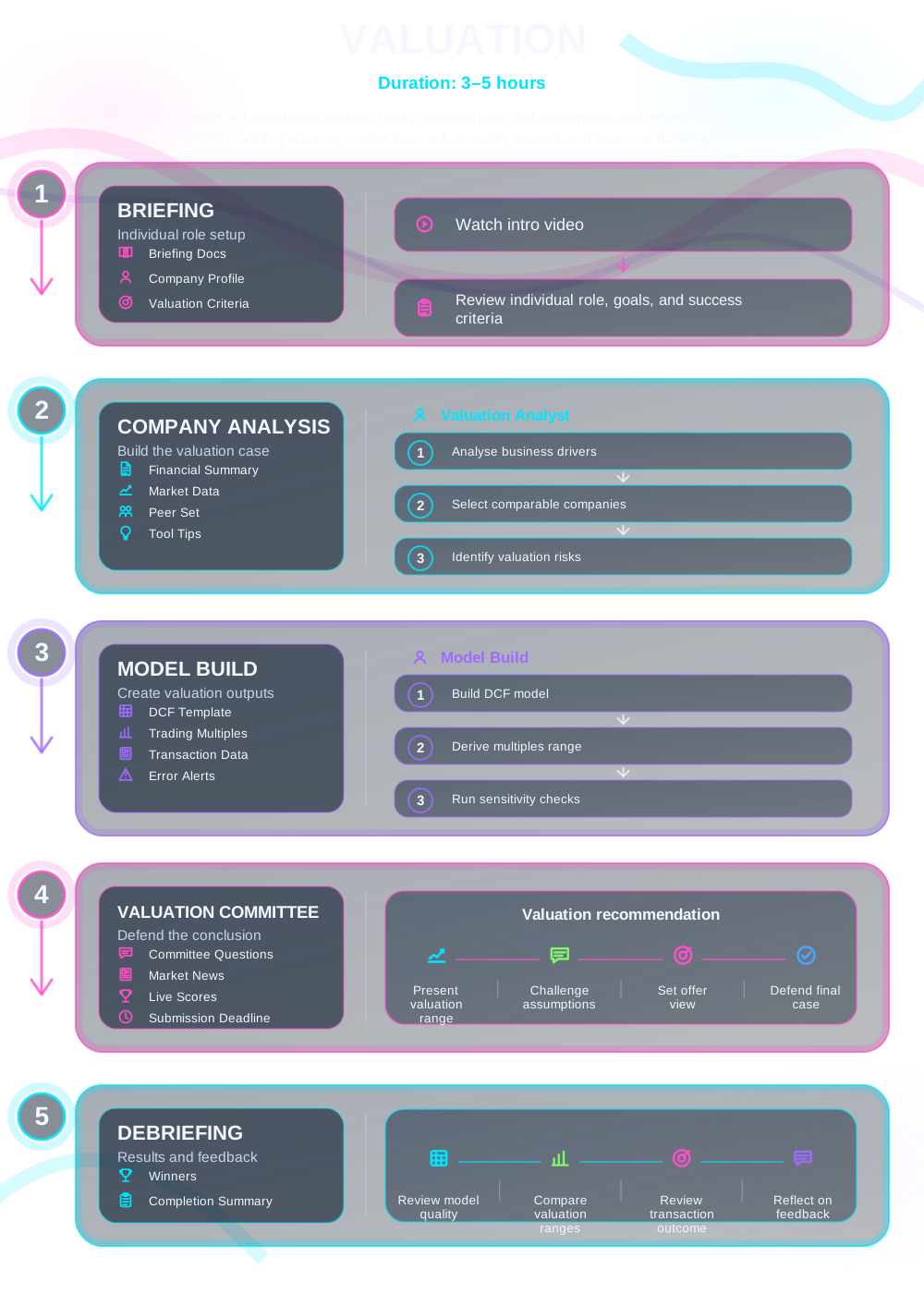

What Participants Do
In the simulation, participants will:
- Analyze a detailed company and industry case pack.
- Build a three-statement financial model to forecast future performance.
- Construct a full DCF valuation from the ground up, including WACC calculation.
- Conduct a Comparable Company Analysis by researching and selecting a peer group.
- Perform a Precedent Transactions analysis using a provided deal database.
- Reconcile the valuation ranges from the three methods to establish a target equity value.
- Prepare a professional "Valuation Committee" presentation to defend your assumptions and final valuation.
- Participate in a peer review and challenge session, simulating a real deal team debate.

Learning Objectives
By the end of the simulation, participants will be able to:
- Construct a robust, three-statement financial model to forecast a company's performance.
- Calculate a company's intrinsic value using a DCF model, including defensible estimates for WACC and terminal value.
- Execute a relative valuation using both trading and transaction comps, justifying peer selection and multiples.
- Synthesize the outputs of DCF, Comparables, and Precedent Transactions into a coherent valuation range and recommendation.
- Develop professional judgment by making and defending key valuation assumptions.
- Communicate complex valuation findings effectively in a written report and oral presentation.
How the Valuation Simulation Works
This simulation can be run individually or in teams in academic or corporate contexts. Each cycle represents a stage of getting through a pressing financial situation.
1. Preparation and Onboarding Participants receive the simulation case pack and access to our platform with refresher info on core valuation concepts.
2. Financial Modeling Phase Participants build the financial model based on historical data and provide management guidance.
3. Valuation Phase Participants work through the three core valuation methodologies in dedicated modules, inputting their analysis into a structured template.
4. Synthesis and Reporting The individual valuation outputs are consolidated into a final valuation range. Participants draft a summary report.
5. The Final Pitch Teams (or individuals) present their valuation to an "Investment Committee" (instructors or peers), defending their assumptions and facing challenging questions.
6. Debrief and Feedback A comprehensive debrief session is held, comparing different approaches and highlighting key learning takeaways. Personalized feedback is provided on the valuation model and report.
Frequently Asked Questions
Assessment
Assessment of participant performance can be tailored according to the host institution’s objectives (business school, corporate training, assessment centre). Typical assessment criteria include:
- Accuracy, structure, and integrity of the DCF and comparable analyses.
- Depth and logic of scenario analysis
- Clarity and synthesis of the three valuation methods into a coherent investment thesis.
- Ability to persuasively communicate key assumptions and defend the valuation under questioning.