It is ideal for graduate finance students (MSc, MBA), banking professionals in risk, finance, or auditing roles, and anyone seeking to understand bank resilience and regulatory capital.

Stress Testing Simulation
In this Stress Testing Simulation, participants design severe but plausible scenarios, model their financial impact, and make critical decisions to ensure institutional resilience in the face of economic shocks.

Stress Testing Simulation Overview
The Stress Testing Simulation is a dynamic, hands-on training tool developed by experienced risk management professionals. It replicates the high-stakes environment where financial institutions and regulators assess the resilience of banks against severe economic and financial downturns.
Participants navigate the complete stress testing cycle, from scenario design and data collection to impact modeling, results analysis, and strategic decision-making. Each round introduces escalating challenges (deepening recessions, market crashes, sovereign defaults, or sector-specific crises) forcing teams to adapt their models, question their assumptions, and recommend defensive actions. The simulation captures the intense pressure and strategic complexity of real-world stress testing exercises, such as those conducted for the Comprehensive Capital Analysis and Review or the European Banking Authority (EBA) guidelines.
This simulation is ideal for university finance programs, MBA courses, executive training in banks, and regulatory body workshops. It transforms abstract regulatory concepts into a tangible, competitive experience, showing how capital adequacy, risk appetite, and strategic planning interact under extreme duress.

Stress Testing Simulation Concepts
Participants work through realistic scenarios, which can be customized to emphasize or exclude specific topics depending on the learning goals. This modular structure allows the simulation to be tailored to any type of session. Key concepts include:
- Regulatory frameworks for stress testing
- Design of severe but plausible macroeconomic and financial scenarios
- Modeling credit risk losses under stress
- Impact on market risk and trading book valuations
- Conduct risk and operational risk considerations
- Capital and liquidity depletion analysis
- Strategic management actions
- Model risk and validation challenges
- Communication of results to senior management and regulators
- The use of stress testing for strategic planning and risk appetite setting

Gameflow

What Participants Do
In the simulation, participants will:
- Analyze and interpret a given severe macroeconomic scenario.
- Model the impact on key risk parameters and financial statements.
- Assess capital and liquidity shortfalls under stress.
- Debate and decide on strategic management actions to mitigate risks.
- Negotiate assumptions and model limitations within their team.
- Prepare and deliver a formal presentation of results and recommendations to the "board" or "regulators".

Learning Objectives
By the end of the simulation, participants will be able to:
- Understand the purpose, process, and regulatory drivers of bank stress testing.
- Design coherent adverse and severely adverse macroeconomic scenarios.
- Apply basic models to translate scenario variables into financial impacts.
- Identify key vulnerabilities in a bank’s balance sheet under stress.
- Evaluate the pros and cons of different strategic management actions.
- Communicate complex stress test results clearly and persuasively to stakeholders.
- Appreciate the role of stress testing in risk governance and strategic decision-making.
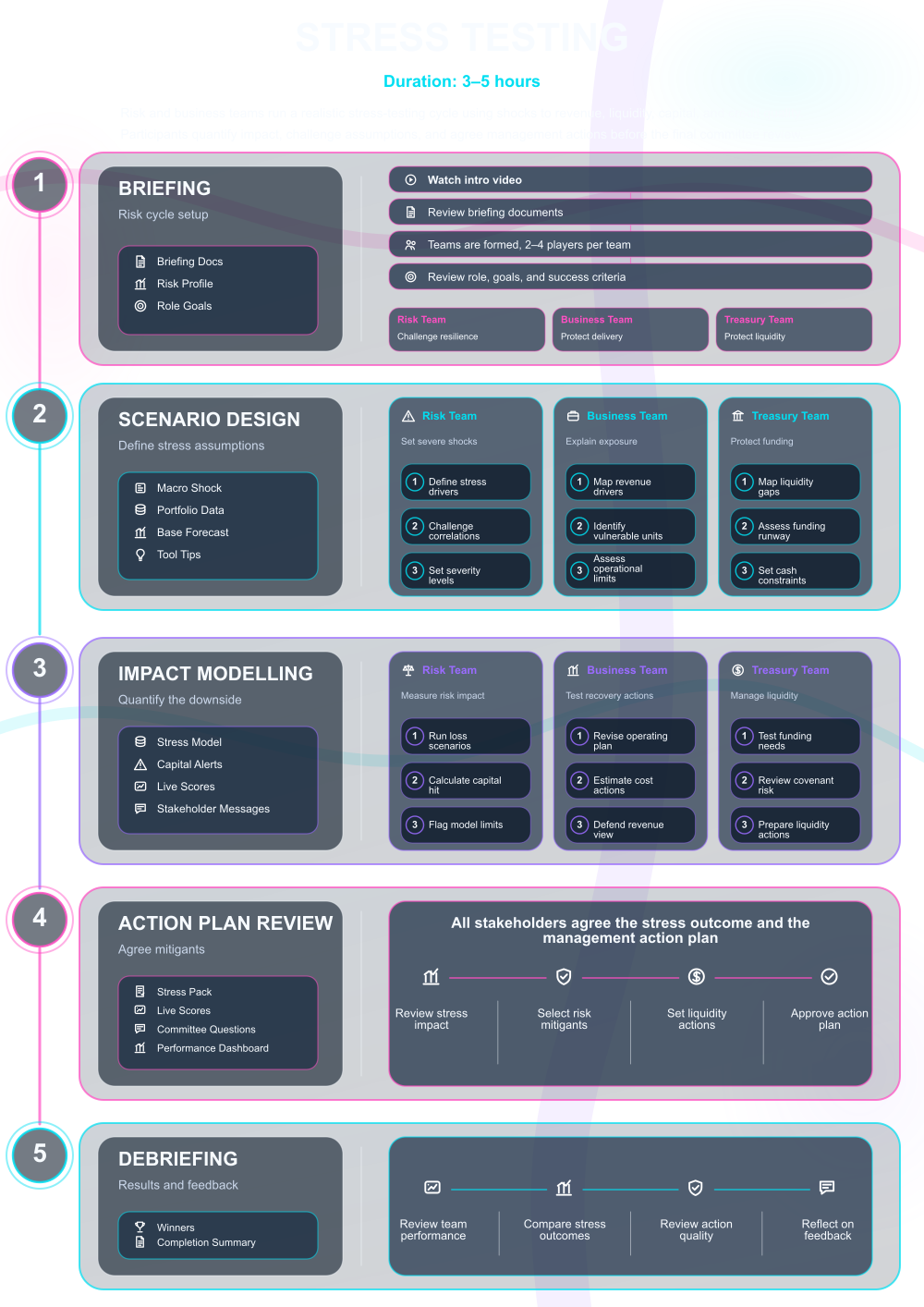
How the Stress Testing Simulation Works
This simulation can be run individually or in teams in academic or corporate contexts. Each cycle represents a stage of getting through a pressing financial situation.
1. Team Formation and Briefing Participants are divided into teams, each representing the risk department of a major bank. They receive a detailed starting brief on their bank's portfolio and the initial economic scenario.
** 2. Scenario Analysis and Impact Modeling** Teams analyze the first shock. Using provided data and model templates, they calculate the projected impact on loan defaults, securities valuations, and projected capital ratios.
3. Strategic Response and Reporting Teams must decide on their first set of strategic actions and summarize their findings and plans in a brief report or dashboard.
4. Escalation and Iteration A second, more severe scenario layer is introduced. Teams must update their models, reassess their capital position, and possibly revise their strategic actions under greater pressure.
5. Final Presentation and Debrief Each team presents its final stress test results, the rationale for its chosen actions, and its assessment of the bank's resilience to a panel acting as the regulator/senior management. This is followed by an instructor-led debrief linking the simulation experience to real-world theory and practice.
Frequently Asked Questions
Assessment
Assessment of participant performance can be tailored according to the host institution’s objectives (business school, corporate training, assessment centre). Typical assessment criteria include:
- Accuracy and logic of the quantitative impact modeling.
- Suitability and feasibility of the recommended management actions.
- Final capital and liquidity position after stress and strategic adjustments.
- Clarity, persuasiveness, and professionalism of the final presentation and teamwork during the exercise.