Yes, it works at both levels. The simulation complexity can be adjusted for different learner groups.

Strategic Business Planning Simulation
Participants act as strategy leaders navigating real-world trade-offs between growth, risk, competition, and internal capabilities. They design, communicate, and iterate on business plans across dynamic, multi-round scenarios.

Strategic Business Planning Simulation Overview
The Strategic Business Planning Simulation challenges participants to think like senior executives or founders shaping the future of a company. Over a series of rounds, they craft and refine strategic plans while navigating uncertainty, internal constraints, competitive threats, and evolving stakeholder priorities.
Learners begin with a detailed business context and are tasked with setting long-term goals, allocating resources, prioritizing initiatives, and forecasting results. Each round reveals new variables - such as market disruption, supply chain issues, or talent shortages - that force participants to revise their plans and justify their rationale.
This simulation integrates analytical thinking with storytelling, leadership, and cross-functional coordination. It’s designed for business students, corporate trainees, and entrepreneurs who want to experience what it means to build and execute strategy under pressure.

Strategic Business Planning Simulation Concepts
Participants work through realistic scenarios, which can be customized to emphasize or exclude specific topics depending on the learning goals. This modular structure allows the simulation to be tailored to any type of session. Key concepts include:
- SWOT and Competitive Analysis
- Strategic Goal-Setting and KPIs
- Business Model Design and Trade-offs
- Market Segmentation and Targeting
- Resource Allocation and Prioritization
- Scenario Planning and Risk Mitigation
- Internal Alignment (teams, culture, leadership)
- External Forces (tech shifts, regulation, competition)
- Strategic Communication and Stakeholder Buy-In
- Agility and Strategic Iteration

Gameflow
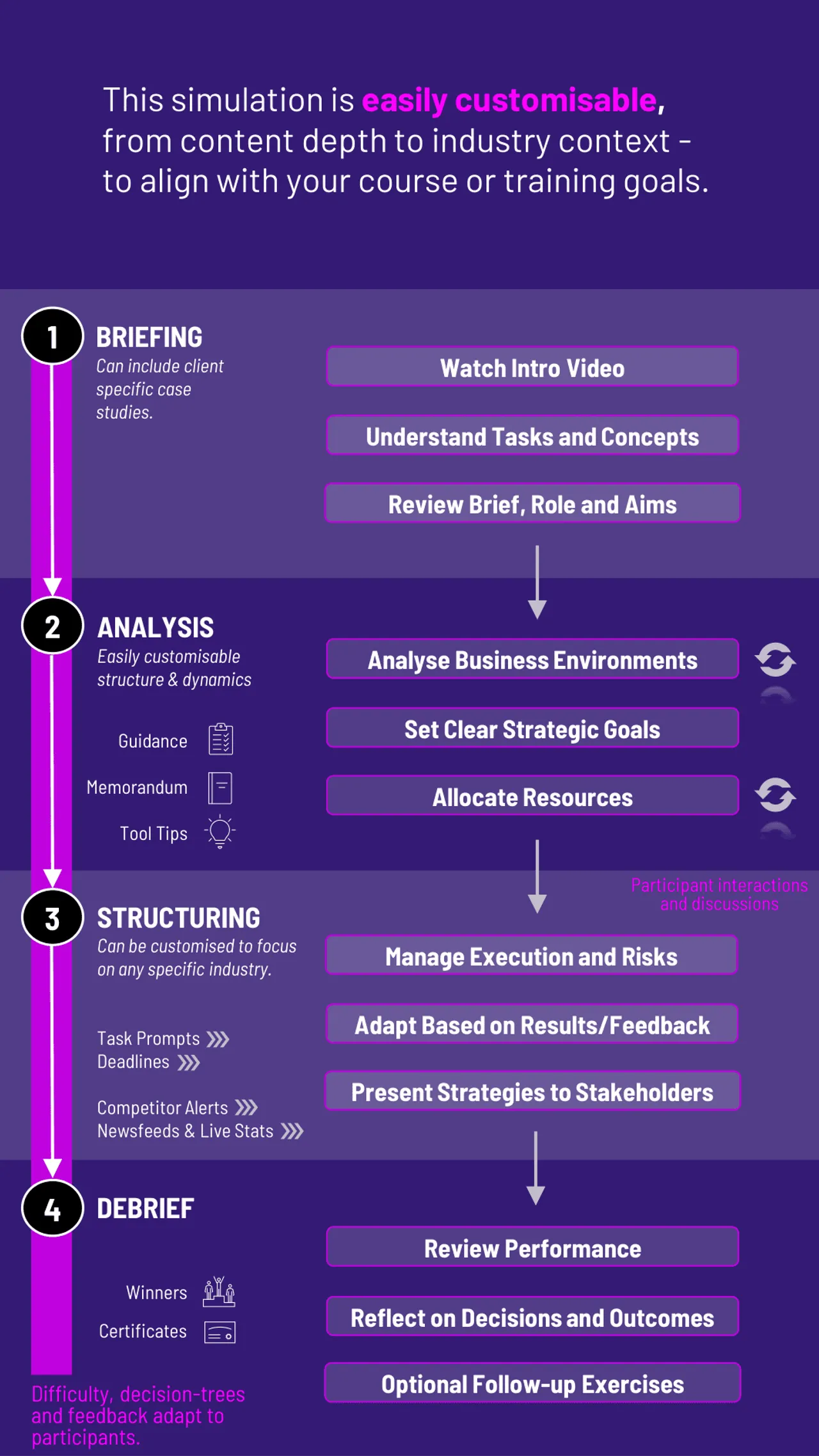

What Participants Do
Throughout the simulation, participants:
- Analyze a company’s internal and external environment
- Set clear strategic goals based on data and context
- Choose among competing investments or growth initiatives
- Allocate limited resources (capital, time, talent)
- Manage execution risks and unintended consequences
- Respond to shifts in the market and customer demand
- Present and defend their strategy to key stakeholders
- Adapt their plan based on results, feedback, and new constraints
- Build alignment across departments or business units
- Reflect on how strategy evolves over time in real business settings

Learning Objectives
By the end of the simulation, participants will:
- Understand how strategic plans are built from internal and external analysis
- Set SMART objectives and align actions to them
- Make resource allocation decisions under constraints
- Conduct scenario planning and evaluate risks
- Develop strategic agility and decision iteration
- Coordinate across functions and align teams
- Forecast business impact with logic and discipline
- Use storytelling to gain stakeholder buy-in
- Respond to external pressure with clarity and confidence
- Reflect on the iterative nature of strategy execution
The simulation’s flexible structure ensures that these objectives can be calibrated to match the depth, duration, and focus areas of each program, whether in higher education or corporate learning.
How the Strategic Business Planning Simulation Works
1. Receive Market Context and Company Brief Each round begins with an overview of the company’s financial health, market position, and upcoming challenges. Participants are tasked with aligning business goals to the situation at hand.
2. Analyze Strengths, Weaknesses, Opportunities, and Threats Participants explore internal data (culture, financials, capabilities) and external forces (competition, macro trends) to decide where to focus.
3. Set Strategy and Make Decisions They create strategic priorities and decide how to allocate resources—across product lines, geographies, R&D, marketing, hiring, and more.
4. Review Feedback and Outcomes Based on their decisions, the simulation generates performance metrics, market reactions, and stakeholder sentiment.
5. Justify and Communicate Plans Participants are required to explain their logic and defend choices to a virtual board, senior executives, or investors.
6. Adapt Strategy in New Rounds As new disruptions arise, participants must revisit and revise their plans to keep the business on track.

Why This Strategic Business Planning Simulation Works
Strategy isn't about filling out templates - it’s about making choices, adapting, and communicating under pressure. This simulation replicates the full arc of real-world strategic planning: from vision to execution, from alignment to agility.
Participants leave with stronger decision-making instincts, clearer communication skills, and a deep understanding of how strategy plays out in fast-moving environments.
Frequently Asked Questions
Assessment
Participants are evaluated on:
- Strategic clarity and prioritization
- Resource allocation logic
- Responsiveness to changing business context
- Communication effectiveness and stakeholder persuasion
- Quality of performance outcomes (growth, ROI, risk balance)
- Consistency and adaptability across simulation rounds
- Team collaboration (for group simulations)
- Final strategic presentation or executive memo
- Reflection on process and learning
- Ability to think long-term while delivering short-term results
Additionally, you can also add a built-in peer and self-assessment tool to see how participants rate themselves. This flexibility allows the simulation to be easily integrated by professors as graded courses at universities and by HR at assessment centres at companies.