It’s ideal for students pursuing careers in equity research, asset management, investment banking, or corporate finance.

Securities Analysis Simulation
Students take on the role of investment analysts, valuing securities, analyzing financial performance, and issuing recommendations to optimize portfolio decisions under real-world pressures with our securities analysis simulator.

Securities Analysis Simulation Overview
The Securities Analysis Simulation is a rigorous, research-intensive experience developed by equity analysts and portfolio managers to reflect the realities of public market investing.
Students take on the role of buy-side or sell-side analysts, diving deep into company fundamentals, market trends, and valuation techniques. Their task: build a defensible investment thesis and recommend whether to buy, sell, or hold.
Students must navigate a stream of financial reports, earnings calls, news updates, and macroeconomic signals. Every piece of data could shift the market view - and their valuation. The Securities Analysis Simulation builds the discipline and intuition needed to succeed in equity research, asset management, and investment strategy roles.

Securities Analysis Concepts
- Fundamental Equity Valuation
- Bond Valuation and Credit Risk Analysis
- Financial Statement Interpretation
- Discounted Cash Flow (DCF) Modeling
- Relative Valuation (P/E, EV/EBITDA, P/B)
- Economic Moats and Competitive Positioning
- ESG Analysis and Non-Financial Factors
- Macroeconomic and Sector Trend Analysis
- Analyst Forecasting and Earnings Models
- Buy/Sell/Hold Recommendation Frameworks
- Portfolio Fit and Risk Assessment
- Investment Memo Writing and Presentation

Gameflow
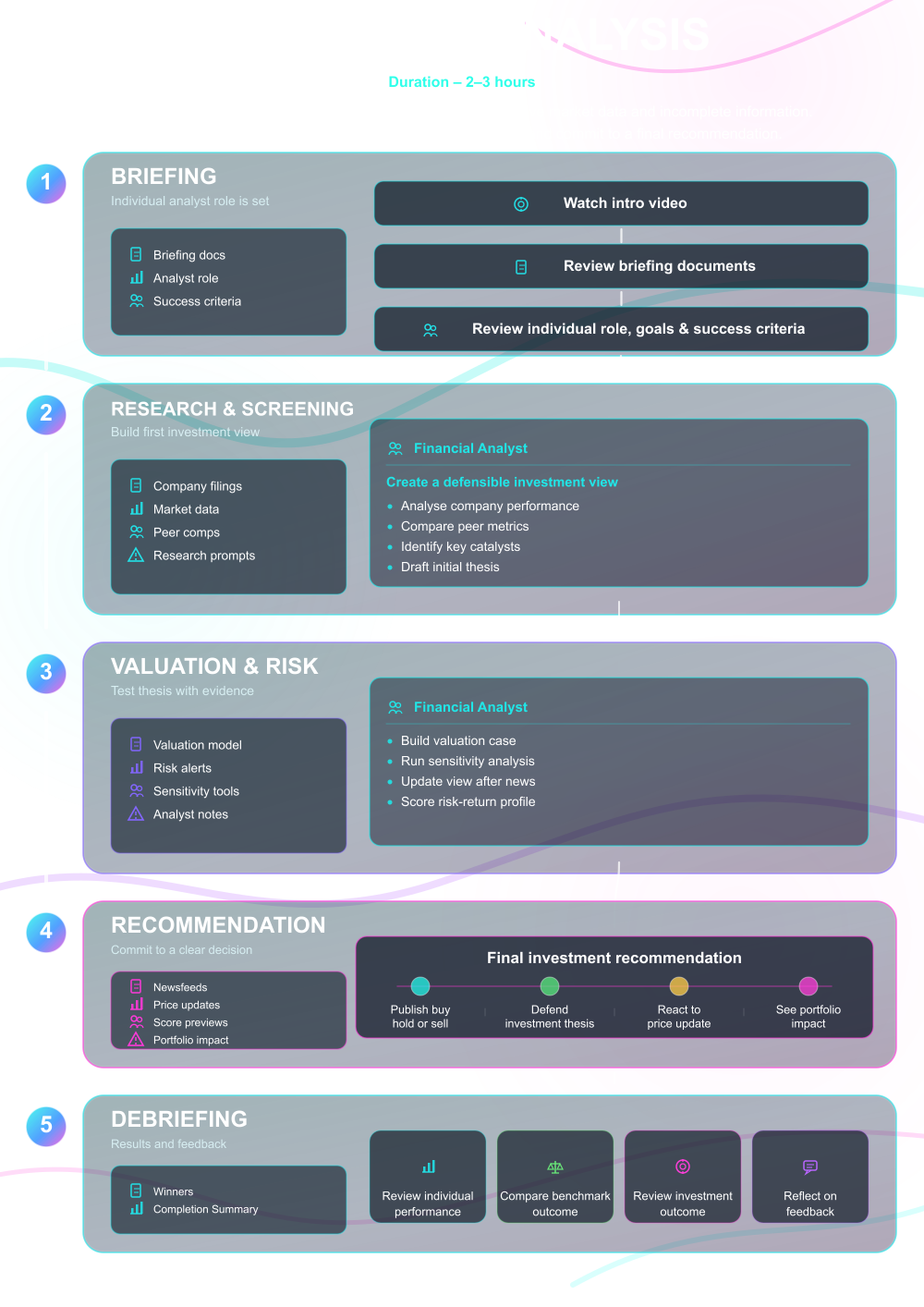

What Students Do
During the securities analysis simulation, students engage in the following tasks to develop and apply securities analysis skills:
- Analyze Company Financials: Break down income statements, balance sheets, and cash flow statements.
- Build Valuation Models: Construct DCF and comparables-based valuation frameworks.
- Assess Industry Conditions: Study macro and sector-specific trends to inform assumptions.
- Review Earnings Reports: Analyze management commentary and quarterly results.
- Determine Investment Ratings: Issue buy, hold, or sell recommendations based on analysis.
- Present Investment Cases: Defend analysis in front of a simulated investment committee.
- Score Risk-Return Tradeoffs: Evaluate volatility, beta, and margin of safety.
- Analyze Fixed Income Instruments: Assess yield, creditworthiness, and maturity alignment.
- Incorporate ESG Factors: Evaluate non-financial performance drivers and reputational risk.
- Draft Investment Memos: Communicate analysis, assumptions, and outcomes effectively.

What Students Learn
- Valuation Mastery: Learn to value equity and debt instruments using DCF and multiples.
- Financial Literacy: Gain confidence in interpreting financial statements and ratios.
- Market Awareness: Develop a keen sense of how macroeconomic forces impact securities.
- Modeling Skills: Strengthen Excel-based financial modeling and forecasting techniques.
- Investment Decision-Making: Build frameworks to assess whether a security is over- or under-valued.
- Effective Communication: Present complex analysis clearly and persuasively.
- Analytical Thinking: Critically assess qualitative and quantitative information.
- ESG Integration: Factor in environmental, social, and governance considerations.
- Portfolio Fit Evaluation: Assess how a security aligns with broader investment goals.
- Professional Readiness: Prepare for careers in research, investing, and financial services.

Why The Securities Analysis Simulation Works
The Securities Analysis Simulation delivers a practical, fast-paced environment where students learn to think and act like professional analysts. It trains them to synthesize vast amounts of information, draw informed conclusions, and communicate actionable recommendations - just like they would on the job. From valuation modeling to pitch delivery, every element is grounded in real-world application.
This securities analysis simulation is especially effective in helping students understand the nuances of security selection and the tension between risk and reward. It teaches them how to navigate imperfect data, forecast under uncertainty, and manage stakeholder expectations. With immediate feedback and market-driven pressure, the learning becomes dynamic, personalized, and highly transferable to a wide range of financial careers.