Yes. The simulation includes built-in support and can be tailored for beginner to advanced learners.

Scenario Analysis Simulation
In this analytical Scenario Analysis Simulation, participants test financial and strategic outcomes under different assumptions. They learn how to assess uncertainty, model trade-offs, and guide better decision-making in high-stakes situations.

Scenario Analysis Simulation Overview
The Scenario Analysis Simulation places participants in the role of decision-makers responsible for evaluating major financial or operational initiatives. Their challenge: simulate best-case, base-case, and worst-case outcomes under varying assumptions - and make resilient, data-informed decisions.
Participants face changing variables such as market demand, input costs, interest rates, competitor actions, or regulatory shifts. They must assess how these assumptions affect KPIs like cash flow, profitability, and valuation - and then guide leadership on the path forward.
Developed with input from corporate strategists and FP&A professionals, this simulation teaches how to model business uncertainty and use scenario thinking as a competitive advantage.
It’s ideal for students or professionals in finance, strategy, or planning roles.

Scenario Analysis Simulation Concepts
Participants work through realistic scenarios, which can be customized to emphasize or exclude specific topics depending on the learning goals. This modular structure allows the simulation to be tailored for various types of sessions. Key concepts include:
- Scenario Thinking: Building structured what-if cases for complex business choices
- Sensitivity vs. Scenario Analysis: Understanding the difference and when to use each
- Key Drivers Identification: Selecting the most impactful variables to test
- Financial Modeling: Linking assumptions to P&L, cash flow, and valuation
- Decision-Making Under Uncertainty: Choosing strategies with the best risk-return balance
- Strategic Flexibility: Planning for contingencies and response strategies
- Data Communication: Presenting complex results to non-technical stakeholders
- Iterative Learning: Adjusting scenarios as new information becomes available

Gameflow
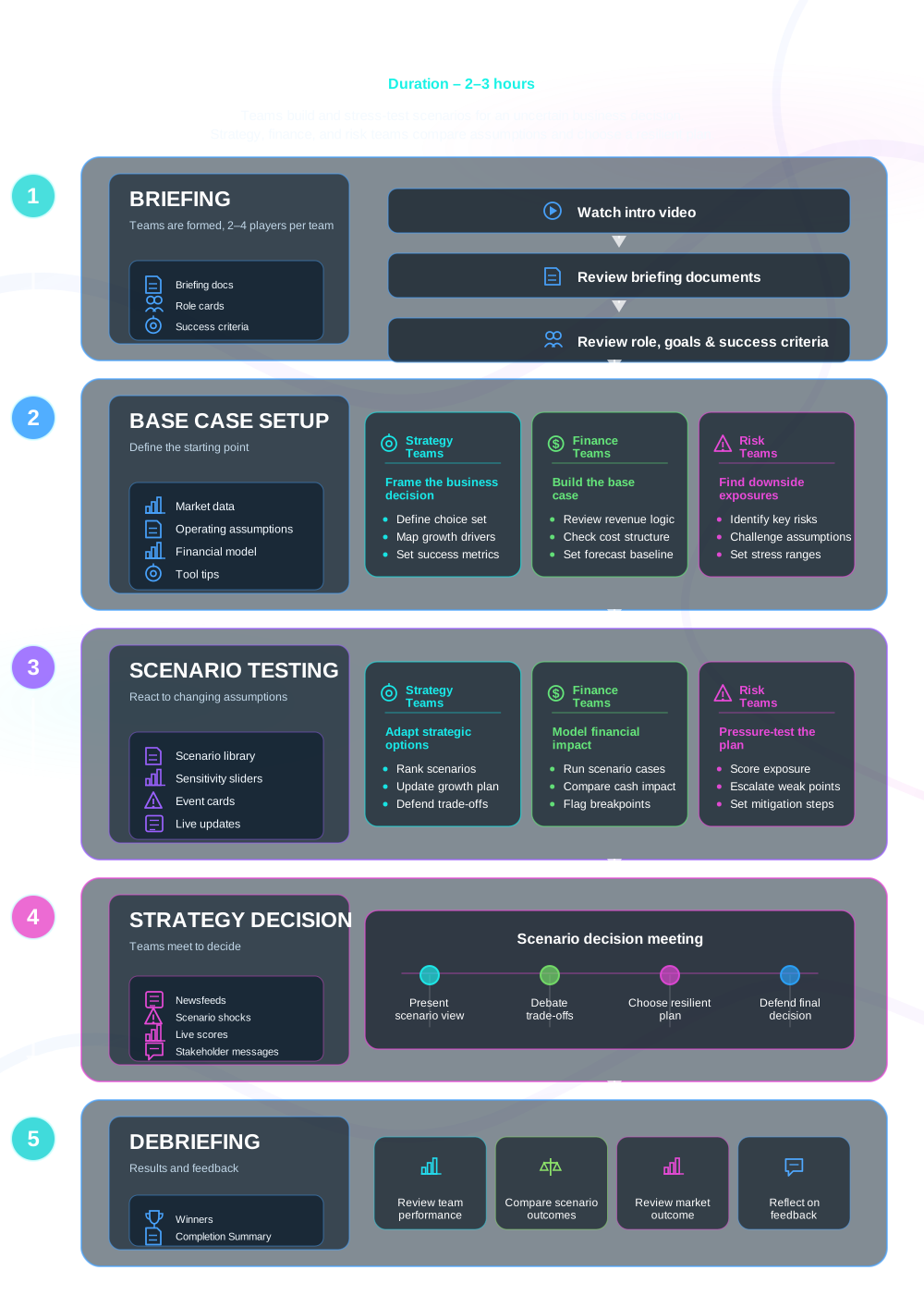

What Participants Do
Participants act as analysts or managers responsible for evaluating a major business decision or investment. In each scenario, they:
- Review a brief for an initiative - such as launching a product, entering a new market, or investing in a new facility
- Identify key drivers of uncertainty and define possible scenarios
- Build or adjust financial models to capture case-specific outcomes
- Compare and interpret outputs under each scenario (base, best, worst)
- Make and justify a recommendation to senior leadership or a board
- Respond to new inputs or market shifts, refining the analysis dynamically
- Collaborate with peers or functionally across teams, depending on the format

Learning Objectives
By the end of the simulation, participants will be more confident in:
- Applying structured thinking to ambiguous business problems
- Translating assumptions into financial outcomes
- Using scenario and sensitivity analysis effectively
- Communicating recommendations grounded in data
- Understanding the risks and returns of each strategic path
- Making decisions in environments of incomplete information
- Balancing optimism and caution in forward-looking planning
- Collaborating on decisions that cross finance, operations, and strategy
- Adapting decisions in real time as new variables emerge
The simulation’s flexible structure ensures that these objectives can be calibrated to match the depth, duration, and focus areas of each program, whether in higher education or corporate learning.
How the Scenario Analysis Simulation Works
The simulation can run in teams or individually, and adapts to classroom or corporate training settings.
1. Receive a Business Case or Brief Participants are given a high-stakes business initiative along with initial data and assumptions.
2. Identify Key Drivers and Build Scenarios They define the top variables that affect outcomes and model three or more scenarios - best-case, base-case, and worst-case.
3. Run Financial Models Using the simulation interface and spreadsheets, participants test different combinations of assumptions and explore the results.
4. Make a Recommendation Based on results, participants present a decision or strategy to senior stakeholders - explaining logic, risks, and expected returns.
5. Respond to New Information Additional rounds may introduce new data or surprise developments, requiring scenario revision or re-analysis.
6. Reflect and Debrief Teams or individuals review what drove success or failure, how assumptions changed outcomes, and how better modeling improves strategic thinking.

Why This Scenario Analysis Simulation Works
Scenario analysis is one of the most underutilized tools in business decision-making. This simulation makes it practical, accessible, and urgent.
Participants learn not just how to model uncertainty, but how to turn that analysis into smarter, more resilient decisions. It’s perfect for corporate strategy, FP&A, MBA finance, and operations planning courses alike.
Frequently Asked Questions
Assessment
Participants can be evaluated on:
- Scenario structuring and assumption clarity
- Depth and accuracy of financial impact modeling
- Risk-awareness and contingency planning
- Strategic quality of decision-making
- Quality of presentation and stakeholder alignment
- Peer and instructor review in multi-team formats
- Adaptability as new inputs emerge during the simulation
You can also include memo writing and debrief presentations as part of the assessment structure. Additionally, you can also add a built-in peer and self-assessment tool to see how participants rate themselves. This flexibility allows the simulation to be easily integrated by professors as graded courses at universities and by HR at assessment centres at companies.