Basic familiarity helps, but the simulation includes guided coding examples.

Risk Modeling with Python Simulation
In this hands-on Risk Modeling with Python Simulation, participants apply Python to build financial risk models - analyzing data, testing scenarios, and communicating insights while balancing technical accuracy with practical decision-making.

Risk Modeling with Python Simulation Overview
Participants step into the role of financial analysts and risk managers tasked with quantifying, modeling, and mitigating risk. Each round introduces new datasets, scenarios, and modeling challenges using Python.
They must build and refine models for credit risk, market risk, or portfolio risk while interpreting outputs for non-technical stakeholders. The simulation emphasizes both coding skills and communication clarity.
This simulation is ideal for finance, data science, and risk management courses. It blends programming with applied finance, making technical concepts directly relevant to business and investment decision-making.

Risk Modeling with Python Simulation Concepts
Participants work through realistic scenarios, which can be customized to emphasize or exclude specific topics depending on the learning goals. This modular structure allows the simulation to be tailored to any type of session. Key concepts include:
- Python basics for financial modeling
- Probability distributions and risk factors
- Monte Carlo simulations and scenario analysis
- Value at Risk (VaR) and Conditional VaR
- Credit scoring and default risk modeling
- Portfolio diversification and risk-return trade-offs
- Data cleaning, visualization, and automation in Python
- Communicating technical results to business leaders
- Stress testing financial models
- Integrating risk models into strategic decision-making

Gameflow
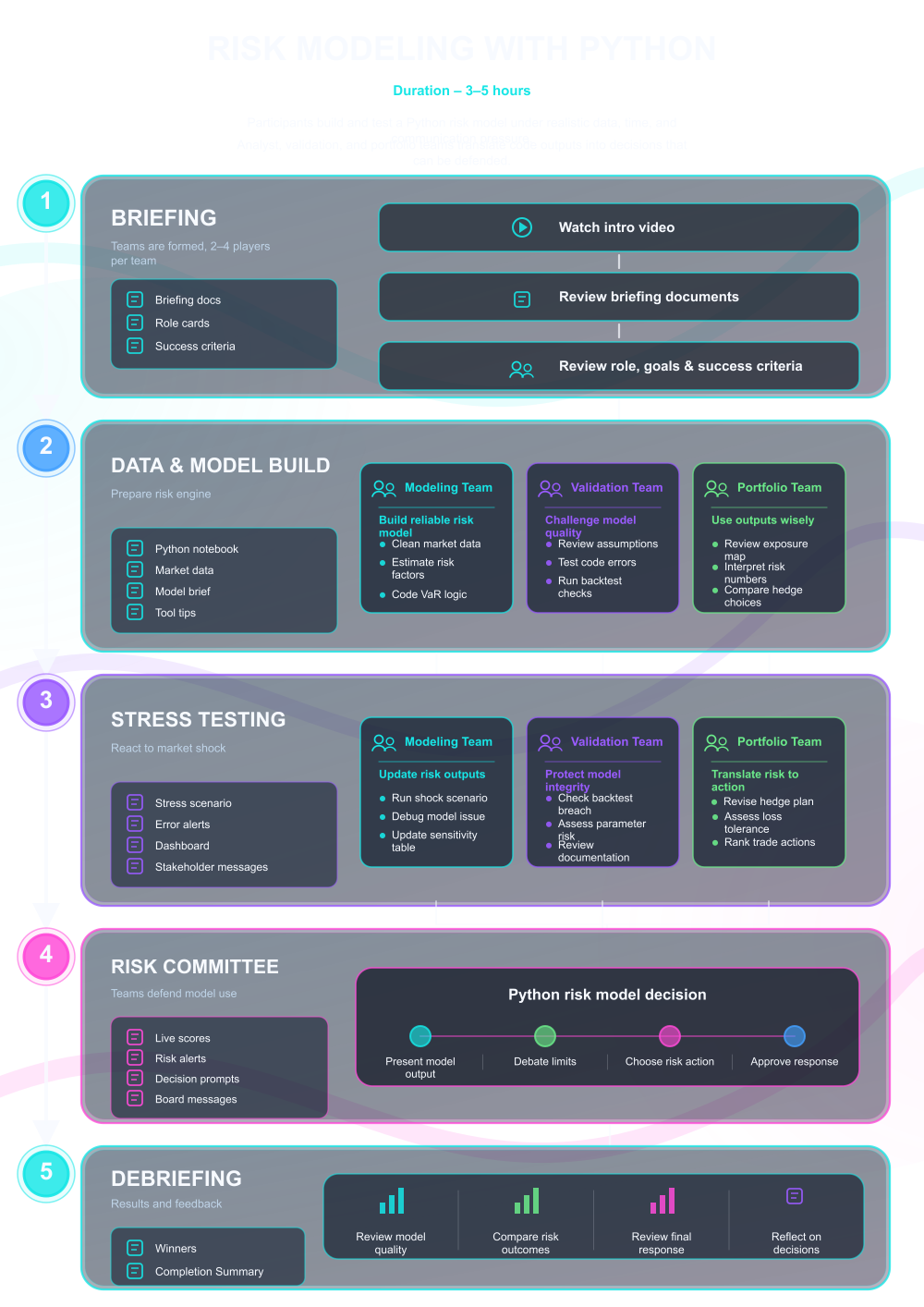

What Participants Do
In the simulation, participants act as risk analysts coding in Python. They:
- Import, clean, and analyze financial datasets
- Build risk models using Python libraries
- Run Monte Carlo simulations to test scenarios
- Evaluate model outputs for accuracy and bias
- Present findings to boards, regulators, or investment committees
- Reflect on model limitations and practical applications

Learning Objectives
By the end of the simulation, participants will be able to:
- Apply Python to financial risk modeling problems
- Understand key risk measures like VaR and stress tests
- Build and interpret Monte Carlo simulations
- Identify strengths and weaknesses in risk models
- Communicate technical outputs to non-technical stakeholders
- Manage trade-offs between model complexity and usability
- Apply coding best practices to finance problems
- Translate data insights into strategic risk decisions
- Collaborate on technical and business perspectives
- Build confidence in Python for real-world finance contexts
The simulation’s flexible structure ensures that these objectives can be calibrated to match the depth, duration, and focus areas of each program, whether in higher education or corporate learning.
How the Risk Modeling with Python Simulation Works
The simulation can run individually or in teams in classrooms, coding bootcamps, or corporate training. Each cycle represents a stage of risk modeling.
1. Receive a Scenario or Brief: Participants are introduced to a risk challenge (e.g., portfolio stress test or credit scoring).
2. Analyse the Situation: They review data inputs, market context, and modeling objectives.
3. Build Risk Models in Python: Participants write Python code to construct and test models.
4. Collaborate Across Roles: Teams may divide into coders, analysts, and communicators to align insights.
5. Communicate Outcomes: Participants present findings through reports, memos, or presentations.
6. Review and Reflect: Feedback highlights technical accuracy, business impact, and clarity. Participants refine models across rounds.
Frequently Asked Questions
Assessment
Assessment can be tailored to focus on coding ability, financial reasoning, or communication. Participants may be evaluated on:
- Accuracy and robustness of Python models
- Interpretation of outputs for business impact
- Responsiveness to new datasets or scenarios
- Clarity in communicating technical findings
- Collaboration in team-based coding and analysis
You can also include memo writing and debrief presentations as part of the assessment structure. Additionally, you can also add a built-in peer and self-assessment tool to see how participants rate themselves. This flexibility allows the simulation to be easily integrated by professors as graded courses at universities and by HR at assessment centres at companies.