It’s ideal for students pursuing careers in real estate, investment, development, or commercial lending.

Real Estate Finance Simulation
Students take on the role of real estate finance professionals, underwriting property deals, modeling cash flows, and structuring financing to maximize returns under real-world pressures with our real estate finance simulator.

Real Estate Finance Simulation Overview
The Real Estate Finance Simulation gives students the opportunity to step into the role of real estate investment professionals, analyzing development deals, managing cash flows, evaluating risk, and structuring financing for commercial and residential properties. Students make strategic decisions in a dynamic market environment, simulating the high-stakes challenges of the real estate finance industry.
From navigating zoning regulations to assessing cap rates and negotiating loan terms, students are exposed to a wide range of technical and strategic elements. The real estate finance simulation encourages practical learning by modeling realistic property investment scenarios. It’s designed to develop the financial and analytical skills required in real estate investment, development, and asset management careers.

Real Estate Finance Concepts
- Real Estate Valuation Techniques
- Capitalization Rates and Discounted Cash Flow (DCF)
- Loan-to-Value and Debt Service Coverage Ratios
- Development Feasibility Analysis
- Mortgage Financing Structures
- Cash Flow Modeling
- Property-Level vs. Portfolio-Level Metrics
- Equity Waterfall Structures
- Market and Location Analysis
- Lease Structuring and Revenue Forecasting
- Zoning and Regulatory Considerations
- Real Estate Exit Strategies

Gameflow
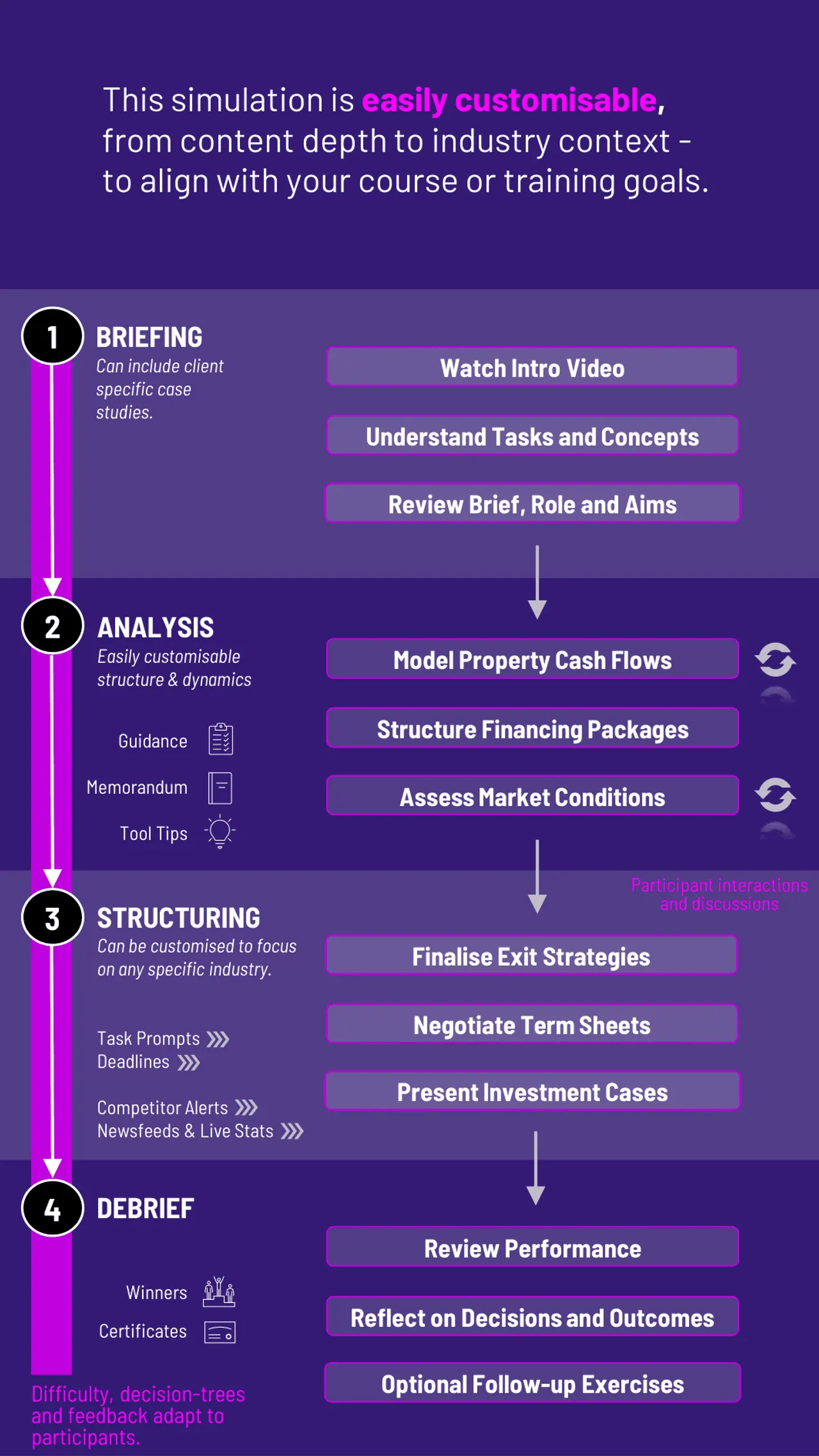

What Students Do
During the real estate finance simulation, students engage in the following tasks to develop and apply real estate finance skills:
- Underwrite Real Estate Deals: Analyze acquisition costs, income potential, and risk factors.
- Model Property Cash Flows: Build financial models to project cash inflows and outflows.
- Structure Financing Packages: Choose debt and equity sources aligned with investment goals.
- Assess Market Conditions: Evaluate market trends, comps, and location data.
- Analyze Feasibility of Developments: Run pro forma models to test project viability.
- Negotiate Term Sheets: Simulate loan and partnership negotiations.
- Evaluate Exit Strategies: Determine optimal holding periods and exit points.
- Apply Equity Waterfalls: Structure investor returns across tiers of participation.
- Forecast Operating Metrics: Calculate NOI, IRR, and other performance indicators.
- Present Investment Cases: Deliver investment rationales to simulated boards or committees.

What Students Learn
- Real Estate Valuation: Gain fluency in income- and market-based valuation techniques.
- Financial Modeling: Build and interpret detailed financial models for property assets.
- Debt and Equity Structuring: Understand how to finance deals with appropriate capital mixes.
- Risk Analysis: Assess sensitivity of returns to key market and project variables.
- Cash Flow Forecasting: Project and manage cash flows over the asset lifecycle.
- Development Decision-Making: Analyze whether and when to pursue new developments.
- Exit Strategy Planning: Identify the right time and method for exiting investments.
- Stakeholder Communication: Develop presentation skills tailored to investors and partners.
- Use of Market Data: Integrate economic, demographic, and property-specific data into investment decisions.
- Real-World Readiness: Translate classroom learning into applied industry skills.

Why The Real Estate Finance Simulation Works
The Real Estate Finance Simulation offers a realistic, high-impact environment for students to practice the end-to-end investment process - from deal sourcing and underwriting to financing and exiting. It places students in decision-making roles and presents them with evolving market conditions, challenging them to respond with agility, accuracy, and sound financial judgment.
This real estate finance simulation is especially effective because it mirrors the structure and workflows of real-world real estate firms. It strengthens technical proficiency in valuation and modeling while developing soft skills in negotiation, communication, and strategic thinking. As a result, students walk away prepared for the pace and pressure of careers in real estate investment and finance.