Not at all. The simulation is designed for business students and professionals. The analytical tools are user-friendly, often with point-and-click interfaces, and the focus is on interpretation and strategic application, not complex programming.

Predictivie Analytics Simulation
In today's data-rich world, intuition is no longer enough. Master the power of data-driven decision-making in a competitive business environment.

Predictivie Analytics Simulation Overview
Success hinges on the ability to extract meaningful insights from data and use them to make proactive, strategic decisions. The Predictive Analytics Simulation plunges participants into a dynamic business scenario where they must leverage data analysis, statistical models, and forecasting techniques to outmaneuver competitors.
This hands-on, competitive simulation moves beyond theory. Teams are equipped with real-world datasets and powerful analytical tools. They must clean data, build predictive models, and translate their forecasts into actionable business strategies—from optimizing marketing spend and managing inventory to setting prices and forecasting sales.
Participants will experience firsthand how predictive analytics directly impacts profitability and market share, transforming them from passive data readers into active data strategists.

Predictivie Analytics Simulation Concepts
Participants work through realistic scenarios, which can be customized to emphasize or exclude specific topics depending on the learning goals. This modular structure allows the simulation to be tailored to any type of session. Key concepts include:
- Data Literacy and Exploration
- Predictive Modeling
- Model Validation and Accuracy
- Feature Engineering
- Trade-off Analysis
- From Insight to Action
- ROI of Analytics

Gameflow
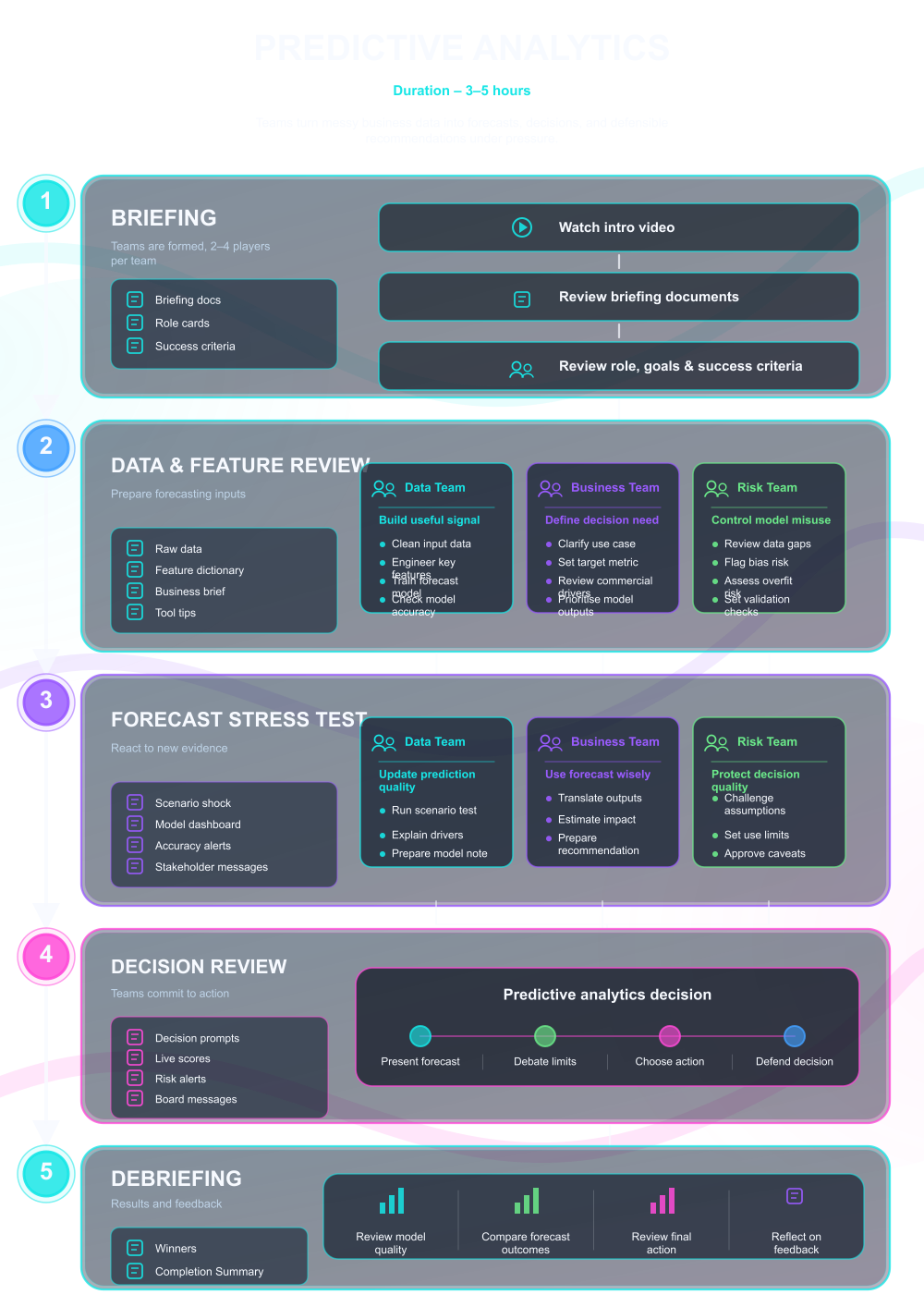

What Participants Do
In the simulation, participants will:
- Analyze rich datasets containing historical sales, customer demographics, operational metrics, and market conditions.
- Build and refine multiple predictive models to forecast key business outcomes like demand, customer churn, and conversion rates.
- Make strategic decisions each period based on their model's forecasts, adjusting tactics in real-time.
- Compete against other teams in a simulated market, where the accuracy of their predictions directly influences their financial results.
- Iterate and improve their models based on performance feedback and changing market dynamics within the simulation.
- Present their analytical approach and strategic rationale, defending their data-driven choices.

Learning Objectives
By the end of the simulation, participants will be able to:
- Interpret the core principles and business value of predictive analytics.
- Construct a basic predictive model using a provided dataset and analytical software.
- Evaluate the quality and accuracy of different predictive models.
- Formulate business strategies that are directly informed by data-driven forecasts.
- Articulate the financial and competitive advantages gained through the application of predictive analytics.
- Collaborate effectively within a team to solve complex business problems using data.
How the Predictivie Analytics Simulation Works
This simulation can be run individually or in teams in academic or corporate contexts. Each cycle represents a stage of getting through a pressing financial situation.
1. Introduction and Tool Training Participants are formed into teams, each running a virtual company. They receive training on the simulation interface and the integrated analytical tools.
2. Data Immersion Teams are given access to financial data. They perform initial analysis to understand market trends, customer behavior, and key performance drivers.
3. Model Building and First Decision Teams build their first predictive model and submit their initial strategic decisions.
4. Results and Market Feedback The simulation processes all team decisions, generating results that show market share, profitability, and other KPIs. Teams receive new data reflecting the market outcome.
5. Iterative Refinement Teams analyze the new results, refine their predictive models for improved accuracy, and submit a new set of decisions for the next round. This cycle repeats for several rounds.
6. Debrief and Presentation The simulation concludes with a comprehensive debrief. Teams present their analytical journey, key learnings, and how their data-driven strategies led to their final results.
Frequently Asked Questions
Assessment
Assessment of participant performance can be tailored according to the host institution’s objectives (business school, corporate training, assessment centre). Typical assessment criteria include:
- Accuracy and robustness of financial models
- Application of multiple valuation methods
- Responsiveness to shocks and assumption changes
- Clarity in communicating recommendations
- Collaboration in building and presenting analyses
Assessment may incorporate peer and self-review components, facilitator scoring, and debrief discussion. Results may feed into grades, executive feedback, certification or development plans.