Participants should have a basic understanding of financial concepts like cash flows, time value of money, and introductory corporate finance. The simulation is ideal for MBA students, finance undergraduates, and early-career professionals in roles involving business case analysis.

NPV Simulation
Step into the role of a corporate finance manager and determine the future of your company by analyzing, debating, and deciding on major capital projects using the core principle of finance: Net Present Value.

NPV Simulation Overview
The NPV Simulation plunges participants into the high-stakes world of capital allocation. Faced with multiple investment proposals: from R&D initiatives and new market expansion to machinery upgrades and acquisitions. Teams must build financial models, forecast cash flows, assess risks, and calculate critical metrics.
The simulation captures real-world complexity: cash flow projections are uncertain, input assumptions are debatable, and capital is limited. Participants must defend their analyses, negotiate with stakeholders (played by other teams or built-in simulation logic), and ultimately create a value-maximizing portfolio of projects within the company's budget and strategic goals. It transforms NPV from a textbook formula into a practical, impactful decision-making tool.
Although ideal for undergraduate and graduate finance courses, executive training, and corporate finance skill workshops, the simulation is modular and scalable, allowing instructors to vary complexity.

NPV Simulation Concepts
Participants work through realistic scenarios, which can be customized to emphasize or exclude specific topics depending on the learning goals. This modular structure allows the simulation to be tailored to any type of session. Key concepts include:
- Net Present Value
- Discounted Cash Flow Analysis
- Weighted Average Cost of Capital
- Internal Rate of Return
- Payback Period
- Capital Rationing and Portfolio Optimization
- Risk Assessment and Scenario Analysis
- Free Cash Flow Projection
- Strategic vs. Financial Alignment

Gameflow

What Participants Do
In the simulation, participants will:
- Analyze detailed business cases for several potential investment projects.
- Build financial models to project unlevered free cash flows.
- Determine an appropriate discount rate based on provided company and market data.
- Calculate NPV, IRR, and other metrics for each project.
- Perform sensitivity and scenario analysis on key drivers.
- Debate the strategic merits and risks of each proposal within their team.
- Negotiate for capital allocation under budget constraints.
- Present and justify their final investment portfolio to the "Board".

Learning Objectives
By the end of the simulation, participants will be able to:
- Apply DCF/NPV methodology to realistic business investment scenarios.
- Interpret investment metrics (NPV, IRR) to make accept/reject decisions.
- Evaluate the qualitative and strategic factors beyond the numbers.
- Synthesize multiple projects into a value-maximizing capital budget under constraints.
- Develop skills in financial modeling, assumption-based debate, and persuasive communication of financial recommendations.
How the NPV Simulation Works
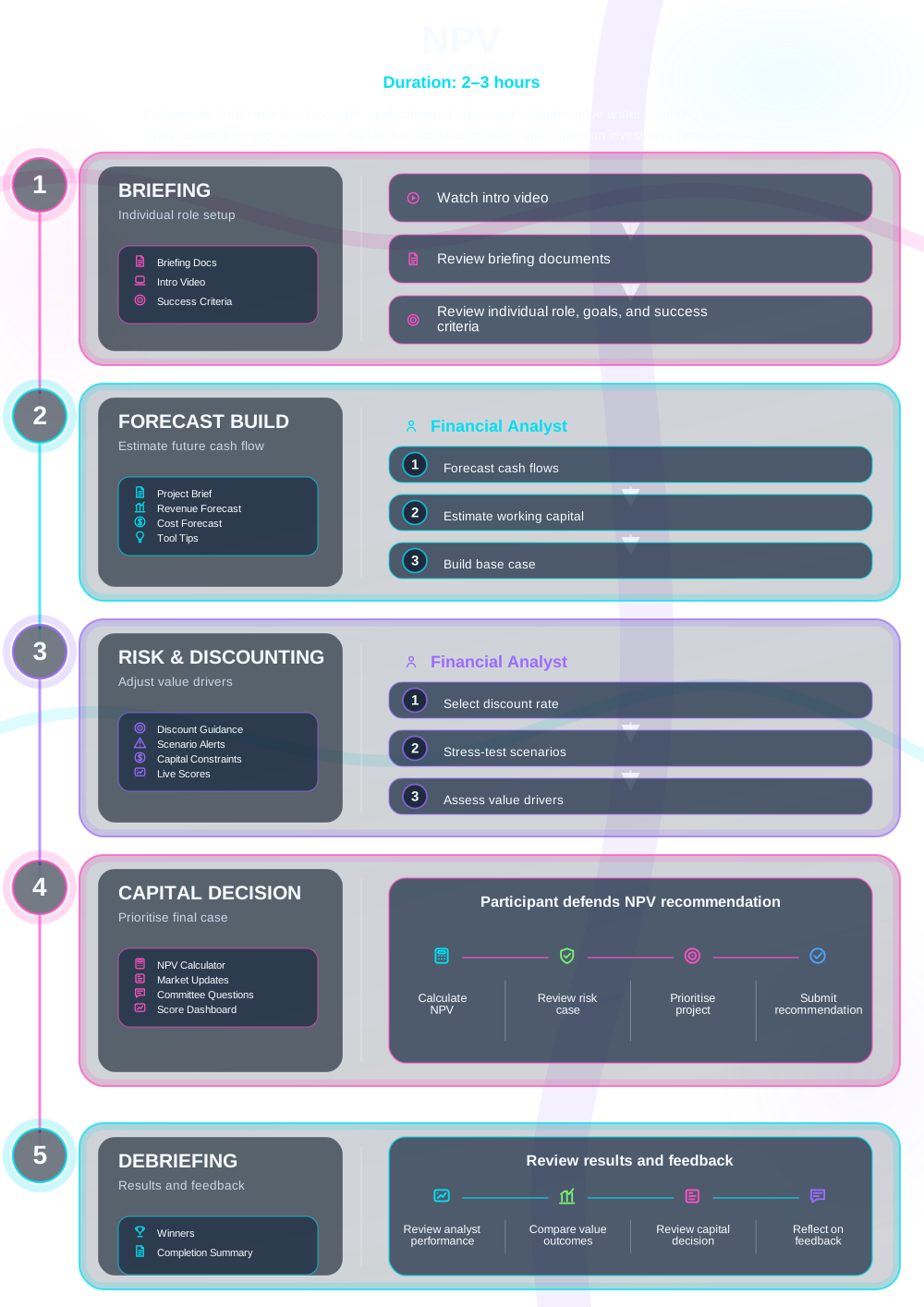
This simulation can be run individually or in teams in academic or corporate contexts. Each cycle represents a stage of getting through a pressing financial situation.
1. Briefing and Setup Instructors assign teams and launch the simulation. Teams access their digital dashboard containing a set of confidential investment proposals and market data.
** 2. Financial Modeling & Initial Valuation** Teams build DCF models from scratch for each project, forecasting cash flows and determining the appropriate risk-adjusted discount rate to calculate baseline NPV and IRR.
3. First-Round Capital Allocation Teams submit their initial investment rankings. The instructor then imposes a strict capital budget, forcing teams to prioritize and form a high-value project portfolio within the constraint.
4. Market Volatility and Scenario Update A new simulation round is triggered. Instructors release new economic data or competitive intelligence. Teams must re-evaluate assumptions, run sensitivity analysis, and adjust their models accordingly.
5. Final Portfolio Submission and Rationale Teams submit their final, optimized capital allocation plan. They must also provide a concise written rationale, defending their selections based on both financial metrics and strategic reasoning.
6. Automated Scoring and Results The simulation platform automatically calculates the total NPV generated by each team’s final portfolio. A live leaderboard ranks all teams based on value creation.
7. Instructor-Led Debrief and Learning Synthesis The competitive results set the stage for a comprehensive debrief. The instructor facilitates discussion on key decisions, common pitfalls, and connects the practical experience directly to core capital budgeting theory.
Frequently Asked Questions
Assessment
Assessment of participant performance can be tailored according to the host institution’s objectives (business school, corporate training, assessment centre). Typical assessment criteria include:
- Depth and logic of scenario analysis
- Clarity, coherence, and persuasiveness of the valuation memo and presentation
- Ability to adapt and revise valuations in light of news shocks or changes
- Collaboration, division of work, integration of roles, and final coherence
- Rating by peers and self-reflection on approach and decisions