It is designed for finance students, MBA candidates, and professionals interested in hedge funds, proprietary trading, investment banking, and private equity who want hands-on experience with event-driven investing strategies.

Merger Arbitrage Simulation
In this Merger Arbitrage Simulation, participants analyze deal terms, assess probabilities, manage multi-stock portfolios, and respond to breaking deal news, all while balancing risk, leverage, and time in a competitive market.

Merger Arbitrage Simulation Overview
Participants become merger arbitrage fund managers navigating a dynamic landscape of live and rumored M&A transactions. Each simulation round presents a new set of announced deals with varying structures, cash, stock, or mixed consideration, along with critical data on regulatory hurdles, shareholder approval risks, and competing bids.
The core challenge is to build and manage a portfolio of arbitrage positions by going long the target company and, where applicable, shorting the acquirer's stock to hedge market risk. Participants must analyze SEC filings, assess deal completion probabilities, calculate potential returns and spreads, and allocate capital strategically. They face real-world disruptions such as regulatory interventions, material adverse changes, financing issues, and sudden market volatility that threaten deal closure.
The simulation emphasizes quantitative analysis, real-time decision-making under uncertainty, and sophisticated risk management, bringing the specialized strategy of merger arbitrage to life for university finance programs, MBA courses, and professional trading workshops.

Merger Arbitrage Simulation Concepts
Participants work through realistic scenarios, which can be customized to emphasize or exclude specific topics depending on the learning goals. This modular structure allows the simulation to be tailored to any type of session. Key concepts include:
- Merger arbitrage strategy mechanics and payoff structures
- Analyzing deal terms: cash, stock, and mixed consideration offers
- Calculating arbitrage spreads and annualized returns
- Assessing deal completion probability and risk factors (regulatory, financing, shareholder)
- Portfolio construction and position sizing for arbitrage strategies
- Hedging techniques: shorting the acquirer and managing market exposure
- Impact of deal breaks and trading during rumor periods
- Legal and regulatory frameworks affecting M&A transactions
- Role of arbitrageurs in market efficiency and capital allocation

Gameflow
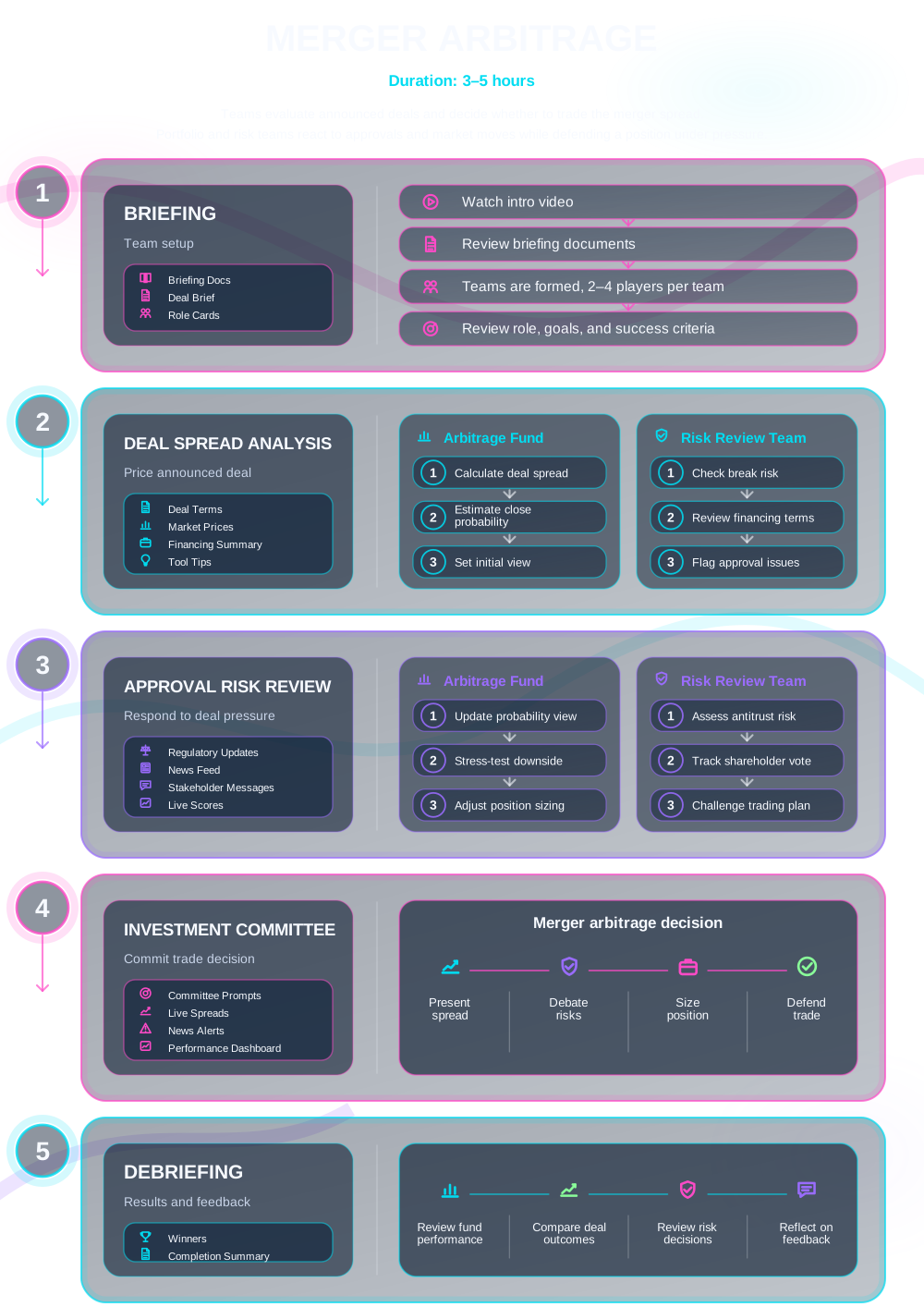

What Participants Do
In the simulation, participants will:
- Analyze publicly announced M&A deals to model potential returns.
- Calculate arbitrage spreads and assess risk-adjusted returns for cash and stock deals.
- Construct and manage a portfolio of arbitrage positions with appropriate hedges.
- Monitor news feeds and regulatory updates for deal-breaking events.
- Decide when to enter, size, or exit positions based on changing deal odds.
- Present portfolio strategy and performance justifications to a fund's investment committee.

Learning Objectives
By the end of the simulation, participants will be able to:
- Understand the mechanics and economic rationale of merger arbitrage.
- Analyze and compare different M&A deal structures from an arbitrageur's perspective.
- Calculate key metrics like arbitrage spread, annualized return, and implied break probability.
- Implement basic hedging strategies to isolate deal-specific risk.
- Evaluate the impact of regulatory, financial, and market events on deal completion.
- Construct a risk-managed portfolio of arbitrage positions.
- Make decisive allocations under time pressure and uncertainty.
How the Merger Arbitrage Simulation Works
This simulation can be run individually or in teams in academic or corporate contexts. Each cycle represents a stage of getting through a pressing financial situation.
1. Deal Briefing Participants receive a set of announced M&A deals with term sheets, stock prices, and expected timelines.
** 2. Analysis and Modeling** They analyze each deal, calculating spreads, returns, and assessing key risks to completion.
3. Portfolio Allocation Teams decide which deals to invest in, determine position sizes, and execute any necessary hedges.
4. Market Developments New rounds introduce breaking news (regulatory decisions, rival bids, or market shocks) forcing re-evaluation.
5. Portfolio Rebalancing Participants adjust their holdings based on updated deal probabilities.
6. Reporting and Debrief Teams report performance metrics. A final review highlights how decisions aligned with arbitrage fundamentals and risk management.
Frequently Asked Questions
Assessment
Assessment of participant performance can be tailored according to the host institution’s objectives (business school, corporate training, assessment centre). Typical assessment criteria include:
- Risk-adjusted returns, absolute returns, and drawdowns of the arbitrage portfolio.
- Quality of deal analysis, appropriateness of position sizing, and effectiveness of hedging strategies.
- Ability to identify and mitigate specific deal risks and respond to adverse developments.
- Clarity and strength of the reasoning behind portfolio choices, as demonstrated in investment committee memos or presentations.