It’s ideal for students and professionals pursuing careers in risk management, trading, asset management, corporate treasury, or financial regulation.

Market Risk Simulation
In the Market Risk Simulation, participants step into the roles of risk managers, traders, and financial analysts at institutions exposed to dynamic global markets.

Market Risk Simulation Overview
Each simulation round presents evolving challenges, sudden interest rate shifts, equity market corrections, currency fluctuations, or commodity price shocks. All requiring rapid analysis and decisive action.
Participants learn to identify, measure, and mitigate market risks using both traditional tools and advanced quantitative methods. They must interpret real-time data, adjust hedging strategies, comply with regulatory limits, and communicate risk exposures to stakeholders. The simulation bridges theory and practice, highlighting how market risk interconnects with trading decisions, portfolio management, and institutional stability.
Ideal for university finance programs, risk certification courses, and corporate training, this hands-on experience transforms abstract risk concepts into actionable skills, preparing participants for high-stakes financial environments.

Market Risk Simulation Concepts
Participants work through realistic scenarios, which can be customized to emphasize or exclude specific topics depending on the learning goals. This modular structure allows the simulation to be tailored to any type of session. Key concepts include:
- Value at Risk and Expected Shortfall methodologies
- Stress testing and scenario analysis
- Sensitivity analysis
- Hedging strategies using derivatives
- Liquidity risk and market impact
- Regulatory frameworks
- Volatility modeling and forecasting
- Correlation and diversification breakdowns during crises
- Risk-adjusted performance measurement
- Behavioral biases in risk decision-making

Gameflow
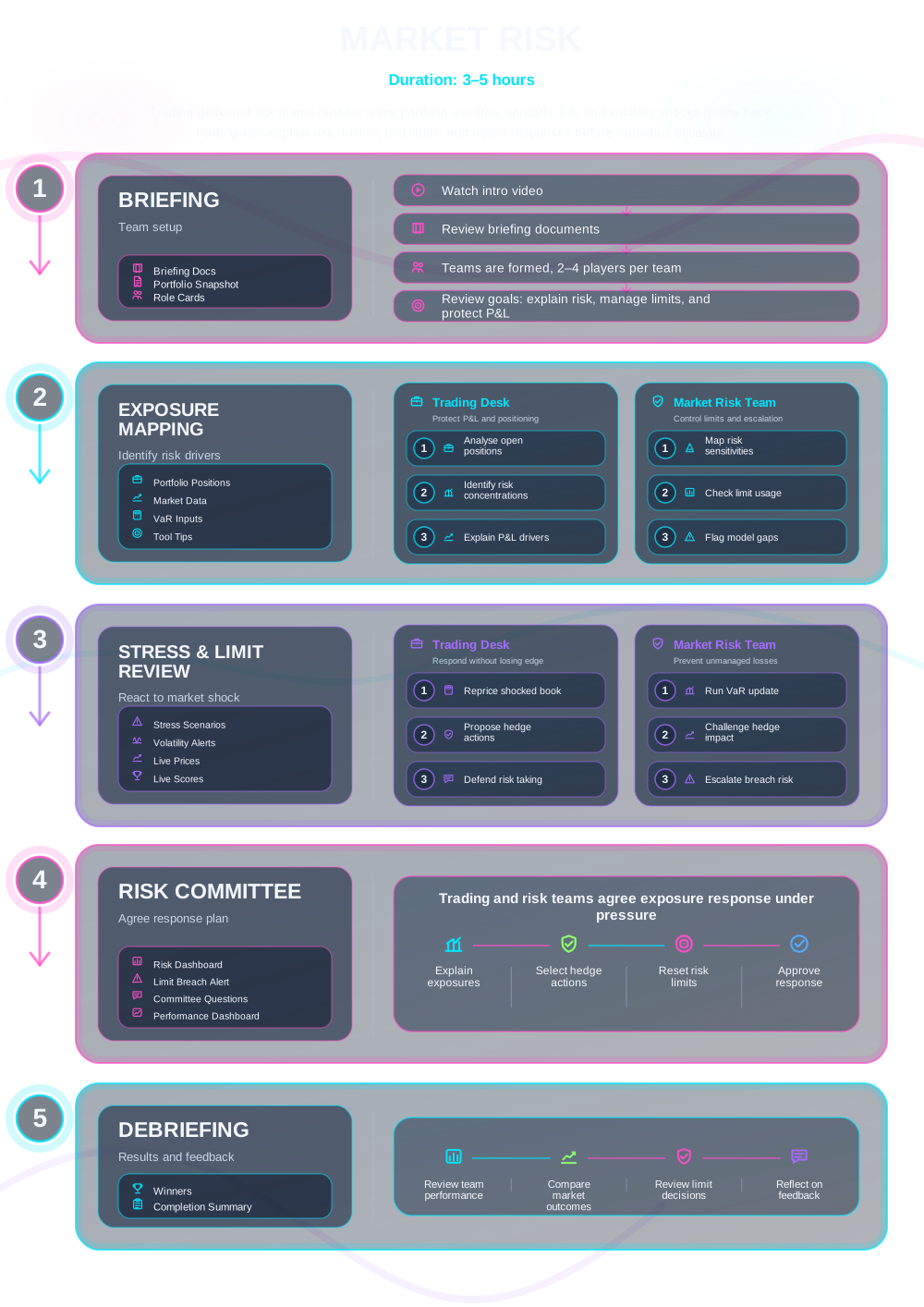

What Participants Do
In the simulation, participants will:
- Monitor live market data feeds and identify emerging risk exposures
- Calculate and interpret VaR, stress test results, and sensitivity metrics
- Design and execute hedging strategies using appropriate derivatives
- Adjust portfolio positions to stay within regulatory and internal risk limits
- Respond to simulated market shocks
- Prepare and present risk reports to a simulated management committee or board
- Collaborate across teams to align trading, risk, and compliance objectives
- Review and learn from round outcomes to refine strategies in subsequent cycles

Learning Objectives
By the end of the simulation, participants will be able to:
- Understand key market risk metrics and their practical applications
- Implement VaR, stress testing, and scenario analysis in realistic settings
- Design effective hedging strategies for various risk types
- Navigate regulatory constraints and internal risk governance frameworks
- Communicate risk exposures and mitigation plans clearly to stakeholders
- Recognize behavioral pitfalls and cognitive biases in risk management
- Develop confidence in making risk-adjusted decisions under time pressure
- Apply quantitative tools to balance risk, return, and liquidity in dynamic markets
How the Market Risk Simulation Works
This simulation can be run individually or in teams in academic or corporate contexts. Each cycle represents a stage of getting through a pressing financial situation.
1. Receive a Market Scenario and Risk Brief Participants review the initial market environment, portfolio positions, regulatory limits, and institutional objectives.
** 2. Analyze Risk Exposures** Using provided data tools, participants calculate current VaR, identify concentration risks, and run stress scenarios.
3. Make Risk Management Decisions Decisions may include adjusting hedges, rebalancing portfolios, approving/rejecting proposed trades, or escalating breaches.
4. Collaborate Across Functions Teams may role-play as risk management, trading desks, and senior management to negotiate risk-return trade-offs.
5. Experience Market Shocks and React The simulation injects unexpected market events, forcing participants to reassess exposures and respond promptly.
6. Report and Justify Decisions Participants summarize their risk posture, actions taken, and results in a structured management report or brief presentation.
7. Review Feedback and Reflect The system provides scores on risk metrics, hedging effectiveness, limit adherence, and communication clarity. Strategies are refined in subsequent rounds.
Frequently Asked Questions
Assessment
Assessment of participant performance can be tailored according to the host institution’s objectives (business school, corporate training, assessment centre). Typical assessment criteria include:
- Accuracy and insight of risk metric calculations
- Effectiveness and cost-efficiency of implemented hedging strategies
- Adherence to regulatory and internal risk limits
- Clarity, structure, and persuasiveness of risk reports or presentations
- Ability to adapt strategies based on new market information and shocks
- Peer and self-assessment feedback on collaboration and decision-making