It is ideal for MBA students, business undergraduates, and professionals aspiring to roles in consulting, corporate strategy, or internal business development.

Management Consulting Simulation
In this Management Consulting Simulation, participants must diagnose complex business problems, develop actionable solutions, and present recommendations to a skeptical client board, all while navigating internal team dynamics and tight deadlines.

Management Consulting Simulation Overview
Participants are immersed in a dynamic business scenario where they act as a consulting team hired to solve a critical, multi-faceted challenge for a client company. Each round of the simulation introduces new layers of complexity: unexpected market shifts, new competitor moves, internal client data, or shifting stakeholder priorities.
Teams must analyze quantitative and qualitative data, formulate hypotheses, synthesize findings, and build persuasive narratives. They learn to balance rigorous analytical frameworks with practical business acumen and clear communication. This simulation emphasizes the end-to-end consulting lifecycle, from initial problem definition and work-planning to the final high-stakes client presentation and Q&A.
Ideal for MBA programs, executive education, and corporate training, this simulation brings the pressure and payoff of top-tier consulting to life. It demonstrates how structured thinking, client management, and team leadership interact to drive impact in real-world business environments.

Management Consulting Simulation Concepts
Participants work through realistic scenarios, which can be customized to emphasize or exclude specific topics depending on the learning goals. This modular structure allows the simulation to be tailored to any type of session. Key concepts include:
- Problem Definition and Hypothesis-Driven Thinking
- Business Analysis Frameworks
- Data Synthesis and Insight Generation
- Developing Actionable Recommendations and Implementation Roadmaps
- Client Relationship and Expectation Management
- Storylining and Developing Persuasive Narratives
- Team Leadership and Workstream Management
- Effective Slide Deck Creation and Executive Presentation
- Handling Challenging Client Q&A
- Practice Development and Consulting Firm Economics

Gameflow
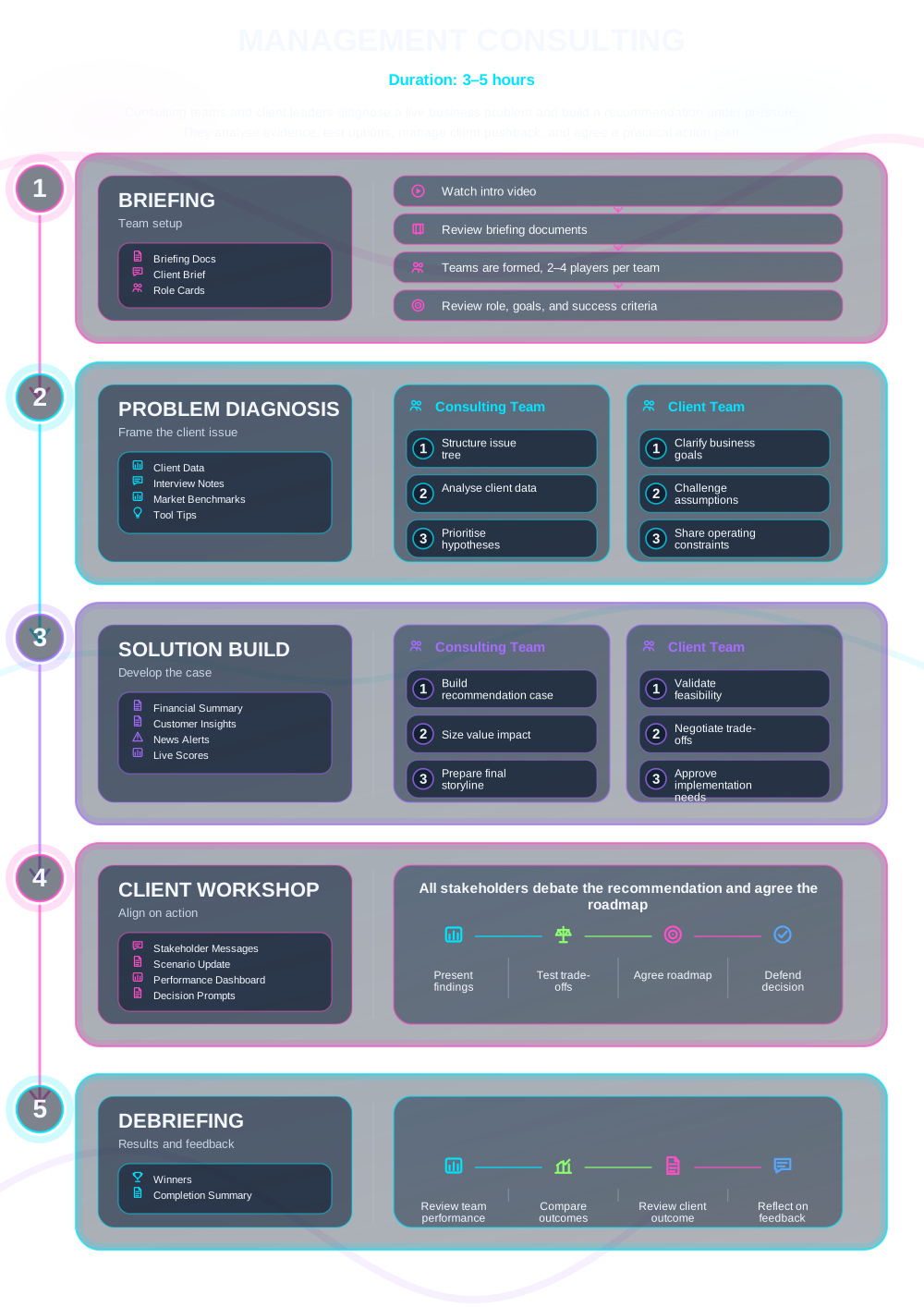

What Participants Do
In the simulation, participants will:
- Define the core client problem and structure a hypothesis-driven approach.
- Analyze provided financial statements, market data, and interview transcripts.
- Apply business frameworks to break down complex issues.
- Synthesize data into clear, evidence-based insights.
- Build a logical storyline and create a client-ready slide deck.
- Rehearse and deliver a final recommendation presentation.
- Defend their strategy during a simulated boardroom Q&A with facilitators acting as client executives.
- Reflect on team dynamics and their problem-solving process.

Learning Objectives
By the end of the simulation, participants will be able to:
- Apply a structured, hypothesis-driven approach to solve ambiguous business problems.
- Utilize key consulting frameworks to analyze competitive landscapes and internal capabilities.
- Transform data analysis into coherent, actionable business insights.
- Craft and deliver a compelling, client-focused narrative.
- Manage team workflow and dynamics under time pressure.
- Confidently present recommendations and handle pointed stakeholder questions.
- Understand the core drivers of value and impact in a consulting engagement.
How the Management Consulting Simulation Works
This simulation can be run individually or in teams in academic or corporate contexts. Each cycle represents a stage of getting through a pressing financial situation.
1. Receive the Client Brief Teams are introduced to the client CEO and presented with the core business challenge.
2. Analyze and Structure the Problem Teams review the "information packet" including financials, market reports, and internal memos. They define their approach and work plan.
3. Develop the Analysis Participants dive deep into data, apply frameworks, and begin formulating their root-cause analysis and strategic recommendations.
4. Synthesize and Build the Story Insights are woven into a logical "answer-first" storyline, and teams create their presentation decks.
5. The Client Presentation Teams pitch their solutions to a panel (facilitators or executives) in a high-stakes simulation of a final review meeting.
6. Feedback and Reflection Teams receive direct feedback on their analytical rigor, strategic logic, and communication effectiveness, linking the experience directly to consulting best practices.
Frequently Asked Questions
Assessment
Assessment of participant performance can be tailored according to the host institution’s objectives (business school, corporate training, assessment centre). Typical assessment criteria include:
- Application of appropriate frameworks and accurate data interpretation.
- Quality, practicality, and impact of the final recommendations.
- Clarity, structure, and persuasiveness of the final presentation and handling of Q&A.
- Effective division of labor, time management, and synthesis of individual contributions into a coherent team output.