It is ideal for students and professionals pursuing careers in equity research, investment banking, asset management, private equity, or any finance role requiring deep analytical and valuation skills.

Investment Research Simulation
In this Investment Research Simulation, participants step into the role of equity research analysts at a top investment bank. Conduct thorough fundamental analysis, build robust financial models, and craft persuasive investment theses.

Investment Research Simulation Overview
Participants are immersed in the high-stakes world of sell-side equity research. They are tasked with covering a publicly traded company, diving deep into its financial statements, industry position, and competitive landscape. Each round presents new market data, earnings releases, and macroeconomic shifts that challenge their initial thesis.
Analysts must integrate quantitative modeling with qualitative judgment to produce actionable research. They build detailed discounted cash flow and comparable company models, forecast financials, and justify their valuation with a clear narrative. The simulation culminates in a competitive setting where teams must pitch their stock recommendation—be it "Buy," "Hold," or "Sell"—to a panel representing the investment committee, defending their analysis against scrutiny and competing viewpoints.
This simulation is designed for university finance programs, MBA courses, and professional training within asset management and investment banking. It bridges the gap between theoretical finance and the practical, pressured world of producing research that drives investment decisions.

Investment Research Simulation Concepts
Participants work through realistic scenarios, which can be customized to emphasize or exclude specific topics depending on the learning goals. This modular structure allows the simulation to be tailored to any type of session. Key concepts include:
- Fundamental analysis and financial statement deep-dive
- Discounted Cash Flow valuation modeling
- Comparable company and precedent transaction analysis
- Investment thesis development and narrative crafting
- Financial forecasting and scenario analysis
- Modeling cost of capital and terminal value
- Critical assessment of management strategy and corporate governance
- Integrating Environmental, Social, and Governance factors into valuation
- Understanding sell-side research report structure and compliance
- Communicating complex analysis clearly and persuasively

Gameflow
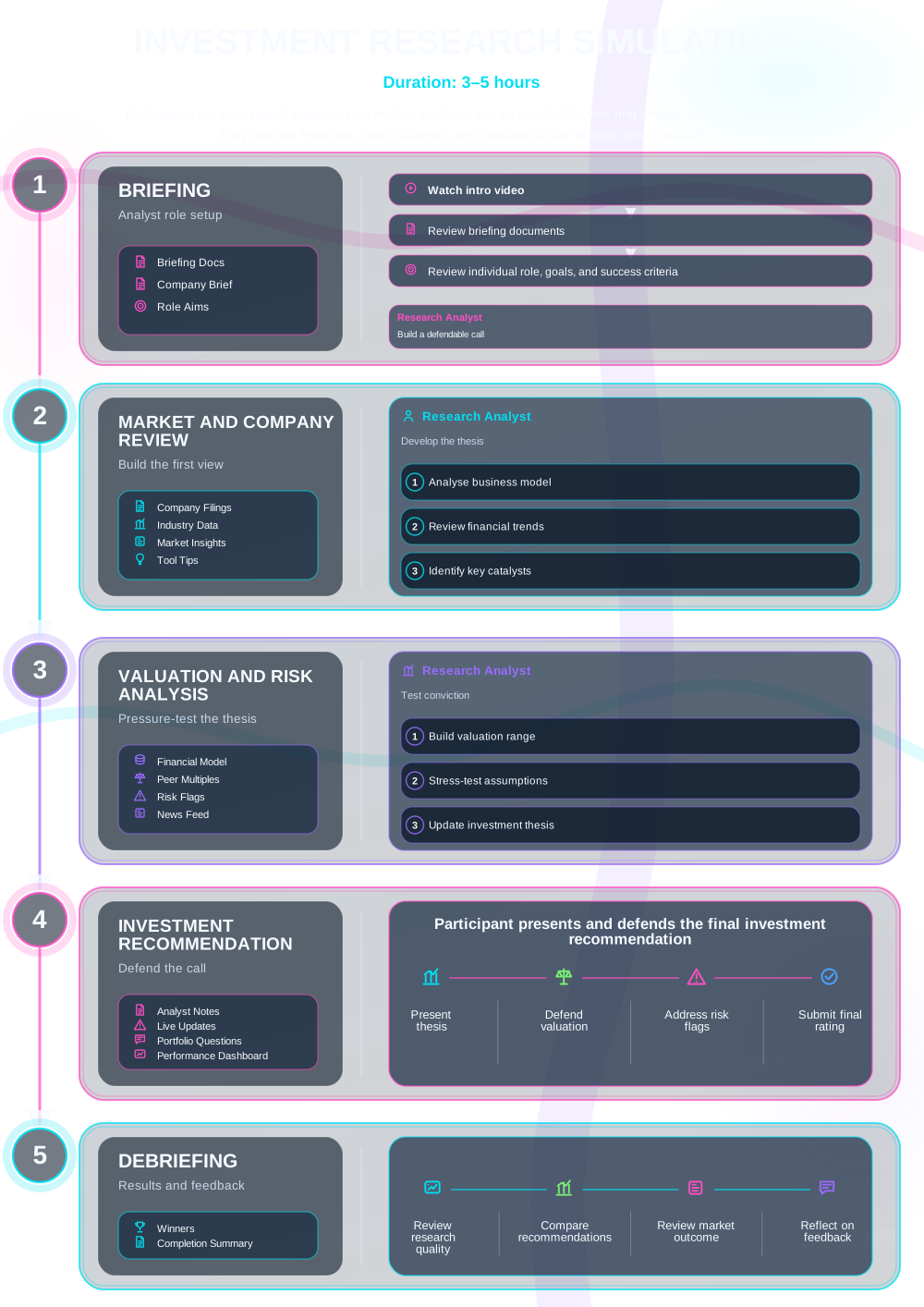

What Participants Do
In the simulation, participants will:
- Receive an initial company brief and a universe of market data.
- Conduct in-depth fundamental analysis of the assigned company.
- Build and calibrate integrated financial models (DCF and comparables).
- Develop a clear, evidence-based investment recommendation and target price.
- Respond to new information, such as quarterly earnings surprises or competitor news.
- Prepare and deliver a professional investment recommendation pitch.
- Defend their valuation assumptions and thesis under challenge.
- Compete for accuracy and persuasiveness against other research teams.

Learning Objectives
By the end of the simulation, participants will be able to:
- Structure and perform a comprehensive fundamental equity analysis.
- Build practical, three-statement integrated financial models.
- Apply core valuation methodologies (DCF, comparables) to determine target prices.
- Synthesize quantitative data and qualitative factors into a coherent investment thesis.
- Assess the impact of market events, competitive dynamics, and management decisions on valuation.
- Communicate research findings effectively in both written and presentation formats.
- Develop critical thinking and justification skills to support investment views under pressure.
- Understand the role, responsibilities, and ethical considerations of a sell-side research analyst.
How the Investment Research Simulation Works
This simulation can be run individually or in teams in academic or corporate contexts. Each cycle represents a stage of getting through a pressing financial situation.
1. Research and Analysis Phase Teams analyze the company's financials, industry reports, and market data. They build their initial financial models and valuation.
** 2. Thesis Development Phase** Participants consolidate their findings into a structured investment thesis with a clear recommendation and target price.
3. Market Update Round New information is released. Teams must quickly assess the impact and adjust their models and thesis accordingly.
4. Preparation Phase Teams create a concise pitch book summarizing their analysis, valuation, and final recommendation.
5. Pitch and Defense Phase Teams present their recommendation to a simulated investment committee (which can be facilitators or other participants). They must field tough questions and defend their assumptions.
6. Debrief and Review Participants receive detailed feedback on their financial models, valuation accuracy, recommendation rationale, and communication effectiveness. Performance analytics are reviewed.
Frequently Asked Questions
Assessment
Assessment of participant performance can be tailored according to the host institution’s objectives (business school, corporate training, assessment centre). Typical assessment criteria include:
- Accuracy and completeness of financial models and valuation outputs.
- Quality and logical consistency of the final investment thesis and recommendation.
- Ability to logically incorporate new market information into an existing analysis.
- Clarity, structure, and persuasiveness of the written research summary and oral pitch.
- Ability to justify assumptions and respond effectively to challenges during the Q&A.