It is ideal for MBA students, finance undergraduates, corporate training programs, and any professionals seeking to improve their capital budgeting and strategic investment analysis skills.

Investment Decisions Simulation
The Investment Decisions Simulation challenges participants to act as senior management, making critical capital budgeting and strategic investment choices to maximize firm value in a dynamic, competitive market.

Investment Decisions Simulation Overview
In this hands-on simulation, participants step into the role of a company's executive team. They are tasked with evaluating a pipeline of potential projects, from R&D and new product launches to market expansion and acquisitions, each with different risk profiles, cash flow patterns, and strategic implications. Operating with limited capital and under conditions of economic uncertainty, teams must analyze financial data, assess risk, and align investments with long-term strategy.
The simulation unfolds over multiple simulated years, with market conditions and competitor actions impacting results. It’s a compressed, risk-free environment to master the art of value-creating investment decision-making.
Although ideal for undergraduate and graduate finance courses, executive training, and corporate finance skill workshops, the simulation is modular and scalable, allowing instructors to vary complexity.

Investment Decisions Simulation Concepts
Participants work through realistic scenarios, which can be customized to emphasize or exclude specific topics depending on the learning goals. This modular structure allows the simulation to be tailored to any type of session. Key concepts include:
- Capital Budgeting
- Discounted Cash Flow
- Risk Analysis
- Capital Rationing
- Strategic Alignment
- Cost of Capital
- Real Options

Gameflow
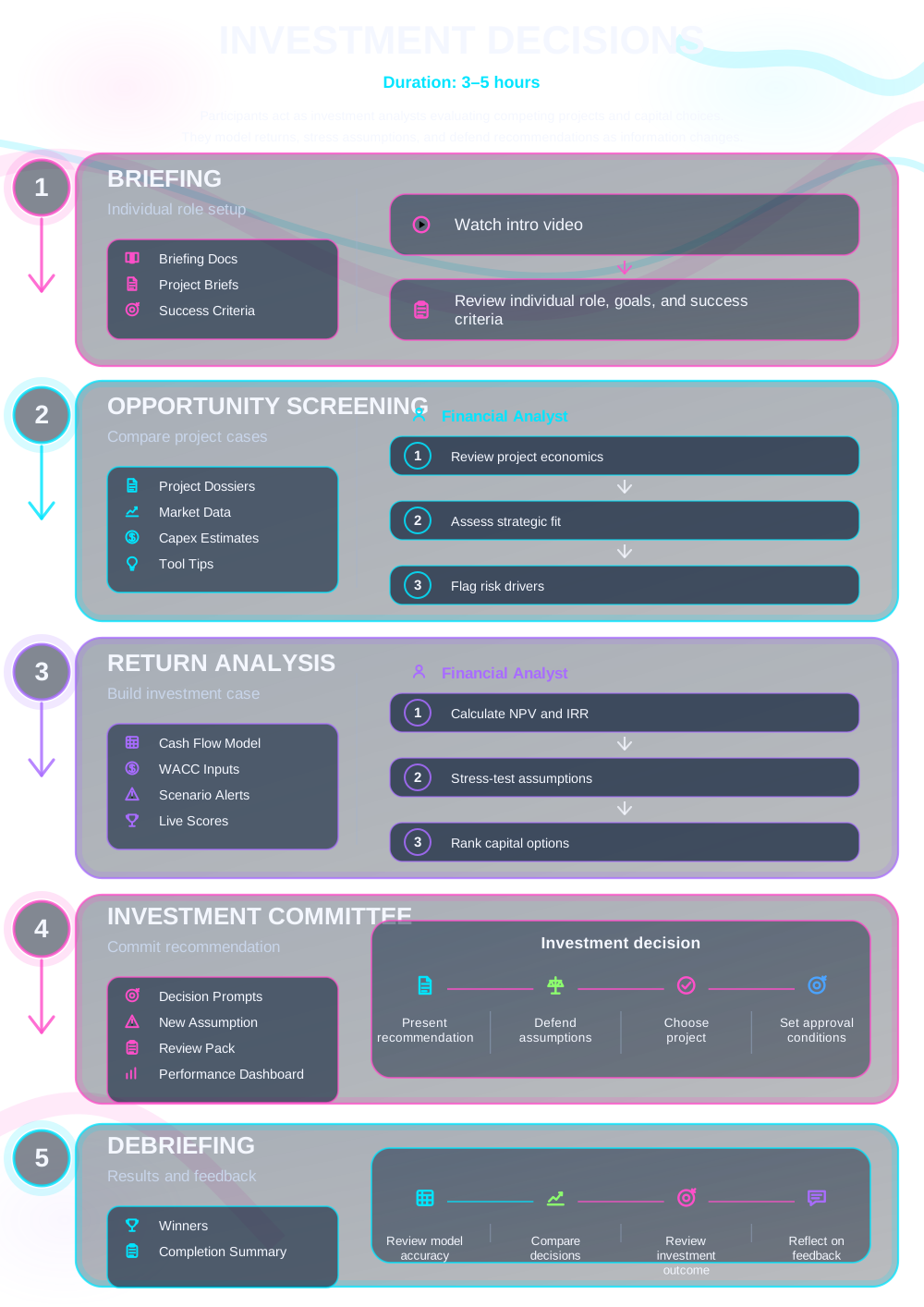

What Participants Do
In the simulation, participants will:
- Analyze detailed project proposals with forecasted financials.
- Build financial models to evaluate project viability.
- Debate and prioritize projects under capital constraints.
- Adjust decisions based on changing macroeconomic updates.
- React to competitor moves and market share shifts.
- Present and defend their final investment portfolio strategy.

Learning Objectives
By the end of the simulation, participants will be able to:
- Apply core capital budgeting techniques to real-world project proposals.
- Construct and optimize a value-maximizing investment portfolio under capital constraints.
- Quantify and incorporate risk into financial decision-making models.
- Articulate the strategic rationale behind investment choices, linking finance to corporate strategy.
- Interpret market feedback and adapt a long-term investment plan dynamically.
How the Investment Decisions Simulation Works
This simulation can be run individually or in teams in academic or corporate contexts. Each cycle represents a stage of getting through a pressing financial situation.
1. Form Teams and Receive Brief Teams are formed as the "Executive Committee" of a company. They receive the company's strategic goals, financial health, and a pipeline of potential investment projects.
2. Initial Analysis and Planning In Round 1, teams analyze project data, run financial calculations, and submit their first investment plan, allocating their initial capital budget.
3. Market Feedback and New Rounds After each decision round, the simulation engine provides results: updated company financials, market reactions, and competitor outcomes. New information and potential projects are introduced in subsequent rounds.
4. Portfolio Adjustment Teams must adapt their strategy, potentially abandoning underperforming projects or seizing new opportunities with their generated cash flows.
5. Final Review and Debrief The simulation culminates in a ranking based on key metrics like cumulative shareholder value creation. A guided debrief links in-simulation experiences to core financial principles.
Frequently Asked Questions
Assessment
Assessment of participant performance can be tailored according to the host institution’s objectives (business school, corporate training, assessment centre). Typical assessment criteria include:
- Accuracy in judgement of company’s assets and quality of assumptions
- Depth and logic of scenario analysis
- Collaboration, division of work, integration of roles, and final coherence
- Rating by peers and self-reflection on approach and decisions