It's designed for finance students, early-career bankers, treasury professionals, and anyone seeking to understand the practical management of a bank's balance sheet and interest rate exposure.

Interest Rate Risk Simulation
In this Interest Rate Risk Simulation, participants are making critical decisions to protect financial institutions from the volatility of changing interest rates while balancing profitability, regulatory demands, and stakeholder expectations.

Interest Rate Risk Simulation Overview
Participants navigate the complex world of Asset-Liability Management within a dynamic banking environment. Each simulation round introduces new economic forecasts, central bank policy shifts, and market shocks, challenging teams to manage a bank's balance sheet effectively.
They must analyze the bank's interest rate sensitivity, make strategic decisions on funding sources, adjust investment portfolios, and use financial instruments to hedge exposures. The simulation emphasizes strategic foresight and quantitative analysis, showing how interest rate decisions directly impact net interest income, economic value, and capital adequacy.
This simulation is ideal for university finance programs, MBA courses, executive training in banking, and corporate workshops for treasury professionals. It brings the critical, yet often abstract, concepts of interest rate risk to life through hands-on, competitive decision-making.

Interest Rate Risk Simulation Concepts
Participants work through realistic scenarios, which can be customized to emphasize or exclude specific topics depending on the learning goals. This modular structure allows the simulation to be tailored to any type of session. Key concepts include:
- Interest Rate Risk identification and measurement
- Asset-Liability Management frameworks and committee governance
- The yield curve and its implications for banking strategy
- Hedging strategies using swaps, futures, and options
- Capital and liquidity requirements under Basel regulations
- Funds Transfer Pricing and its role in performance management
- Impact of central bank monetary policy on banking operations
- Stress testing and scenario analysis for interest rate shocks
- Behavioral modeling of non-maturity deposits
- Strategic balance sheet restructuring

Gameflow
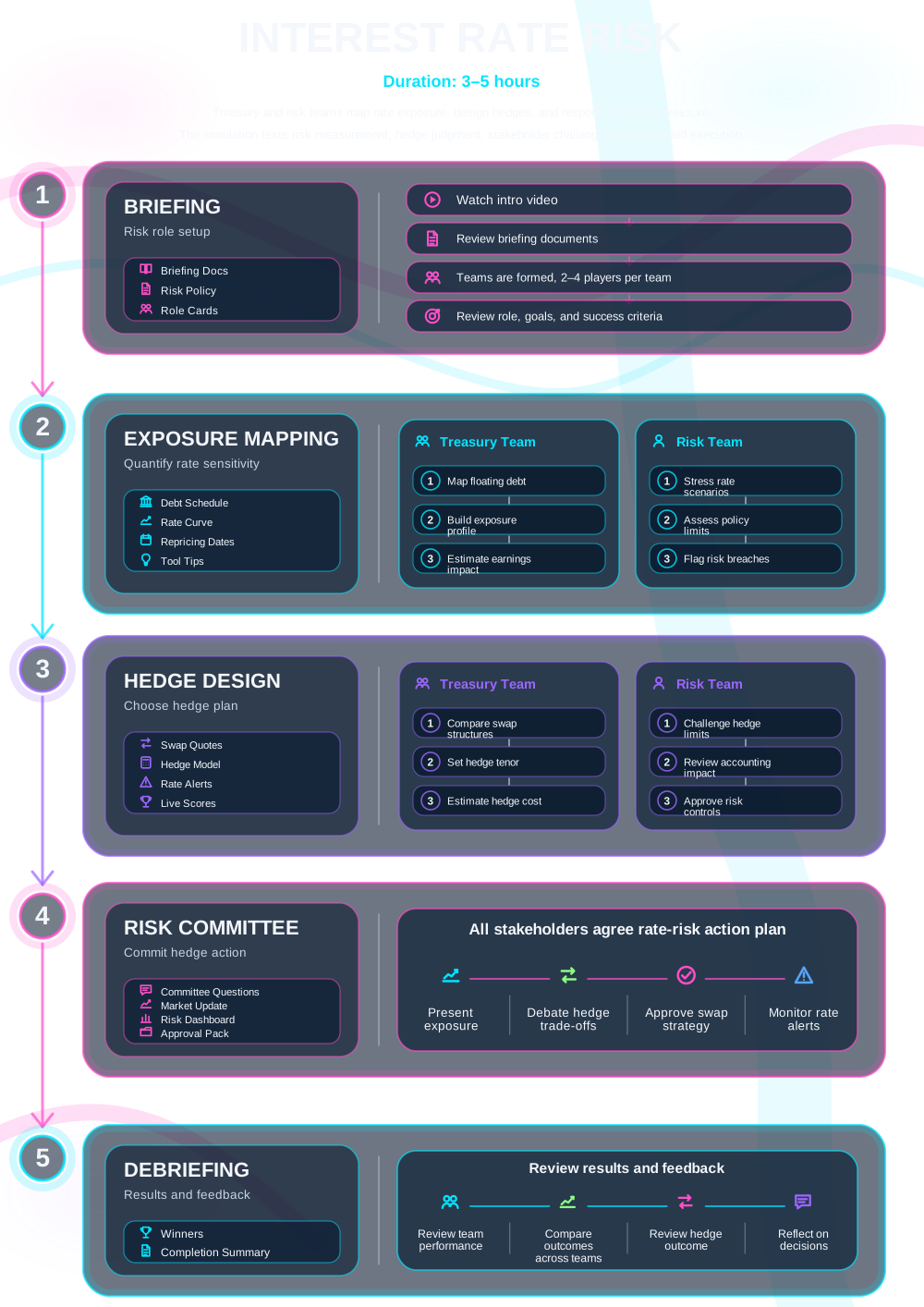

What Participants Do
In the simulation, participants will:
- Analyze the current interest rate risk exposure and balance sheet composition.
- Decide on new loan pricing, deposit campaigns, and funding strategies.
- Select and execute hedging transactions to manage identified gaps.
- Respond to economic updates, regulatory changes, and competitive pressures.
- Present their quarterly ALM strategy and performance to the board.
- Reflect on the outcomes of their decisions and adapt strategies for the next period.

Learning Objectives
By the end of the simulation, participants will be able to:
- Understand the primary sources and types of interest rate risk in banking.
- Apply key metrics like Gap and Duration to quantify risk exposure.
- Formulate strategic ALM decisions to align with the bank's risk appetite.
- Evaluate and execute appropriate hedging strategies using derivatives.
- Interpret the impact of monetary policy and yield curve shifts.
- Integrate regulatory capital and liquidity considerations into treasury decisions.
- Communicate risk positions and management strategies effectively to stakeholders.
- Develop confidence in making high-stakes financial decisions under uncertainty.
How the Interest Rate Risk Simulation Works
This simulation can be run individually or in teams in academic or corporate contexts. Each cycle represents a stage of getting through a pressing financial situation.
1. Receive the Economic and Bank Brief Teams review their bank's starting balance sheet, the economic outlook, and the competitive landscape.
** 2. Analyze the Risk Position** They calculate key risk metrics, identify vulnerabilities, and forecast the impact of potential rate changes.
3. Make Strategic Decisions Teams decide on commercial strategies (loans/deposits) and execute hedging trades in the derivatives market.
4. Collaborate and Negotiate Teams may act as different banks competing for market share or as different departments within one bank.
5. View Results and Market Update The simulation engine processes all decisions, generating new financial statements and a market update for the next round.
6. Review and Adapt Teams see their performance via dashboards (NII, EVE, capital ratios) and must refine their strategy over multiple rounds.
Frequently Asked Questions
Assessment
Assessment of participant performance can be tailored according to the host institution’s objectives (business school, corporate training, assessment centre). Typical assessment criteria include:
- Financial Performance (Net Interest Income stability, Economic Value of Equity)
- Risk Management Effectiveness (reduction in earnings and value-at-risk)
- Quality of Hedging Strategy and cost-effectiveness of derivative usage
- Adherence to Regulatory Capital and Liquidity Ratios
- Strategic Communication of decisions in debrief presentations