It is ideal for business school students, finance professionals, ESG practitioners, and corporate executives seeking practical understanding of sustainable finance and impact investment strategies.

Impact Investing Simulation
This simulation challenges you to deploy capital for measurable social and environmental impact, while also achieving competitive financial returns. Learn to balance the dual bottom line in a realistic, dynamic market.

Impact Investing Simulation Overview
The Impact Investing Simulation immerses participants in the high-stakes world of mission-driven finance. Teams manage a portfolio of potential investments, from green energy projects and sustainable agriculture to affordable housing and social enterprises.
They must conduct rigorous due diligence, quantifying both financial metrics and impact metrics. The simulation replicates real-world tensions: managing stakeholder expectations, structuring deals that balance risk and return, and reporting on impact performance to demanding investors.
Through multiple investment rounds, teams learn that impact and profit are not mutually exclusive, but require sophisticated analysis and strategic trade-offs.

Impact Investing Simulation Concepts
Participants work through realistic scenarios, which can be customized to emphasize or exclude specific topics depending on the learning goals. This modular structure allows the simulation to be tailored to any type of session. Key concepts include:
- Dual Bottom Line
- Impact Measurement and Management
- ESG Integration
- Impact Thesis
- Blended Finance
- Stakeholder Alignment
- Portfolio Construction
- Impact Washing

Gameflow
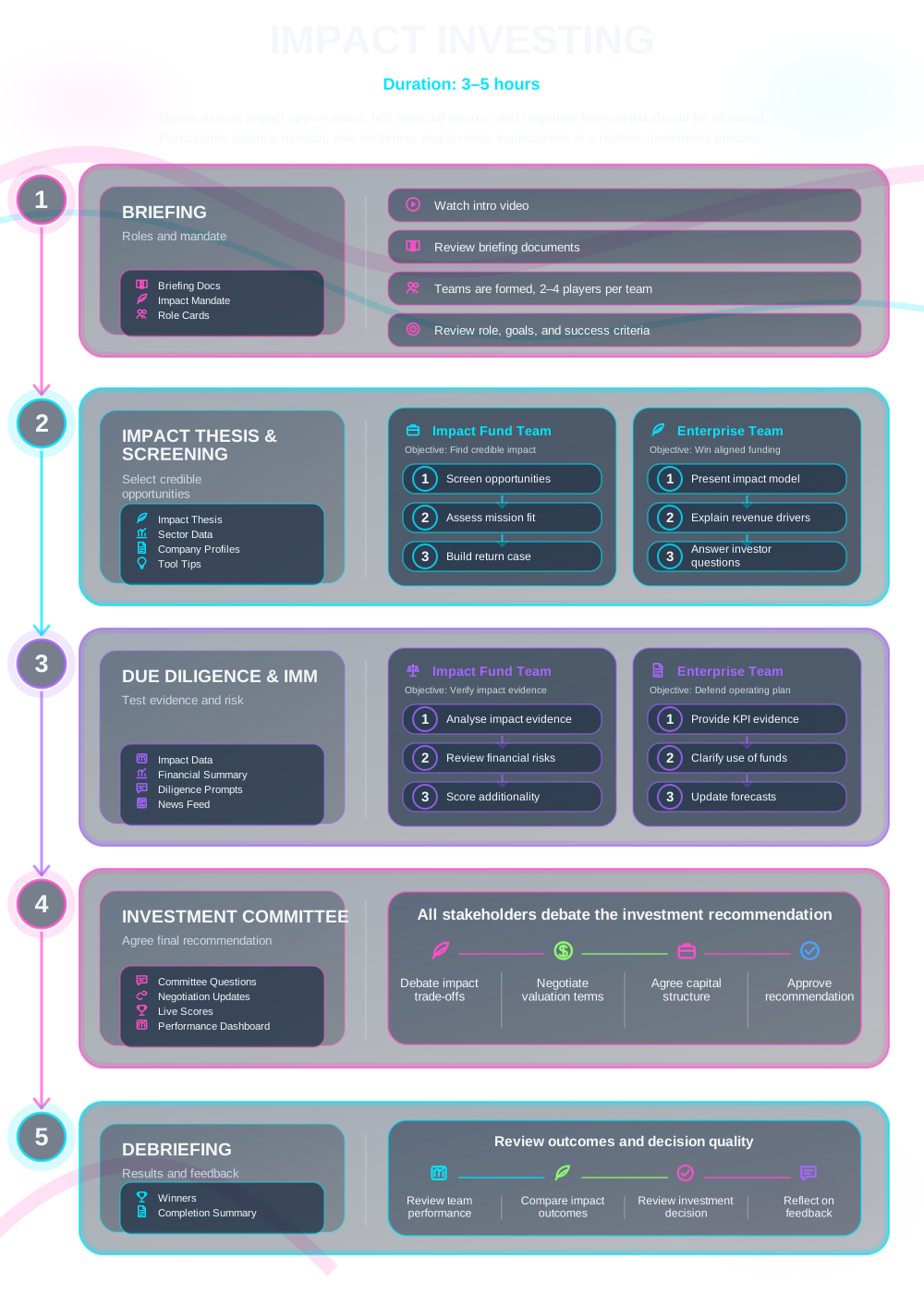

What Participants Do
In the simulation, participants will:
- Screen and evaluate potential investments using integrated financial and impact scorecards.
- Structure investment terms to align incentives for impact and financial performance.
- Negotiate deal terms with entrepreneurs and co-investors.
- Build and manage a diversified impact investment fund portfolio.
- Allocate catalytic capital to strategically de-risk high-impact opportunities.
- Create integrated financial and impact performance reports for fund investors.
- React to external shocks and adjust strategy.
- Present a final portfolio strategy and performance review to a mock Investment Committee.

Learning Objectives
By the end of the simulation, participants will be able to:
- Construct an optimal portfolio based on advanced risk-return optimization techniques.
- Evaluate asset performance using factor models and distinguish between skill-based alpha and market beta.
- Manage portfolio risk through diversification, hedging, and strategic asset allocation.
- Analyze the sources of portfolio return and underperformance through attribution analysis.
- Synthesize economic data and market news into actionable investment decisions.
- Defend investment choices using the rigorous language and frameworks of professional asset management.
How the Impact Investing Simulation Works
This simulation can be run individually or in teams in academic or corporate contexts. Each cycle represents a stage of getting through a pressing financial situation.
1. Team Formation Participants are divided into teams, each managing a new impact fund with a specific mandate.
2. Initial Briefing Teams receive their fund charter, capital commitments, and access to a dynamic deal pipeline with detailed investment memoranda.
3. Due Diligence and Analysis Teams analyze each opportunity, modeling financial projections and scoring impact potential using provided frameworks.
4. Deal Structuring and Bidding Teams decide on investment amounts, instruments, and terms, then "bid" for deals in a competitive market.
** 5. Portfolio Management** Successful investments are added to the portfolio. Teams monitor performance dashboards showing both financial and impact KPI updates each round.
** 6. Strategic Decisions** Each round presents new challenges: follow-on funding requests, exit opportunities, stakeholder demands, and market news.
** 7. Reporting and Final Review** Teams submit periodic reports and conclude with a final presentation, defending their portfolio strategy and performance to achieve the best blended outcome.
Frequently Asked Questions
Assessment
Assessment of participant performance can be tailored according to the host institution’s objectives (business school, corporate training, assessment centre). Typical assessment criteria include:
- A quantitative blend of the team's final financial return metrics and achieved impact KPIs against simulation benchmarks.
- Evaluated on the clarity, depth, and justification of their strategy, deal selection rationale, and response to questioning.
- Quality and consistency of analysis documented in their investment memos and round-by-round strategic choices, showing understanding of core concepts.