This simulation is ideal for MBA students, finance graduates, and professionals in investment banking, asset management, or private wealth looking to deepen their understanding of alternative investments and portfolio management.

Hedge Fund Manager Simulation
Master the Art of Absolute Return in a Dynamic Financial Ecosystem. Compete against other fund managers, making critical decisions on strategy, asset allocation, risk management, and capital raising.

Hedge Fund Manager Simulation Overview
Step into the high-stakes world of hedge fund management. This immersive simulation places you at the helm of your own fund, challenging you to generate absolute returns in a dynamic, multi-asset class environment.
Unlike traditional long-only investments, your goal is to outperform in both rising and falling markets. You will employ sophisticated strategies—from long/short equity and global macro to merger arbitrage—while navigating real-world economic events, volatile markets, and the constant pressure of investor expectations. This is not just about picking stocks; it's about building and managing a complex financial enterprise for survival and supremacy.
Although ideal for undergraduate and graduate finance courses, executive training, and corporate finance skill workshops, the simulation is modular and scalable, allowing instructors to vary complexity.

Hedge Fund Manager Simulation Concepts
Participants work through realistic scenarios, which can be customized to emphasize or exclude specific topics depending on the learning goals. This modular structure allows the simulation to be tailored to any type of session. Key concepts include:
- Absolute Return vs. Relative Return
- Fund Strategy and Mandate
- Long/Short Equity and Market Neutrality
- Leverage and Margin Financing
- Risk Metrics (Sharpe Ratio, Sortino Ratio, Max Drawdown, VaR)
- Portfolio Diversification and Correlation
- Alpha Generation and Beta Exposure
- Fee Structure (Management vs. Performance Fees)
- Capital Raising and Investor Relations
- Hurdle Rates and High-Water Marks

Gameflow
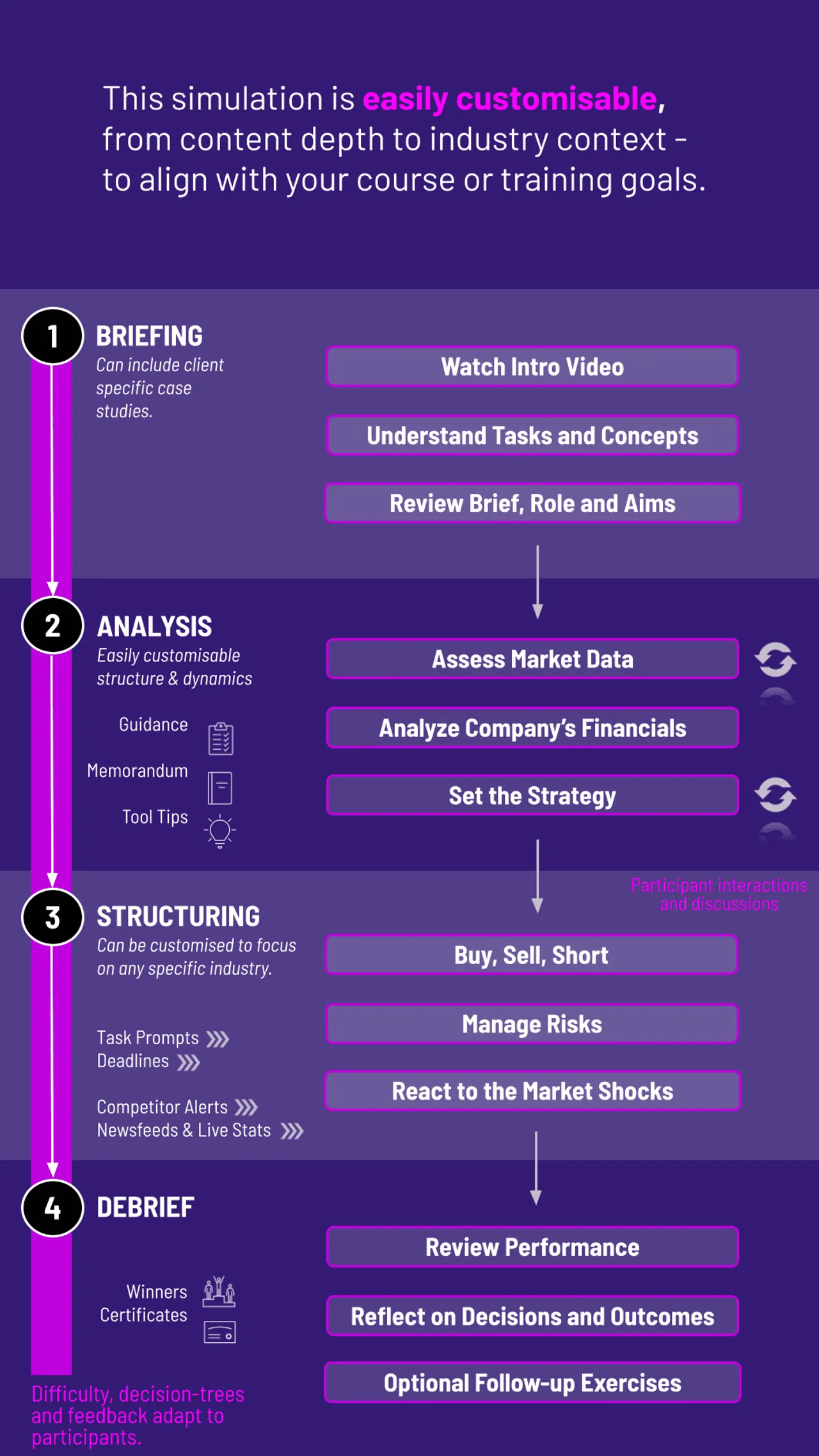

What Participants Do
In the simulation, participants will:
- Define a unique investment strategy and fund mandate.
- Analyze company fundamentals, technical charts, and macroeconomic data.
- Execute trades across equities, indices, currencies, and commodities.
- Employ leverage to amplify returns while managing associated risks.
- Monitor key performance and risk dashboards in real-time.
- Adjust portfolio holdings in response to market news and economic shocks.
- Raise capital from institutional investors by demonstrating performance.
- Manage the fund's P&L and justify performance to a board of investors.

Learning Objectives
By the end of the simulation, participants will be able to:
- Design and articulate a coherent hedge fund investment strategy.
- Construct a diversified, multi-asset portfolio designed for absolute returns.
- Apply leverage judiciously and understand its impact on risk and return.
- Analyze and interpret key performance and risk metrics to evaluate fund health.
- Differentiate between alpha (skill-based returns) and beta (market-based returns).
- Respond strategically to macroeconomic events and competitive pressures.
- Communicate performance and strategy effectively to attract and retain investors.
How the Hedge Fund Manager Simulation Works
This simulation can be run individually or in teams in academic or corporate contexts. Each cycle represents a stage of getting through a pressing financial situation.
1. Analyze Review the economic landscape, company research reports, and their current portfolio.
2. Decide Make strategic trading decisions—buy, sell, short, or use derivatives—based on their analysis.
3. Manage Set leverage levels, assess risk exposure, and review performance metrics.
4. Report At the end of the round, teams receive a detailed performance report and must prepare a brief for their virtual investors, explaining their strategy and results.
5. Adapt The simulation engine processes all decisions, creating a new market state for the next round, incorporating random economic shocks and competitor actions.
Frequently Asked Questions
Assessment
Assessment of participant performance can be tailored according to the host institution’s objectives (business school, corporate training, assessment centre). Typical assessment criteria include:
- Rewarding consistent, risk-adjusted returns over sheer luck. Sharpe Ratio (primary), final Net Asset Value (NAV), and maximum drawdown.
- Clarity of thought, justification for actions, and professional communication.
- Feedback from within the team on contribution, collaboration, and quality of input. Ensures individual accountability in a team-based environment.
- Quality of decision-making observed during the rounds, participation in debriefs, and the ability to adapt strategy effectively.
- Evaluation of a capstone presentation to a "board of investors" (the instructor and peers), defending the fund's performance, lessons learned, and strategic roadmap.