No. The simulation is suitable for all levels, and includes guidance throughout.

Go-To-Market Strategy Simulation
In this hands-on Go-To-Market Strategy Simulation, participants step into the role of commercial leads designing, testing, and executing go-to-market plans across pricing, channels, messaging, and sales execution - all under real-world constraints.

Go-To-Market Strategy Simulation Overview
Participants take on the role of commercial and marketing decision-makers at a growing company preparing to launch a new product or enter a new market. They must build and test their go-to-market (GTM) plan - identifying target segments, refining value propositions, selecting sales and distribution channels, adjusting pricing, and responding to competitive moves.
Each round simulates a new stage in the GTM journey - pre-launch, launch, post-launch - and introduces real-world constraints: limited budgets, market noise, misalignment between teams, or shifting customer behavior. Participants must navigate ambiguity, justify trade-offs, and work cross-functionally.
This simulation is ideal for MBA marketing and strategy courses, executive education programs, and corporate onboarding for product and sales teams. It can be customized for B2B or B2C settings and adapted to reflect different industries, from tech to retail to financial services.

Go-To-Market Strategy Simulation Concepts
Participants work through realistic scenarios, which can be customized to emphasize or exclude specific topics depending on the learning goals. This modular structure allows the simulation to be tailored to any type of session. Key concepts include:
- Segmentation and targeting
- Positioning and messaging
- Pricing strategy and discounting
- Channel mix and distribution
- Product readiness and alignment
- Sales enablement and training
- Marketing campaign planning
- Budget allocation across channels
- Competitive analysis and response
- Measuring success: KPIs and feedback loops

Gameflow
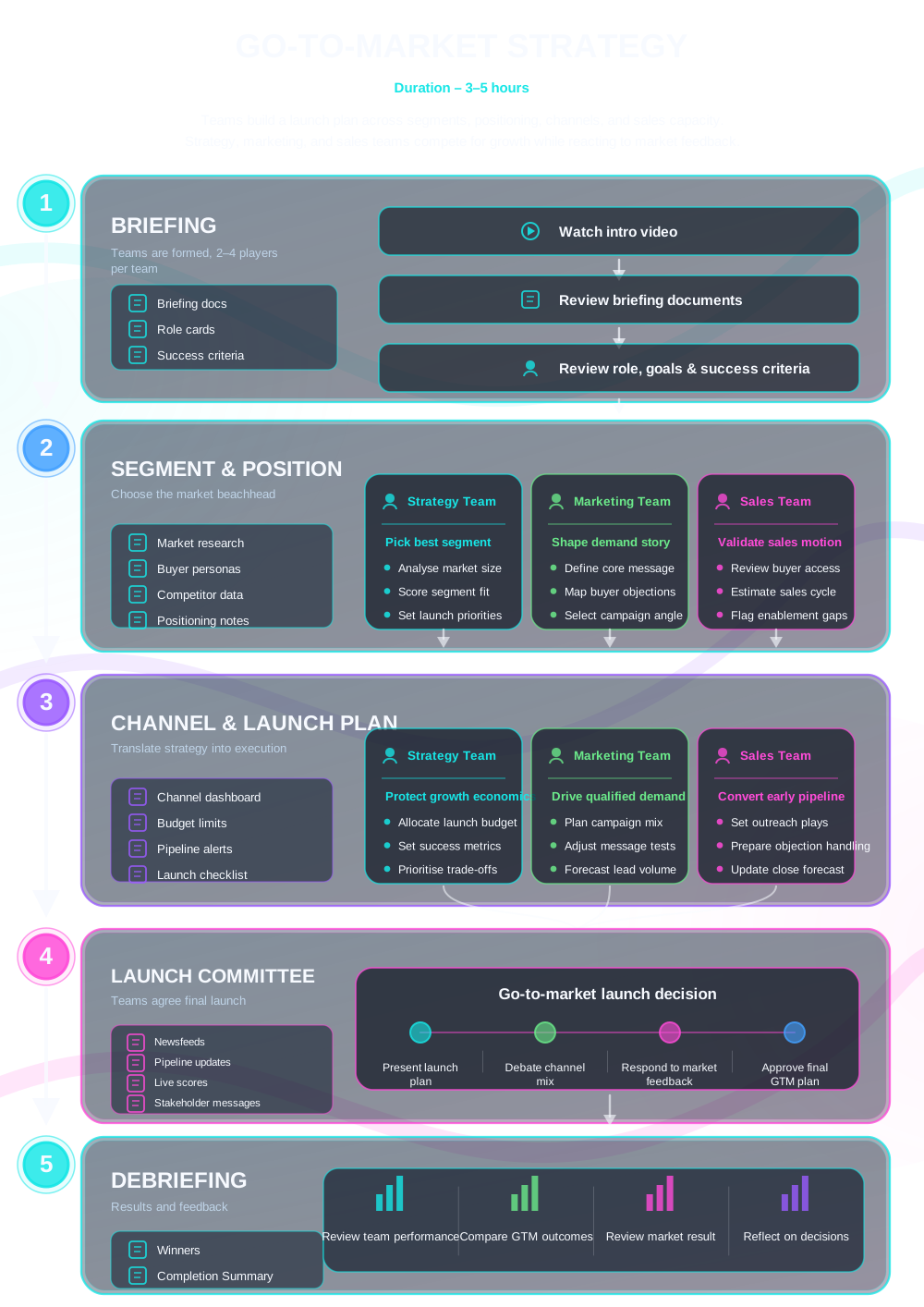

What Participants Do
In this simulation, participants take on roles like Product Manager, CMO, or Head of Sales. They:
- Develop and refine go-to-market plans
- Choose positioning, messaging, and pricing for key segments
- Allocate marketing budgets across paid, owned, and earned channels
- Select and manage distribution and sales channels
- Respond to new data: competitor launches, feedback, or internal constraints
- Present launch strategies to senior stakeholders or investors

Learning Objectives
By the end of the simulation, participants will be able to:
- Build a full go-to-market plan from scratch
- Identify and prioritize target segments and buyer personas
- Align messaging, channels, and pricing to customer needs
- Test and iterate campaign strategy with real-time data
- Allocate limited resources across competing goals
- Balance short-term launch impact with long-term growth
- Collaborate cross-functionally across marketing, sales, and product
- Justify decisions with metrics and market logic
- Respond to unexpected outcomes with agility
- Present commercial strategies clearly to internal stakeholders
The simulation’s flexible structure ensures that these objectives can be calibrated to match the depth, duration, and focus areas of each program, whether in higher education or corporate learning.
How the Go-To-Market Strategy Simulation Works
This simulation is ideal for business schools, marketing bootcamps, corporate commercial training, and product launches. Each round represents a phase in the GTM journey - strategy design, launch execution, or adjustment post-launch.
1. Receive a Brief: Participants are given a product and market context, customer profiles, constraints, and launch goals. They may represent a startup, scale-up, or a large enterprise launching something new.
2. Explore and Strategize: Teams assess market research, competitor activity, internal capabilities, and past campaign data to design a go-to-market plan tailored to their target segments.
3. Make Go-To-Market Decisions: They choose messaging, channels, pricing, sales enablement tools, and allocate marketing spend - all within defined budget or team constraints.
4. Respond to Market Feedback: Launch results, competitor responses, or internal frictions are revealed. Teams must adapt plans and reallocate or re-prioritize.
5. Communicate and Reflect: Participants summarize their strategic choices, justify trade-offs, and explain results via short debriefs, memos, or presentations.
6. Repeat the Cycle: Each round builds on the last. Teams adapt their GTM strategy in real-time as new data emerges.
Frequently Asked Questions
Assessment
Assessment can be tailored to focus on commercial thinking, communication, adaptability, or collaboration. Participants may be evaluated on:
- Alignment between strategy and market needs
- Channel selection and budget optimization
- Clarity and persuasiveness in GTM presentations
- Responsiveness to feedback and competitive moves
- Collaboration and internal alignment
- Iterative improvement in launch outcomes
You can also include memo writing and debrief presentations as part of the assessment structure. Additionally, you can also add a built-in peer and self-assessment tool to see how participants rate themselves. This flexibility allows the simulation to be easily integrated by professors as graded courses at universities and by HR at assessment centres at companies.