No. The simulation introduces concepts like payoff matrices and equilibria in an accessible way.

Game Theory Simulation
In this Game Theory Simulation, participants act as decision-makers navigating competitive and cooperative scenarios - using strategic reasoning, payoff analysis, and negotiation to anticipate rivals, align allies, and maximize outcomes under uncertainty.

Game Theory Simulation Overview
Participants explore the practical application of game theory in business and economics. Each round presents a strategic dilemma - pricing wars, partnership choices, market entry battles, or regulatory negotiations - requiring careful anticipation of competitor and stakeholder moves.
Through interactive decision-making, participants experience classic models like the prisoner’s dilemma, Nash equilibrium, and zero-sum vs win-win scenarios. The simulation brings theory to life, showing how strategic reasoning applies in real-world contexts.
This simulation is ideal for economics, strategy, and negotiation courses, as well as executive education. It can be tailored to emphasize competition, cooperation, or mixed-motive strategies depending on the audience.

Game Theory Simulation Concepts
Participants work through realistic scenarios, which can be customized to emphasize or exclude specific topics depending on the learning goals. This modular structure allows the simulation to be tailored to any type of session. Key concepts include:
- Competitive vs cooperative strategy
- Nash equilibrium and strategic stability
- Prisoner’s dilemma and trust-building
- Zero-sum vs positive-sum outcomes
- Payoff matrices and decision trade-offs
- Reputation and repeated interactions
- Negotiation and coalition-building
- Asymmetric information and signaling
- Strategy under uncertainty
- Applications to pricing, markets, and regulation

Gameflow
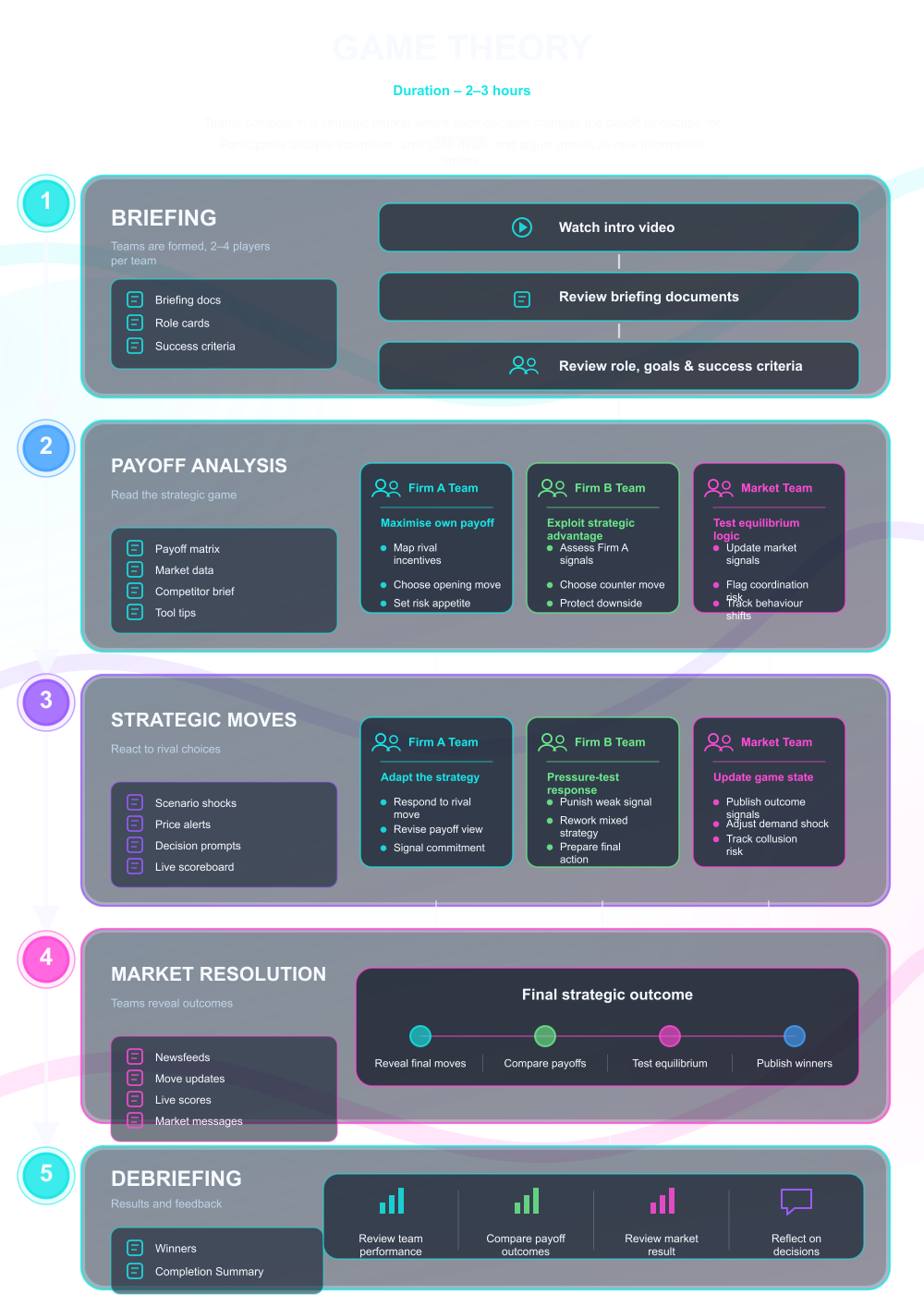

What Participants Do
In this simulation, participants act as decision-makers in strategic scenarios. They:
- Analyse payoff matrices and potential outcomes
- Choose competitive or cooperative strategies
- Negotiate with peers to form alliances or agreements
- Respond to rivals’ moves in iterative rounds
- Manage trust, reputation, and credibility
- Reflect on how game theory shapes real-world decision-making

Learning Objectives
By the end of the simulation, participants will be able to:
- Apply game theory models to business and economic decisions
- Understand the trade-offs in cooperation vs competition
- Use payoff analysis to anticipate rival behaviour
- Recognise the role of trust and reputation in repeated games
- Develop negotiation skills in multi-party settings
- Identify equilibria and strategic stability in dynamic contexts
- Communicate reasoning clearly to allies and adversaries
- Adapt strategies based on rival moves and feedback
- Balance short-term gains with long-term relationships
- Apply game theory across markets, pricing, and policy scenarios
The simulation’s flexible structure ensures that these objectives can be calibrated to match the depth, duration, and focus areas of each program, whether in higher education or corporate learning.
How the Game Theory Simulation Works
This simulation can run individually or in teams across academic and corporate contexts. Each cycle mirrors a strategic game with evolving payoffs and dynamics.
1. Receive a Scenario or Brief: Participants are introduced to a strategic dilemma with defined roles, goals, and payoff options.
2. Analyse the Situation: They evaluate possible outcomes using payoff matrices, probabilities, and rival incentives.
3. Make Strategic Decisions: Participants select strategies - competitive, cooperative, or hybrid—based on objectives and expectations.
4. Negotiate or Interact: In multi-party rounds, participants negotiate alliances, deals, or coordinated actions.
5. Review Results: Outcomes are revealed based on combined choices, with payoffs distributed according to the model.
6. Iterate and Reflect: Each new round introduces complexity (new rivals, repeated interactions, asymmetric information), requiring adaptation and reflection.
Frequently Asked Questions
Assessment
Assessment can be tailored to focus on analytical skill, negotiation, communication, or adaptability. Participants may be evaluated on:
- Accuracy of payoff and strategic reasoning
- Effectiveness in negotiation and coalition-building
- Creativity in strategy development
- Responsiveness to rival and ally actions
- Communication clarity and persuasiveness
You can also include memo writing and debrief presentations as part of the assessment structure. Additionally, you can also add a built-in peer and self-assessment tool to see how participants rate themselves. This flexibility allows the simulation to be easily integrated by professors as graded courses at universities and by HR at assessment centres at companies.